
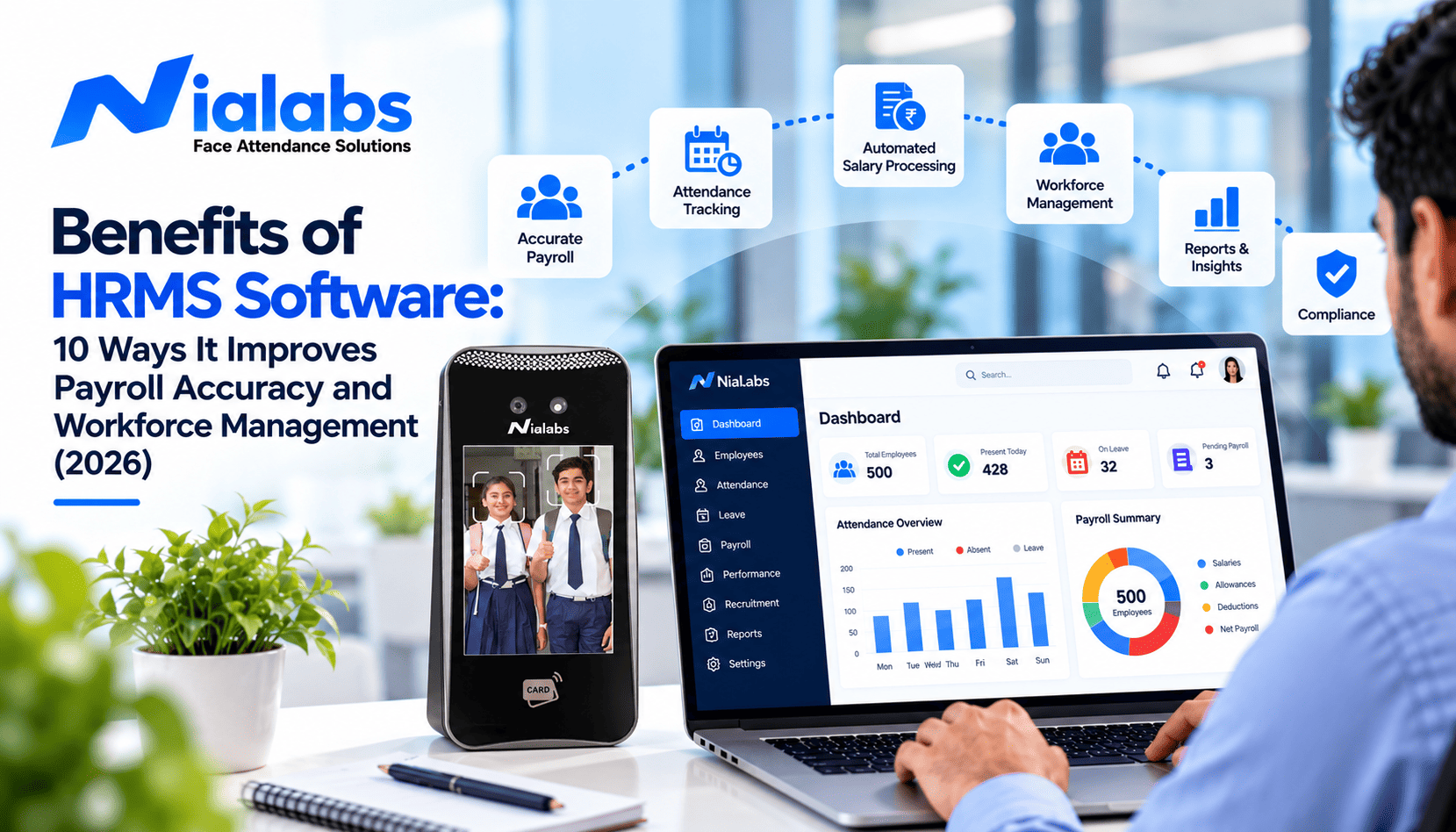
The main benefits of HRMS software are payroll that is calculated correctly the first time, automatic PF, ESI, Professional Tax and TDS, and one live view of attendance, leave and salary cost across every branch. An HRMS does this by keeping each employee's record, attendance, leave, and salary rules in a single system, so payroll is built from verified data instead of spreadsheets that are copied and pasted every month.
The timing matters for Indian businesses. India's four Labour Codes took effect on 21 November 2025 and changed how wages are defined for PF and gratuity, made overtime payable at a minimum of twice the ordinary rate and set a two-working-day deadline for final settlements. Manual payroll was already error-prone; under the new rules, it is also a compliance risk. This guide covers 10 benefits of an HRMS, with worked examples. If you are new to the term, start with what an HRMS is and how it works.
Key Takeaways
- An HRMS removes most manual payroll errors because salary is calculated from attendance and leave data already in the system, not retyped from spreadsheets.
- Under the Labour Codes, effective 21 November 2025, excluded allowances above 50% of total pay are added back to wages, which can raise PF and gratuity. An HRMS recalculates this every payroll run.
- Final settlements must be paid within two working days of resignation, removal or retrenchment, which is hard to meet without automated attendance, leave and dues data.
- Payroll is only as accurate as attendance: verified biometric punches that flow straight into the HRMS remove buddy punching and missed-punch disputes.
- Most DPDP Rules obligations become enforceable on 13 May 2027, so salary, bank and biometric data should move out of emailed spreadsheets into an access-controlled system.
The 10 Benefits of HRMS Software at a Glance
| # | Benefit | What changes | Who gains most |
|---|---|---|---|
| 1 | Fewer payroll errors | Salary built from system data, not copied spreadsheets | Finance and HR |
| 2 | Automatic statutory deductions | PF, ESI, PT, LWF and TDS calculated every run | Multi-state employers |
| 3 | Labour Code wage compliance | 50% wage rule checked and applied each month | Every employer |
| 4 | Attendance linked to payroll | Verified punches feed salary without exports | Factories, schools, hospitals |
| 5 | Shift, overtime and leave rules | Rosters, OT at twice the rate and LOP applied automatically | Shift-based workforces |
| 6 | Faster full and final settlement | Dues ready within the two-working-day deadline | HR and exiting employees |
| 7 | Employee self-service | Payslips, leave and tax forms on mobile | Employees and HR |
| 8 | Real-time workforce visibility | Live attendance, overtime and cost by branch | Managers and leadership |
| 9 | Data protection and DPDP readiness | Role-based access instead of emailed files | Every employer |
| 10 | Lower audit and penalty risk | Time-stamped records ready for inspectors | Compliance and finance |
1. Removes Manual Payroll Errors
Spreadsheet payroll fails in small, repeated ways: a formula pointing at the wrong cell, leave that was approved on WhatsApp but never entered, or an old salary structure left in last month's file. One mistake in a template can flow into dozens of payslips before anyone notices.
An HRMS removes the copy-and-paste step. Attendance, approved leave, overtime and the current salary structure are already in the system, so payroll is calculated from the same records HR and managers see. A variance check that flags unusual month-on-month changes catches the rest before salaries are released.
Many payroll errors start with wrong inputs, not wrong formulas. An HRMS fixes the inputs.
2. Calculates PF, ESI, Professional Tax and TDS Automatically
Indian payroll carries several deductions, each with its own rules: EPF, ESIC, Professional Tax slabs that differ by state, Labour Welfare Fund and income tax under the regime each employee chooses. Calculating these by hand for every employee, every month, is where compliance gaps usually begin.
An India-ready HRMS applies the correct rate and threshold to each employee automatically, then generates the challans, returns and Form 16 needed for filing. When you open a branch in a new state, its PT and LWF rules are applied to that branch's staff from the next payroll run.
3. Keeps Payroll Compliant with the New Labour Codes
The four Labour Codes took effect on 21 November 2025, consolidating 29 central labour laws. The biggest payroll change is the uniform definition of wages under the Code on Wages: basic pay, dearness allowance and retaining allowance form wages, and if the excluded allowances exceed 50% of total remuneration, the excess is added back to wages. This changes the base for PF, gratuity and other wage-linked dues.
Here is how the 50% rule works for an employee earning ₹1,00,000 a month with a basic salary of ₹30,000:
| Step | Before the Labour Codes | After the Labour Codes |
|---|---|---|
| Basic pay (wages) | ₹30,000 | ₹30,000 |
| Excluded allowances | ₹70,000 (70% of pay) | Capped at ₹50,000 (50% of pay) |
| Excess added back to wages | Not applicable | ₹20,000 |
| Wages for PF and gratuity | ₹30,000 | ₹50,000 |
| Employee PF at 12% | ₹3,600 | ₹6,000 |
The PF figures assume contributions are calculated on actual wages. Where PF is calculated on the statutory wage ceiling of ₹15,000, the PF amount does not change, but gratuity and other wage-linked dues still do. An HRMS flags every salary structure that breaks the 50% rule and recalculates the affected dues each month. State rules are still being notified at different speeds, so confirm state-specific requirements with your compliance advisor.
4. Links Attendance Directly to Payroll
Payroll can only be as reliable as the attendance behind it. When punches come from a standalone machine, HR exports a file, fixes mismatched employee IDs and re-uploads it, and every step is a chance for error or manipulation. Buddy punching adds another layer: if one employee can punch for another, the payroll is wrong before it is even calculated.
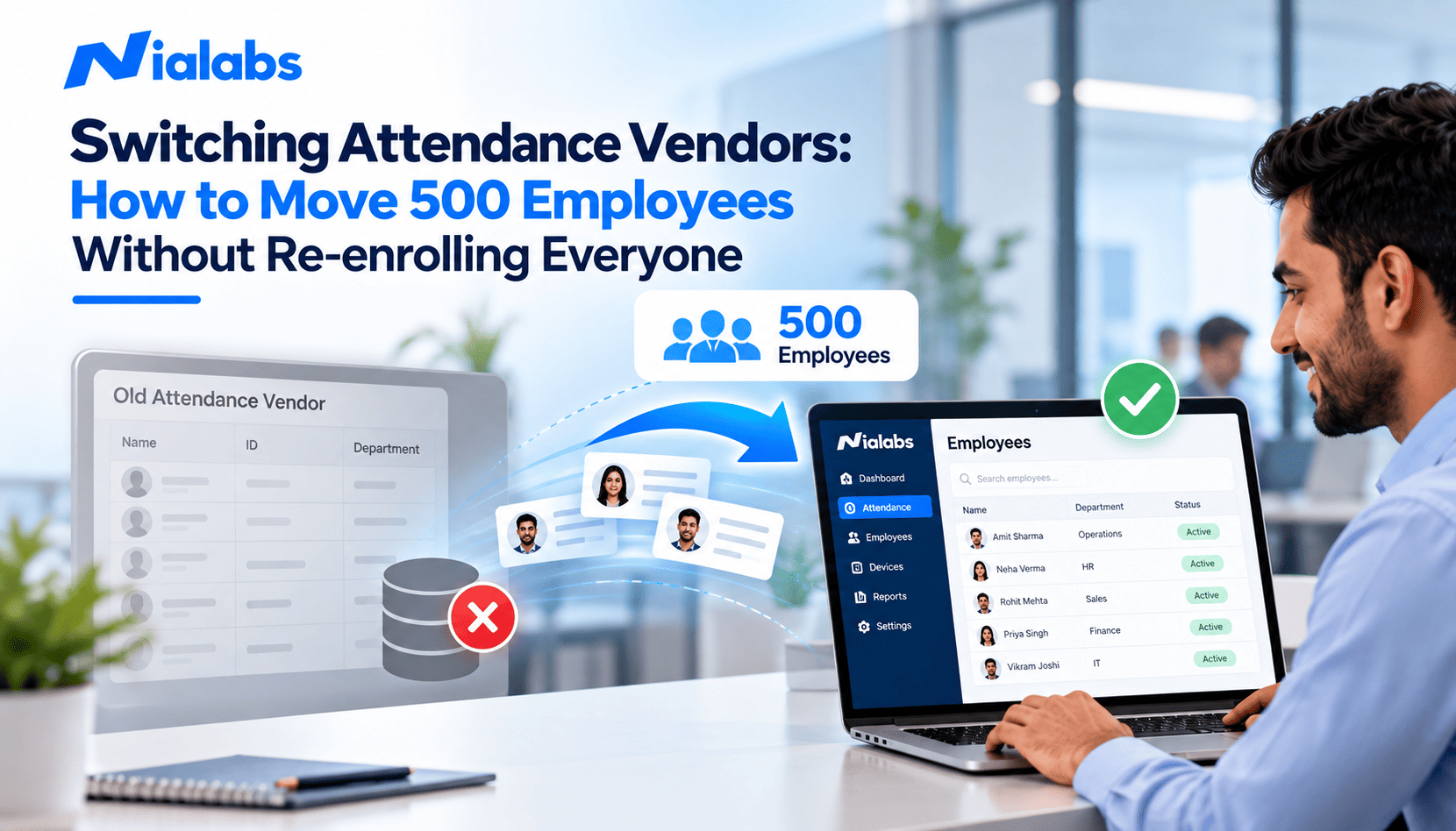
An HRMS with payroll integration receives verified punches directly. Nialabs face recognition attendance with liveness detection blocks photos, videos and proxy punches, and pushes attendance into Nialabs HRMS or into platforms such as Keka, GreytHR, and Darwinbox through APIs. Devices keep punches during a power cut and sync later, which is why attendance data survives a power cut instead of leaving gaps at month-end. Read more on how biometric attendance improves payroll accuracy.
5. Applies Shift, Overtime and Leave Policies Automatically
Factories, hospitals, schools and retail stores run rotating shifts, night shifts that cross midnight and different leave policies for different staff. An HRMS applies shift rules to each punch, calculates overtime hours and works out loss-of-pay days from leave balances, without HR checking each register by hand.
Overtime accuracy matters more now. Under the Code on Wages, overtime is payable at not less than twice the ordinary rate of wages. If 20 shift workers each log four extra hours a week, an error of even one hour per person is paid out at double rate. Missed punches still happen, so the HRMS should also run a clean attendance regularisation workflow before payroll closes.
6. Speeds Up Full and Final Settlements
Under Section 17(2) of the Code on Wages, wages due to an employee who resigns, is removed, dismissed or retrenched, or loses work because the establishment closes, must be paid within two working days. Under older practice, many companies took several weeks to close a settlement.
Meeting a two-day deadline manually is difficult, because HR has to pull final attendance, leave encashment, notice-period adjustments, recoveries and statutory deductions from different files. An HRMS has all of this in one record, so the settlement can be calculated, approved and paid within the deadline.
7. Gives Employees Self-Service Access
Employee self-service lets staff view payslips, apply for leave, request attendance corrections, update personal and bank details and download Form 16 from a phone. HR stops answering the same salary and leave questions every day.
Self-service also builds trust. When employees can see their attendance, leave balance and salary breakup themselves, payroll disputes drop because most questions are answered before they reach HR.
8. Provides Real-Time Workforce Visibility
Dashboards show attendance, absenteeism, late marks, overtime and payroll cost by branch and department as they happen. Managers can spot a department with rising overtime or repeated late arrivals before the cost appears in the month-end payroll.
For companies with several sites, this is the difference between managing from monthly reports and managing from live data. Our guide to biometric attendance for multi-location businesses covers how branches feed one dashboard.
9. Protects Employee Data and Supports DPDP Readiness
Payroll files contain bank account numbers, PAN, salary history and, with biometric attendance, biometric templates. Sending these as spreadsheets over email exposes them to anyone the file is forwarded to. Under the Digital Personal Data Protection Act 2023, this is personal data, and the DPDP Rules 2025 make most obligations enforceable from 13 May 2027.
An HRMS keeps this data in one platform with role-based access, so a branch manager sees attendance but not salary, and payroll staff see salary but not biometric data. Audit logs, retention periods and deletion requests are handled in the system. See our glossary entry on biometric data privacy for what to ask your vendor. This is general guidance, not legal advice.
10. Lowers Compliance Risk and Audit Pressure
Every punch, approval, salary change and statutory calculation is stored with a timestamp and the name of the person who made it. When a labour inspector or auditor asks for wage registers, attendance records or proof of PF and ESI deposits, the reports are generated in minutes instead of days.
Fewer errors also mean fewer corrections. Revised returns, interest on late deposits and penalties usually trace back to manual mistakes, and an HRMS prevents most of them at the source.
Manual Payroll vs HRMS Payroll
| Task | Manual or spreadsheet payroll | HRMS payroll |
|---|---|---|
| Attendance input | Exported from the machine, edited by hand | Verified punches synced in real time |
| Labour Code 50% wage rule | Checked once, if at all | Checked and applied every run |
| PF, ESI, PT and TDS | Calculated in separate sheets | Calculated automatically with challans |
| Overtime at twice the rate | Counted from registers | Calculated from shift rules and punches |
| Full and final settlement | Hard to close within two working days | Within two working days |
| Employee queries | Email and WhatsApp to HR | Answered in the self-service app |
| Audit records | Scattered files | Time-stamped, one-click reports |
How to Make Sure You Get These Benefits
An HRMS delivers these benefits only if it fits Indian payroll and connects to reliable attendance. Before you buy, check these five points:
- Statutory coverage: PF, ESI, PT and LWF for every state you operate in, plus TDS, challans and Form 16.
- Labour Code readiness: wage components and statutory rules you can edit without paid custom development.
- Attendance integration: a real-time API or direct sync with your biometric devices, tested with real employee IDs.
- Data controls: role-based access, audit trails and a working deletion process.
- Clear pricing: per-employee fees, add-on modules, setup and device costs in one quote.
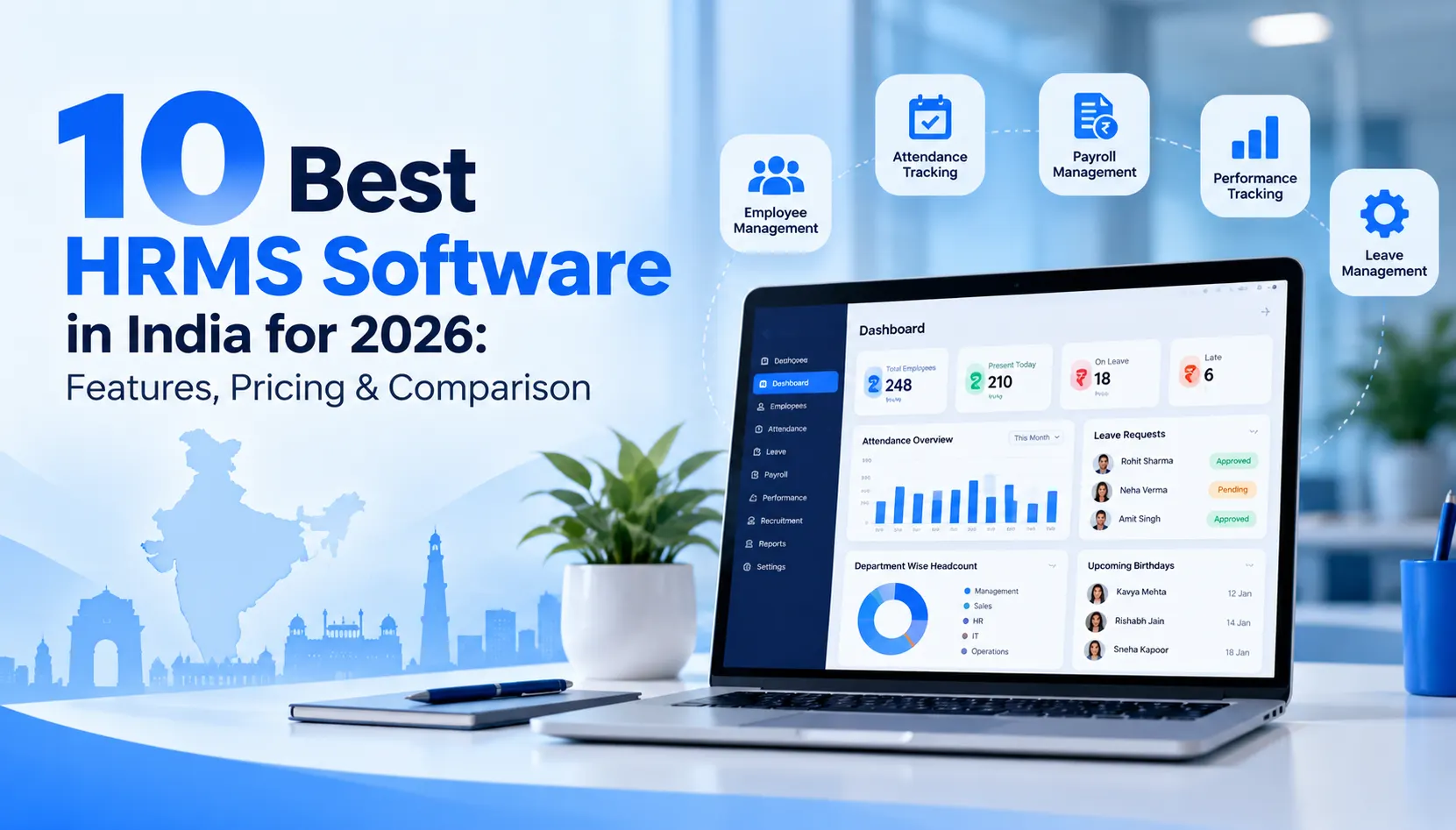
For the full module checklist, see 15 HRMS features to check before you buy, then compare leading HRMS vendors in India on the same criteria.
Where Nialabs Fits
Nialabs makes its own NiaFace attendance device and builds the HR software that runs on it. Nialabs attendance and payroll HRMS comes in two plans, Attendance Only and Attendance + Payroll, covering core HR, shifts, leave, payroll with PF, ESI, PT and TDS, payslips and reports, with employee and HR mobile apps.
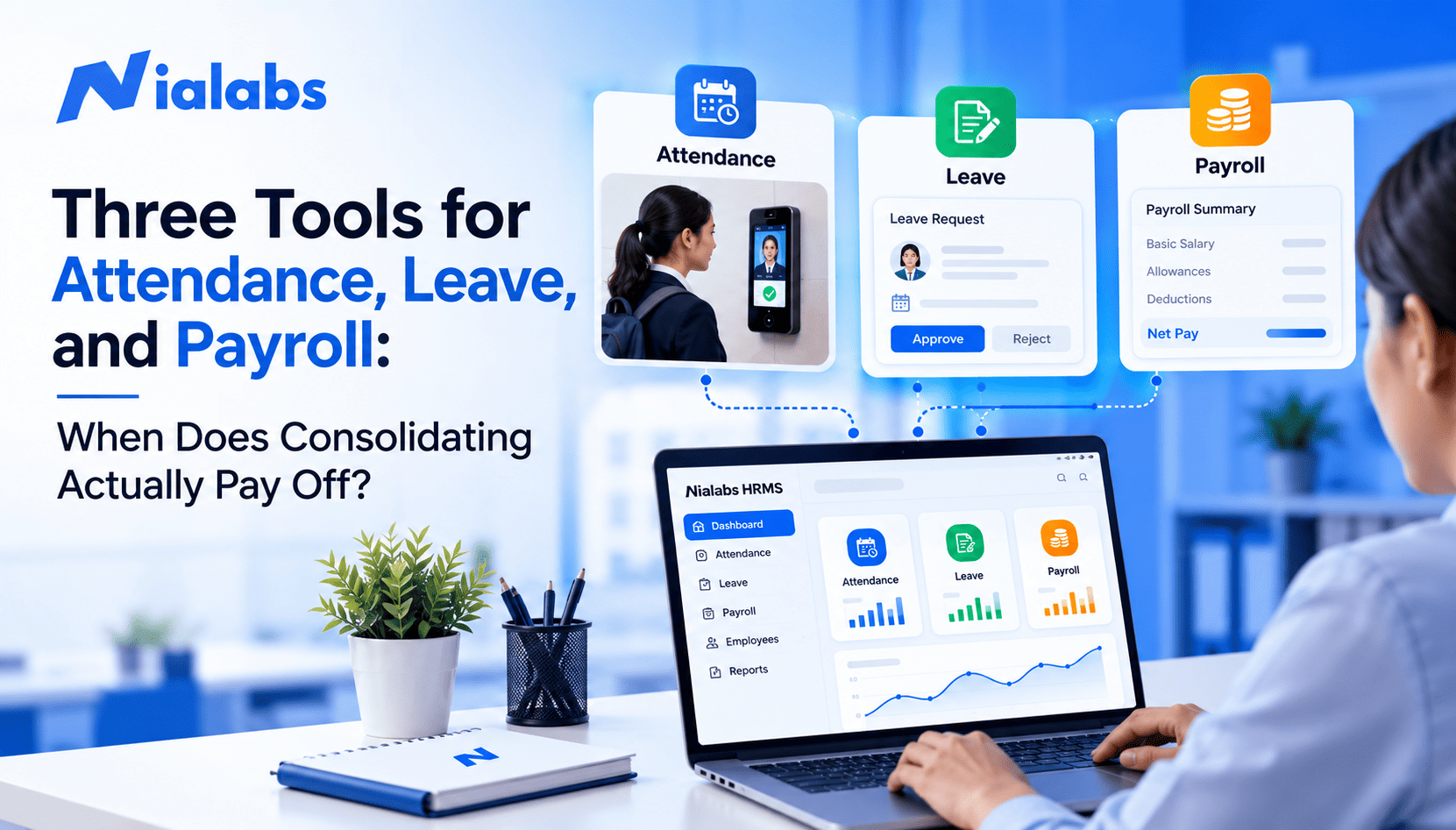
Because the device and software come from one company, verified punches move from the gate to payroll without a third-party connector. Devices work offline and sync when the connection returns, and you can match NiaFace attendance terminals to each site. If you already run another HRMS, Nialabs devices can push attendance into it instead. Our guide on when consolidating attendance, leave and payroll tools pays off helps you decide which setup fits.
Frequently Asked Questions
What are the main benefits of HRMS software?
The main benefits of HRMS software are accurate payroll, automatic PF, ESI, Professional Tax and TDS, Labour Code wage compliance, attendance linked directly to payroll, faster final settlements, employee self-service, real-time workforce visibility, secure employee data and lower audit risk.
How does HRMS software improve payroll accuracy?
HRMS software calculates salary from attendance, leave, overtime and salary structures already stored in one system, so nothing is copied between spreadsheets. It applies statutory rules automatically and can flag unusual month-on-month changes before salaries are paid.
Is HRMS the same as payroll software?
No. Payroll software only calculates salaries and deductions. An HRMS also manages employee records, attendance, leave, self-service, onboarding and exits, and feeds that data into payroll, which is why its payroll is usually more accurate.
How does an HRMS help with the new Labour Codes?
An HRMS applies the new definition of wages, flags salary structures where excluded allowances exceed 50% of total pay, and recalculates PF, gratuity and other wage-linked dues. It also calculates overtime at twice the ordinary rate and helps pay final settlements within two working days.
Can HRMS software integrate with biometric attendance machines?
Yes. Most modern HRMS platforms receive punches from biometric devices through an API, cloud sync or file import. Real-time API integration is the most reliable because verified punches reach payroll without manual uploads.
Is HRMS software useful for small businesses in India?
Yes. A business with 25 to 50 employees still handles attendance, leave, PF, ESI and Professional Tax every month. An HRMS automates this work, and most vendors in India charge per employee per month, so cost grows with headcount.
Does HRMS software help with DPDP Act compliance?
Yes. An HRMS keeps salary, bank and biometric data in one system with role-based access, audit trails and deletion controls, instead of spreadsheets shared over email. Most DPDP Rules obligations become enforceable on 13 May 2027.
Conclusion
The benefits of HRMS software come down to one idea: when employee, attendance and salary data live in one connected system, payroll is accurate, compliant and on time. For Indian businesses in 2026, that now includes applying the 50% wage rule, paying overtime at twice the rate, settling exits within two working days and protecting employee data under the DPDP Act.