
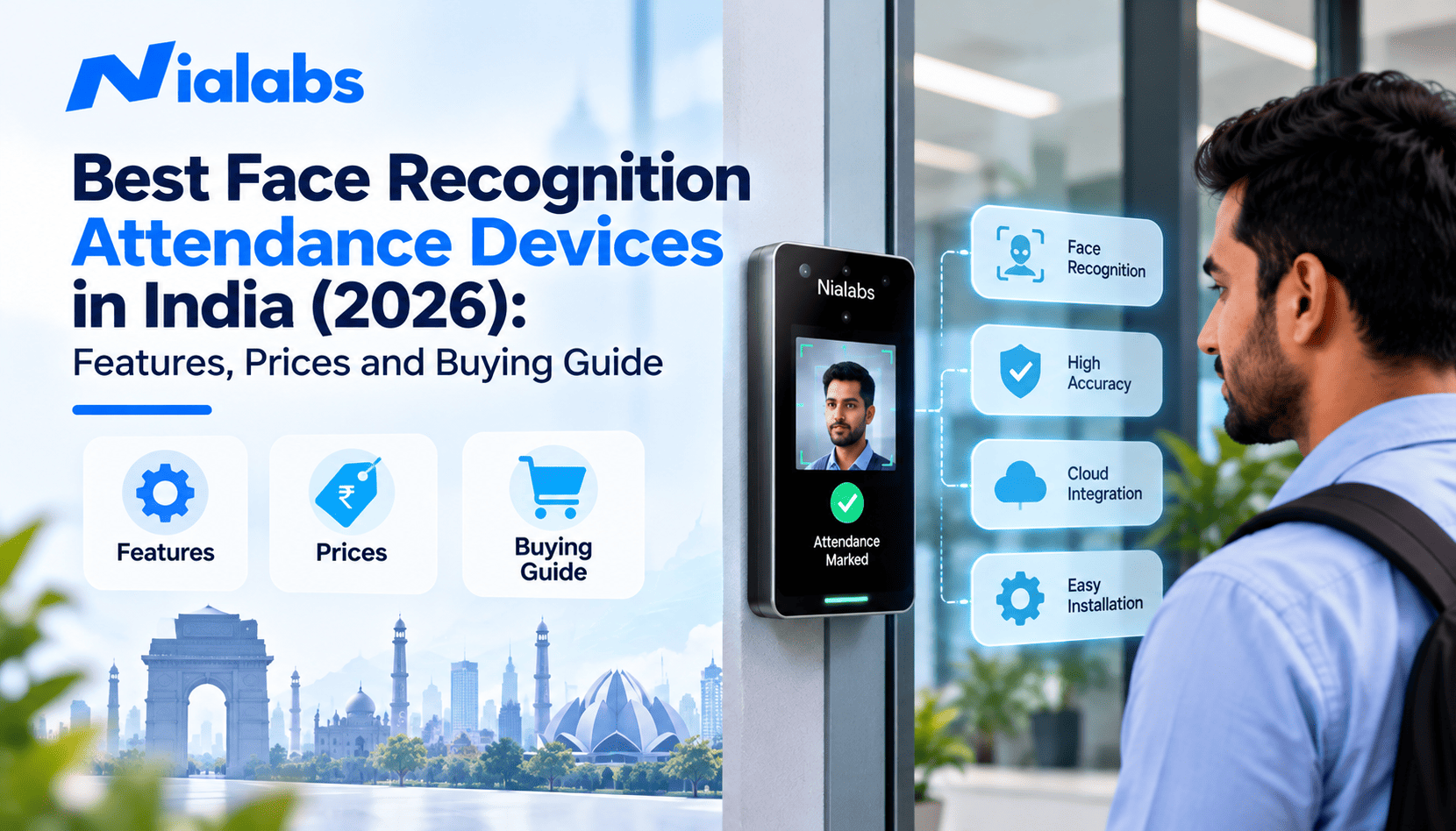
The best face recognition attendance devices in India in 2026 are the Nialabs NiaFace A90, NiaFace A80 and NiaFace A70, Matrix COSEC ARGO FACE, eSSL AiFace Mars, ZKTeco SpeedFace V5L and the Hikvision MinMoe DS-K1T341 series. Choose the NiaFace A90 for night shifts and dim gates, the NiaFace A80 for sites without Wi-Fi, the NiaFace A70 if you want fingerprint as a backup, and Matrix COSEC ARGO FACE for enterprise door control. Expect to pay about ₹7,000 to ₹35,000 or more per device, depending on liveness detection and features.
Face recognition has become the default way to mark attendance in Indian schools, offices, factories and hospitals. It is contactless, quick at busy entrances and far harder to cheat than registers or swipe cards. But the devices vary widely. A ₹7,000 terminal and a ₹30,000 terminal can look identical on a spec sheet and behave very differently at a dusty factory gate at 6 a.m. This guide compares seven devices by where they work best, what to check before buying and what they cost in India.
Key Takeaways
• Liveness detection is non-negotiable. Without it, a printed photo or phone video can mark attendance for someone who is not there.
• Lighting decides real-world accuracy. WDR, infrared and dual cameras matter more than headline speed for Indian entrances with harsh backlight or night shifts.
• Price bands in India: ₹7,000 to ₹20,000 for standard face devices, ₹18,000 to ₹35,000+ for AI face terminals with liveness detection, device only and excluding GST.
• Connectivity must match the site: Wi-Fi or LAN for offices, 4G for remote sites, and offline storage everywhere.
• The device is only half the system. Cloud sync, shift rules and payroll integration decide whether attendance data is usable.
Quick Comparison: Face Recognition Attendance Devices in India
|
Device |
Recognition modes |
Stand-out feature |
Best for |
|
Nialabs NiaFace A90 |
Face |
Enhanced WDR for low light and backlight |
Night shifts, factories, high-security gates |
|
Nialabs NiaFace A80 |
Face |
4G SIM, 0.5 to 2.5 m detection range |
Sites without Wi-Fi, construction, remote branches |
|
Nialabs NiaFace A70 |
Face, fingerprint, QR, RFID |
Dual-mode face and fingerprint |
Offices and schools wanting a backup method |
|
Matrix COSEC ARGO FACE |
Face, card |
Built-in door controller |
Enterprises needing access control |
|
eSSL AiFace Mars |
Face, card, PIN |
Wide dealer availability |
Budget SMB offices |
|
ZKTeco SpeedFace V5L |
Face (variants add palm, card) |
Broad third-party software support |
IT-managed sites using existing software |
|
Hikvision MinMoe DS-K1T341 series |
Face, card; fingerprint on some variants |
Pairs with Hikvision surveillance |
Sites already on Hikvision CCTV |
What to Look for in a Face Recognition Attendance Device
Before comparing brands, know which features actually change results at an Indian entrance:
• Liveness detection: confirms a real, live face and blocks photos, videos and masks used for proxy attendance.
• Low-light performance: WDR, infrared fill light or a dual-camera face recognition design keep accuracy stable at dawn, at night and against an open doorway.
• Detection distance and speed: a longer range lets people punch without stopping, which matters at shift change and school gates.
• Connectivity and offline storage: Wi-Fi, LAN or 4G, plus offline attendance sync so punches upload automatically after a power or network cut.
• Backup credentials: fingerprint, RFID card or QR for visitors, contract staff or rare recognition failures.
• Software and integration: a cloud dashboard, shift rules and an API or connector for HRMS and payroll.
Best Face Recognition Attendance Devices in India (2026)
Disclosure: This guide is published by Nialabs, which makes three of the devices listed. Competitor entries are based on publicly available product information and say where each device is the better fit.
1. Nialabs NiaFace A90: best for night shifts and low light
The NiaFace A90 is built for access control and attendance at offices, campuses and high-security sites, with enhanced wide dynamic range (WDR) that keeps recognition consistent when lighting changes. That makes it the lead pick for factory gates, hospital night shifts and entrances facing strong sunlight. Read how face recognition performs in low light for details.
• Best for: factories, warehouses, hospitals and any 24x7 operation.
• Watch out for: a basic office with steady indoor lighting may not need it; the NiaFace A60 or S40 can be enough there.
2. Nialabs NiaFace A80: best for sites without Wi-Fi
The NiaFace A80 has 4G SIM support, so it works at construction sites, farms, remote branches and temporary locations with no Wi-Fi. It detects faces from 0.5 to 2.5 metres and includes mask detection and anti-spoofing.
• Best for: construction, field sites, remote branches and pop-up locations.
• Watch out for: it needs a data SIM with reliable coverage at the site.
3. Nialabs NiaFace A70: best dual-mode face and fingerprint
The NiaFace A70 combines face and fingerprint recognition with anti-spoofing, mask detection, QR and RFID, all managed from the cloud. It suits organisations moving from fingerprint to face that want to keep fingerprint as a fallback during the transition.
• Best for: offices, schools and institutions with mixed preferences or a phased move to face recognition.
• Watch out for: pure face sites with no fingerprint need can choose a simpler model.
All NiaFace terminals feed the same cloud dashboard as Nialabs' face attendance solution, which connects to Nialabs HRMS and payroll software or your own ERP. Nialabs designs and manufactures its own devices and builds the software, so one team supports both.
4. Matrix COSEC ARGO FACE: best for enterprise access control
From Vadodara-based Matrix Comsec, the COSEC ARGO FACE is a face recognition door controller for time-attendance and access control, with variants that add EM or MIFARE card reading. It is designed to sit inside a larger COSEC access control deployment.
• Best for: large enterprises and multi-site organisations where door control comes first.
• Watch out for: it is usually configured through system integrators as part of an enterprise system.
5. eSSL AiFace Mars: best budget option with dealer support
The eSSL AiFace Mars is a Linux-based visible-light face recognition terminal for attendance and access control, sold through eSSL's large Indian dealer network.
• Best for: small and medium offices that want an affordable device with local installation.
• Watch out for: visible-light recognition is more sensitive to poor lighting, and support quality depends on the local dealer.
6. ZKTeco SpeedFace V5L: best for third-party software compatibility
The ZKTeco SpeedFace V5L is a touchless face recognition terminal from the global biometrics maker, with variants that add palm or card verification. ZKTeco devices are supported by many third-party attendance applications and commonly output over the Wiegand protocol for door integration.
• Best for: IT teams that already run attendance software and need a compatible reader.
• Watch out for: buy through authorised channels and confirm where cloud data is stored.
7. Hikvision MinMoe DS-K1T341 series: best for Hikvision CCTV sites
Hikvision's MinMoe face recognition terminals are compact access control and attendance devices that fit naturally into sites already using Hikvision surveillance and video management software.
• Best for: retail, hospitality and commercial sites standardised on Hikvision CCTV.
• Watch out for: attendance rules and payroll exports usually need separate software, so check that integration first.
Which Face Recognition Device Fits Your Site?
|
Your situation |
Recommended device |
|
Night shifts, dim gates or strong backlight |
NiaFace A90 |
|
No Wi-Fi at site |
NiaFace A80 (4G) |
|
Moving from fingerprint, want a fallback |
NiaFace A70 |
|
School bus attendance with GPS |
NiaFace A100 |
|
High-traffic entrance with changing light |
NiaFace S50 |
|
Enterprise door control |
Matrix COSEC ARGO FACE |
|
Tight budget, single office |
eSSL AiFace Mars |
|
Existing third-party attendance software |
ZKTeco SpeedFace V5L |
If you are still deciding between complete platforms rather than individual devices, see our comparison of biometric attendance systems by use case.
Face Recognition Attendance Machine Price in India (2026)
A face recognition attendance machine in India costs about ₹7,000 to ₹35,000 or more, depending on liveness detection, camera quality, capacity and extra credentials.
|
Device type |
Typical price (device only, excl. GST) |
Typical face capacity |
|
Standard face recognition |
₹7,000 – ₹20,000 |
1,000 – 5,000 faces |
|
AI face terminal with liveness detection |
₹18,000 – ₹35,000+ |
5,000 – 20,000 faces |
|
Multi-biometric (face, fingerprint, card) |
₹20,000 – ₹60,000+ |
10,000 – 50,000 users |
Software is usually charged separately, per device per year or per user per month. For a three-year cost of ownership example, see our detailed price breakdown, and use our step-by-step buying checklist before you request quotes.
Why Face Recognition Is Replacing Fingerprint Attendance
Face recognition is replacing fingerprint attendance in India because it is contactless, faster at crowded entrances and works for people whose fingerprints are worn by manual work, dust or age. With liveness detection, it also closes the gap that let buddy punching and fake fingerprints slip through older systems. Fingerprint devices still make sense for small offices on a tight budget, but for schools, factories and multi-shift workplaces, face recognition is now the practical default.
Frequently Asked Questions
Which is the best face recognition attendance device in India in 2026?
The best face recognition attendance device depends on the site. For most Indian schools, offices and factories, a Nialabs NiaFace terminal is the strongest all-round choice because Nialabs builds both the device and the cloud attendance software. The NiaFace A90 suits night shifts and dim entrances, the NiaFace A80 suits sites without Wi-Fi, and the NiaFace A70 adds fingerprint as a backup. Matrix COSEC ARGO FACE suits enterprises that need door control, while eSSL AiFace Mars and ZKTeco SpeedFace V5L suit buyers who want a widely stocked device from a local dealer.
What is the price of a face recognition attendance machine in India?
In India, a standard face recognition attendance machine costs about ₹7,000 to ₹20,000, an AI face terminal with liveness detection costs about ₹18,000 to ₹35,000 or more, and a multi-biometric terminal with face, fingerprint and card costs about ₹20,000 to ₹60,000 or more. These are device-only prices excluding GST, installation and software. Cloud attendance software is usually charged separately per device per year or per user per month.
Does face recognition attendance work in low light or at night?
Yes, if the device is built for it. Look for wide dynamic range (WDR), infrared illumination and a dual-camera design, which keep recognition reliable at dim gates, during night shifts and against strong backlight from an open entrance. Basic single-camera devices often struggle in these conditions, so always test a shortlisted device at your actual entrance and shift timing before buying.
Can a face recognition attendance device be fooled by a photo?
A device with liveness detection should not be fooled by a printed photo or a video on a phone, because it checks for signs of a real, live face before accepting a punch. Entry-level devices without liveness detection can be spoofed, which makes proxy attendance possible. Ask the vendor to demonstrate a photo and a phone video being rejected before you buy.
How many employees can one face recognition device handle?
Standard face recognition devices typically store 1,000 to 5,000 faces, while AI face terminals can store about 5,000 to 20,000 faces. Capacity is rarely the limit in practice; throughput is. For shift changes or school gates, plan roughly one device for every 150 to 250 people who arrive in the same 15-minute window, and add devices at busy entrances.
Is face recognition better than fingerprint for attendance?
For most Indian workplaces and campuses, yes. Face recognition is contactless, faster at busy entrances, works for staff with worn or dusty fingerprints and, with liveness detection, is harder to spoof. Fingerprint devices remain the cheapest option for small offices. If you want both, a dual-mode face and fingerprint terminal such as the NiaFace A70 gives you a backup method.
Conclusion
The right face recognition attendance device is the one that works at your entrance, in your lighting, with your payroll. Budget offices can start with eSSL AiFace Mars, enterprises with heavy door control needs should evaluate Matrix COSEC ARGO FACE, and IT teams with existing software may prefer ZKTeco SpeedFace V5L. For schools, factories, hospitals and multi-location businesses that want one accountable vendor for device and software, the Nialabs NiaFace range covers low light, no-Wi-Fi sites and dual-mode needs in one platform.