
Most Indian businesses run attendance on a biometric machine and payroll on Excel, with someone manually transferring data between the two every month. That manual step is where errors happen, where payroll disputes start, and where compliance failures quietly build up.
HRMS software eliminates that gap. But only when you choose the right one for your organisation size, compliance requirements, and existing hardware setup.
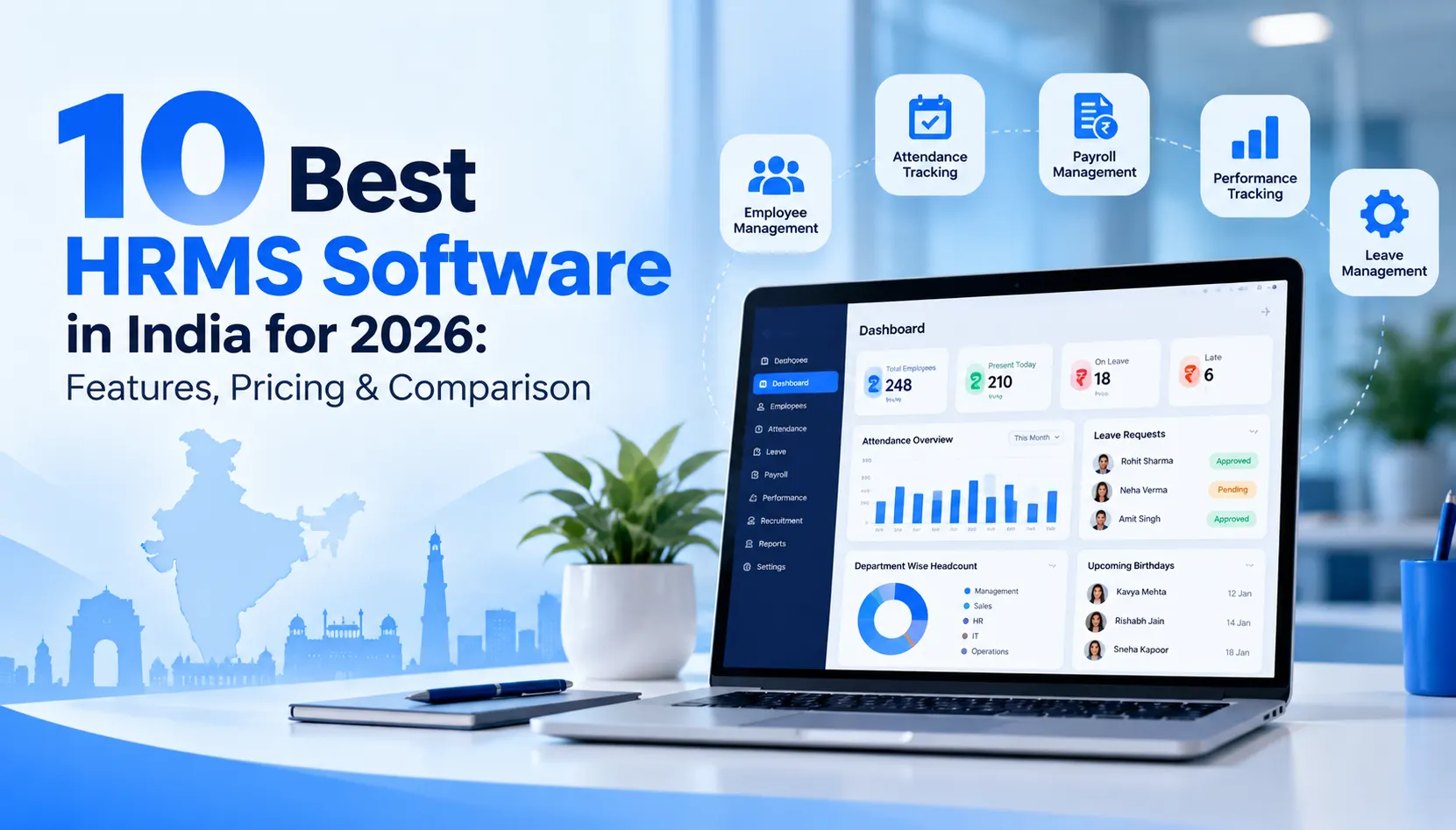
This guide covers the 10 best HRMS software options in India for 2026, with a comparison table, honest reviews, and a decision framework to help you shortlist the right fit.
What Is HRMS Software and Why Does It Matter in 2026?
HRMS (Human Resource Management System) is software that centralises employee data, attendance, payroll, leave management, compliance, and reporting in a single platform, replacing disconnected tools and manual processes with one unified system.
Three things make 2026 a critical year for Indian businesses to get this right:
- Labour Code reforms require updated compliance workflows that legacy systems and Excel cannot handle reliably
- DPDPA 2023 creates data management obligations for employee records, including biometric attendance data classified as sensitive personal data
- Attendance-to-payroll automation is now standard; businesses still doing this manually are carrying avoidable risk and administrative overhead every month
Quick Comparison: 10 Best HRMS Software in India (2026)
| Software | Best For | Starting Price | Key Strength | Free Trial |
|---|---|---|---|---|
| Nialabs HRMS | SMEs with biometric/face recognition attendance | Contact for pricing | Direct attendance hardware integration | Yes |
| Keka HR | Growing SMEs (50–500 employees) | ₹6,999/month (100 employees) | Payroll + appraisal in one platform | Yes |
| greytHR | Compliance-focused SMEs | ₹3,495/month (50 employees) | State-wise statutory compliance automation | Yes |
| Darwinbox | Large enterprises (500+ employees) | Custom pricing | End-to-end HCM with AI features | No |
| Zoho People | Budget-conscious teams | ₹48/employee/month | Affordable, integrates with Zoho suite | Yes |
| Pocket HRMS | Mid-size companies (200–1,000 employees) | Custom pricing | AI chatbot + WhatsApp integration | Yes |
| HROne | Manufacturing & field teams | Custom pricing | 127+ HR processes, mobile-first | Yes |
| Zimyo | Startups and SMEs | ₹60/employee/month | Cloud HRMS with payroll + attendance | Yes |
| Kredily | Very small businesses | Free (basic plan) | Free payroll, leave, and attendance | Yes |
| FactoHR | Multi-location businesses | Custom pricing | Mobile HCM with geo-attendance | Yes |
10 Best HRMS Software in India: Detailed Reviews
1. Nialabs HRMS
Best for: SMEs and organisations that use biometric or face recognition attendance hardware and need seamless attendance-to-payroll integration.
Nialabs HRMS solves the attendance hardware integration gap covered in this guide's introduction. When a face recognition attendance system or biometric device syncs directly into payroll (no manual export required), attendance errors and payroll disputes reduce significantly.
Key features include automated attendance-to-payroll sync, leave and shift management, employee self-service, and cloud-based deployment with local data storage options.
Pricing: Contact Nialabs for pricing based on headcount and configuration.
Limitation: Best suited for organisations already using or planning to deploy Nialabs attendance hardware.
Explore Nialabs HRMS for full product details.
2. Keka HR
Best for: Growing Indian SMEs with 50–500 employees looking for a modern, user-friendly platform.
Keka is one of the most widely adopted HRMS platforms in the Indian mid-market. Its payroll engine handles PF, ESIC, PT, and TDS reliably, and the performance management module makes it a genuine end-to-end platform rather than just a payroll tool.
Key features: payroll automation with statutory compliance, appraisal and goal-setting cycles, attendance and leave management, employee self-service portal.
Pricing: ₹6,999/month for up to 100 employees.
Limitation: Can feel expensive for very small teams; advanced features are locked to higher pricing tiers.
3. greytHR
Best for: Compliance-heavy SMEs that need accurate state-wise PF, ESIC, PT, and TDS calculations.
greytHR has served Indian businesses for over three decades and has 30,000+ clients. Its statutory compliance engine, with state-specific rule sets that update automatically, is one of the most reliable in the market for Indian payroll compliance.
Key features: automated statutory compliance with state-specific rules, payroll processing with audit trails, leave and attendance management, employee records management.
Pricing: ₹3,495/month for up to 50 employees.
Limitation: UI is functional but dated compared to newer platforms; performance management features are limited.
4. Darwinbox
Best for: Large enterprises with 500+ employees needing a comprehensive HCM platform.
Darwinbox covers the full employee lifecycle: recruitment, onboarding, performance, learning, and offboarding, with AI-powered workflows and strong mobile capabilities. It is widely used among large Indian and multinational organisations.
Key features: AI-powered recruitment and onboarding, advanced workforce analytics, multi-country payroll support, mobile app for field and hybrid teams.
Pricing: Custom pricing, suited for enterprise budgets.
Limitation: Overkill and cost-prohibitive for small businesses; implementation requires significant time and resources.
5. Zoho People
Best for: Budget-conscious teams or businesses already using the Zoho product ecosystem.
Zoho People offers one of the most affordable entry points for HR management software in India. It handles core HR functions well and integrates natively with Zoho Payroll and CRM, making it practical for businesses already invested in the Zoho stack.
Key features: leave, attendance, and shift management; multi-location support; native Zoho suite integration; per-employee pricing from ₹48/month.
Pricing: From ₹48/employee/month.
Limitation: Payroll is handled via the separate Zoho Payroll module; Indian compliance depth is limited compared to greytHR or Keka.
6. Pocket HRMS
Best for: Mid-size Indian firms with 200–1,000 employees wanting AI-assisted HR workflows.
Pocket HRMS stands out for its WhatsApp integration. Employees can apply for leave, check payslips, and mark attendance directly through WhatsApp without logging into a separate portal. Its AI chatbot handles routine HR queries, reducing repetitive requests reaching the HR team.
Key features: AI chatbot for employee queries, WhatsApp-based attendance and leave requests, payroll automation with compliance, customisable workflows.
Pricing: Custom pricing (requires a sales enquiry).
Limitation: Pricing is not publicly listed, making initial evaluation harder.
7. HROne
Best for: Manufacturing, logistics, and field-workforce businesses needing mobile-first HR.
HROne automates over 127 HR processes and is designed for large, distributed Indian workforces: multiple shifts, blue-collar teams, geo-tracked field employees. Its mobile-first approach works well where not every employee is at a desk.
Key features: 127+ automated HR processes, geo-location attendance via mobile app, shift and roster management, payroll with labour law compliance.
Pricing: Custom pricing.
Limitation: The breadth of features means setup and configuration can be complex for smaller teams.
8. Zimyo
Best for: Startups and early-stage SMEs wanting a cloud HRMS at an accessible price.
Zimyo covers core HR requirements (payroll, attendance, leave, and performance management) in a clean cloud platform. For businesses outgrowing Excel but not ready for enterprise-level complexity or pricing, Zimyo is a practical starting point.
Key features: cloud payroll with Indian statutory compliance, attendance and leave management, performance management module, employee self-service.
Pricing: From ₹60/employee/month.
Limitation: Reporting and analytics are basic compared to enterprise platforms.
9. Kredily
Best for: Very small businesses (under 50 employees) wanting free core HR functionality.
Kredily offers a genuinely free plan covering payroll, attendance, leave management, expense tracking, and FnF settlement. Over 20,000 businesses use the platform. Paid plans unlock advanced features when needed.
Key features: free payroll, attendance and leave, FnF settlement, expense tracking, paid plans for advanced modules.
Pricing: Free forever (basic); paid plans available.
Limitation: Free plan has feature limitations; customer support response times can be slow.
10. FactoHR
Best for: Multi-location businesses needing mobile HCM with geo-attendance and biometric device support.
FactoHR supports geo-location attendance, selfie check-ins, and biometric device integration, making it suitable for businesses operating across multiple locations with flexible attendance capture requirements.
Key features: mobile HCM with geo-location and selfie attendance, multi-location payroll and compliance, biometric device integration, workforce analytics.
Pricing: Custom pricing.
Limitation: Setup complexity increases for businesses with highly customised payroll structures.
How to Choose the Right HRMS System in India for Your Business
Choosing the best HRMS system in India comes down to five practical questions:
1. What is your organisation size?
Businesses under 50 employees can start with Kredily's free plan or greytHR's entry tier. SMEs between 50–500 employees are best served by Keka, Zimyo, or Nialabs HRMS depending on their setup. Enterprises above 500 employees should evaluate Darwinbox or similar HCM platforms.
2. Do you use attendance hardware?
If your organisation uses biometric attendance machines or face recognition devices, your HRMS must integrate with that hardware directly, not just accept manual CSV uploads. Without direct integration, attendance data has to be exported, formatted, and imported into payroll every month. The effect of eliminating that manual step on payroll accuracy is significant. Always confirm hardware compatibility before purchasing any HRMS.
3. How complex is your compliance requirement?
Businesses operating across multiple states face state-wise PF, PT, and professional tax variations. greytHR and Keka handle this most reliably for Indian SMEs. Verify that the platform offers automatic compliance rule updates; manually maintaining tax tables is a serious liability.
4. Cloud or on-premise?
Cloud-based HRMS software is now the standard for Indian SMEs, with lower upfront cost, automatic updates, and accessible from any device. Under DPDPA 2023, employee data, especially biometric data, must be managed with appropriate consent, storage, and deletion policies. Choose a vendor that is transparent about data residency and data protection practices.
5. What is the total cost of ownership?
Per-employee pricing scales quickly. A platform at ₹60/employee/month costs ₹36,000/month for a 600-person team. Factor in setup fees, support costs, and add-on modules before comparing headline prices. If you also need access control systems integrated with your HR platform, check whether the vendor supports that connection.
Key Features Every HRMS Software for Indian SMEs Should Have
Before committing to any platform, verify it includes these six essentials:
- Indian statutory compliance automation: PF, ESIC, Professional Tax, and TDS with state-specific rules that update automatically
- Attendance hardware integration: direct sync with biometric devices or face recognition systems, not just manual CSV import
- Automated payroll from verified attendance: payroll runs should pull directly from attendance records with no manual reconciliation step
- Leave and shift management: multi-shift scheduling, comp-off tracking, and leave encashment calculations built in
- Employee self-service portal: employees should be able to access payslips, apply for leave, and raise queries independently
- Compliance audit trails: every payroll run, attendance record, and statutory filing should be logged and retrievable for inspections
Choosing the right employee management software for India means verifying it handles statutory compliance automatically, not relying on manual updates whenever PF or PT rules change. Most HR payroll software in India now includes automated PF, ESIC, and TDS calculations, but the quality and accuracy of state-specific rule sets varies significantly between platforms.
Frequently Asked Questions
What is the best HRMS software in India for small businesses?
For businesses under 50 employees on a tight budget, Kredily offers a free core plan covering payroll and attendance. For reliable compliance automation, greytHR's entry tier is well-suited. If you use biometric attendance hardware, Nialabs HRMS integrates directly with attendance devices, eliminating the manual data transfer that causes most payroll errors.
What is the typical cost of HRMS software in India?
Pricing ranges from free (Kredily basic) to ₹48–₹200 per employee per month for SME platforms. Enterprise platforms like Darwinbox use custom pricing. Always request the total cost of ownership, including setup, support, and add-on modules, not just the base subscription rate.
Does HRMS software handle Indian statutory compliance like PF and ESIC?
Yes, most Indian HRMS platforms include automated PF, ESIC, Professional Tax, and TDS calculations. greytHR and Keka are particularly strong on state-wise compliance with automatic rule updates. Always verify that the platform covers your specific states and industry before committing.
Can HRMS software integrate with biometric attendance machines?
Many platforms support biometric integration, but the depth varies. Some require manual data export from the device and import into the HRMS. Nialabs HRMS integrates directly with biometric and face recognition attendance devices, syncing attendance data automatically into payroll, removing the manual transfer step entirely.
What is the difference between HRMS, HRIS, and HCM?
HRIS (Human Resource Information System) focuses on employee data storage and basic admin. HRMS adds payroll, compliance, and workflow automation. HCM (Human Capital Management) covers the full employee lifecycle: recruitment, learning, performance, and succession planning. For most Indian SMEs, an HRMS covers everything needed.
Is cloud-based HRMS software safe for storing employee data in India?
Reputable cloud HRMS platforms use encryption and role-based access controls. Under DPDPA 2023, employee data, including biometric attendance data, is classified as personal or sensitive personal data. Choose a vendor that clearly states their data residency (India-based servers preferred), retention policy, and consent management practices.
If your organisation uses biometric or face recognition attendance hardware and needs payroll that syncs automatically, without manual transfer or monthly reconciliation, explore Nialabs HRMS, built for Indian SMEs with hardware-first attendance integration.