
This is general guidance for Indian employers as of September 2026, not legal advice. The four Labour Codes are in force, but states are still notifying the rules under them, so confirm your state's specific register requirements with your compliance advisor before changing how you keep records.
For decades, Indian employers kept attendance on a paper muster roll: an employee punches in, a supervisor initials the entry, and HR pulls the register at month-end for payroll and for any labour inspection. Biometric attendance systems replaced punching with a fingerprint or a face scan. What they did not automatically settle is the compliance question underneath it: once attendance is captured electronically, do you still need the physical register? The honest answer is that it depends less on the technology and more on whether your electronic record can do everything the law requires the muster roll to do.
Key Takeaways
• The muster roll is not obsolete. It is now called the attendance register-cum-muster roll under Section 50 of the Code on Wages, 2019, and the obligation to maintain it did not go away when the Factories Act, 1948 was repealed on 21 November 2025.
• Electronic records are expressly permitted, but an export of raw punches is not a register. It has to be reproducible in the prescribed format, per employee, per day.
• Attendance and wage registers must be retained for 5 years from the date of the last entry, not 3 years, and not from the date an employee exits.
• Biometric templates and statutory attendance records are governed differently under the DPDP Act: the template can be purged on exit; the attendance record cannot.
What Is a Muster Roll, and Has It Changed Under the New Labour Codes?
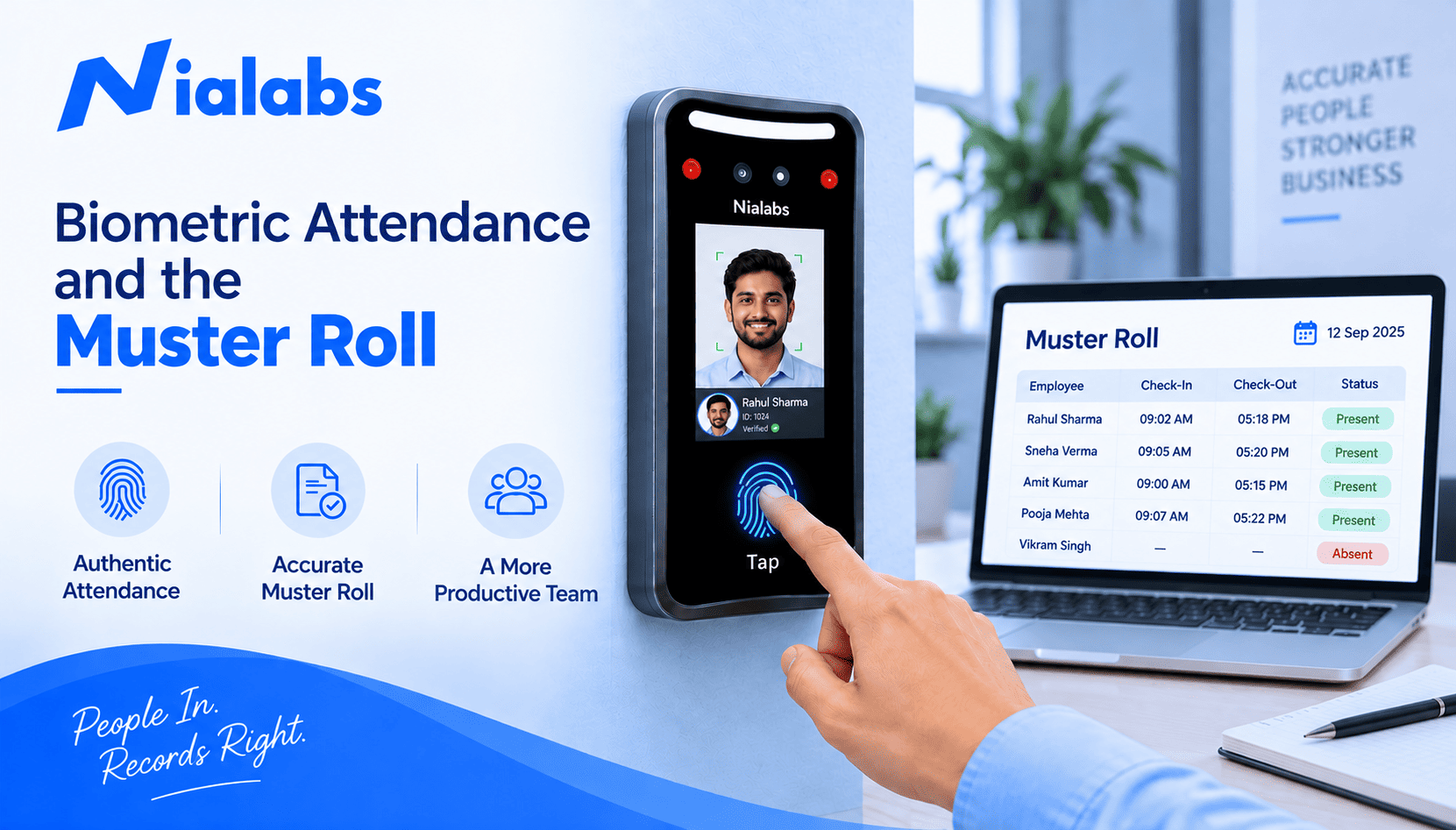
A muster roll is the daily attendance record of every person employed at an establishment, showing employee identity, shift, in and out times, absences, and weekly offs. Under the four Labour Codes in force since 21 November 2025, this record sits primarily under Section 50 of the Code on Wages, 2019, which requires every employer to maintain a register of persons employed, muster roll, wages, and other prescribed particulars. The Occupational Safety, Health and Working Conditions (OSH) Code, 2020 carries the corresponding obligation for covered establishments and is the code that repealed the Factories Act, 1948.
The name changed, the consolidation is real, but the underlying obligation- a daily record of who was present and for how long- did not disappear.
Does Biometric Attendance Legally Replace the Paper Register?
Yes, electronic maintenance is expressly supported under the rules notified for the Labour Codes, which provide for records, registers, and notices to be maintained and displayed electronically. However, installing a biometric device does not automatically satisfy this on its own. The question to ask is narrower: does the biometric system capture, store, and reproduce every field the register is required to hold, in the format your state prescribes?
A device that only logs a punch timestamp, with no employee code, shift, or department attached, is data, not a compliant register. See how a biometric attendance system works for what a complete capture actually involves.
What an Electronic Attendance Record Must Do to Survive an Inspection
Three properties decide whether an electronic register holds up when a labour inspector asks for it, rather than a spreadsheet that merely looks organised.
Reproducible in the prescribed form. You need to be able to print the muster roll for a named month, with every field the form requires and every employee on it, not just a raw export of punches.
An audit trail on every edit. Attendance gets corrected constantly, for real reasons: a missed punch, a device fault, an approved late entry. Each correction is an edit to a statutory record, and the system needs to show who changed it, when, and with whose approval. A register that can be silently overwritten proves nothing in an audit.
Retrievable for the full retention period, even after the employee has left. This is the part most setups get wrong, covered next.
Paper Muster Roll vs Biometric Attendance
|
Factor |
Paper muster roll |
Biometric attendance |
|
How attendance is marked |
Manually, by signature or supervisor initial |
Automatically, at the point of verified identity |
|
Error rate |
Handwriting and transcription errors are common |
Digital timestamps remove manual entry errors |
|
Proxy attendance |
Hard to detect after the fact |
Not possible, identity is verified at the point of punch |
|
Producing a month's record for audit |
Manual compilation from the physical register |
Generated on demand in the prescribed format, if the system supports it |
|
Storage and retention |
Physical storage for the full retention period |
Digital storage, provided backups cover the same period |
|
Editing an entry |
Visible correction on paper, but no structured approval trail |
Should carry a logged audit trail, not all systems provide this by default |
The pattern in that table is not "biometric wins on every row automatically." It is that biometric attendance can close every gap paper leaves open, but only the audit-trail and retention rows depend on how the system is configured, not on the hardware alone.
How Long Must You Keep the Records?
Attendance and wage registers must be preserved for 5 years from the date of the last entry made in them, an increase from the 3 years that applied under the earlier Minimum Wages and Payment of Wages rules. The distinction that trips up most employers: the clock runs from the last entry in the register, not from the date the employee exits. A running register for an active site is retained for 5 years from whenever entries in it stop, which in practice means far longer than 5 years from any individual employee's last working day.
If your current data retention policy still says 3 years, or your system purges attendance data automatically on that basis, it is likely deleting records you are required to hold.
Biometric Data, DPDP, and the Aadhaar Question
Attendance data captured biometrically is personal data under the Digital Personal Data Protection Act, 2023, and it does not sit in a separate, more sensitive legal category the way it did under the older 2011 data rules. That does not lower the obligation. It means the same core requirements apply as to any employee personal data: give notice of what is collected and why, use it only for the stated purpose, secure it, and erase it once that purpose ends.
Two distinctions matter in practice. First, purpose limitation: a face template collected for attendance should not be quietly repurposed for a security or productivity-analytics feature without a separate basis for that use. Second, and this is the one most systems get backwards, storage limitation applies to the biometric template, not to the statutory attendance record. The record of who worked which hours has a 5-year retention obligation behind it. The fingerprint or face template used to identify that person at the point of punch does not, and should be purged when the employee exits rather than kept indefinitely.
One point worth stating plainly: a private employer cannot compel Aadhaar-based biometric authentication for attendance, since Aadhaar authentication by private entities is restricted and attendance is not a permitted purpose under that framework. A compliant biometric attendance system uses its own enrolment, independent of Aadhaar.
What Should a Modern Biometric Attendance Setup Actually Store?
To function as a genuine electronic register rather than a convenience layered on top of a paper one, the system should capture, at minimum: employee identification, date and time of clock-in and clock-out, shift and department, hours worked, late arrival and early departure, overtime performed, and the attendance category for each day, including absence and weekly off, not only days present. Exact fields vary by state and establishment type, so this is a floor, not a final list, and it is worth checking against payroll integration requirements specifically if attendance data feeds directly into salary processing.
Making the Switch Without Creating a Compliance Gap
Before retiring a physical register, an employer should be able to answer: which labour law and state rules actually apply to this establishment, does the biometric system capture every field those rules require, can a full month's record be reproduced in the prescribed format on demand, is every edit to an attendance entry logged with who made it and when, and how long is data retained and backed up. Nialabs biometric devices capture identity, timestamp, and attendance category automatically and support API integration with HRMS, payroll, and ERP systems, which is what keeps the record structured rather than exported into a spreadsheet that has to be reconciled by hand. On data handling specifically, see how liveness detection supports DPDP-compliant biometric capture.
Conclusion
A biometric device does not, by itself, replace the muster roll. What replaces the muster roll is an electronic register that captures the same fields, reproduces them in the required format, logs every edit, and survives the full retention period. Biometric attendance is how most employers will get there, but the compliance test sits in the data structure, not in the hardware on the wall. Talk to an expert about setting up attendance capture that holds up under both a payroll run and a labour inspection.
Frequently Asked Questions
1. Do I still need a paper muster roll if I use biometric attendance?
Not necessarily. Electronic maintenance of the attendance register-cum-muster roll is expressly permitted under the rules notified for the Labour Codes, provided your system can reproduce the record in the prescribed format, carry an audit trail on edits, and meet the retention requirement. Confirm the specific form your state prescribes before retiring the physical register entirely.
2. Will labour inspectors accept biometric attendance records during an inspection?
Generally yes, provided the record can be reproduced for a named period in the prescribed format with every required field, and the system can show an audit trail for any corrections. A raw export of punch timestamps without employee, shift, and department details is not sufficient on its own.
3. Does biometric attendance remove all paperwork requirements?
It significantly reduces manual register-keeping, but statutory forms tied to payroll, leave, and employment, such as the wage register and leave register, remain separate obligations that a biometric attendance log alone does not satisfy.
4. How long must biometric attendance records be kept?
Attendance and wage registers must be retained for 5 years from the date of the last entry made in them, not from the date an employee leaves. This is longer than the 3-year period that applied under the earlier wage rules, so confirm your system is not purging data on the old timeline.
5. Can biometric attendance data be linked to Aadhaar for verification?
Private employers cannot compel Aadhaar-based biometric authentication for attendance, since Aadhaar authentication by private entities is restricted and attendance is not a permitted purpose. A compliant setup uses its own biometric enrolment, separate from Aadhaar.
6. Can biometric attendance integrate with payroll and HRMS for compliance reporting?
Yes. Most modern biometric attendance systems support API-based integration with payroll, HRMS, and ERP platforms, which keeps the attendance record structured and reconcilable with the wage register rather than manually re-entered between systems.