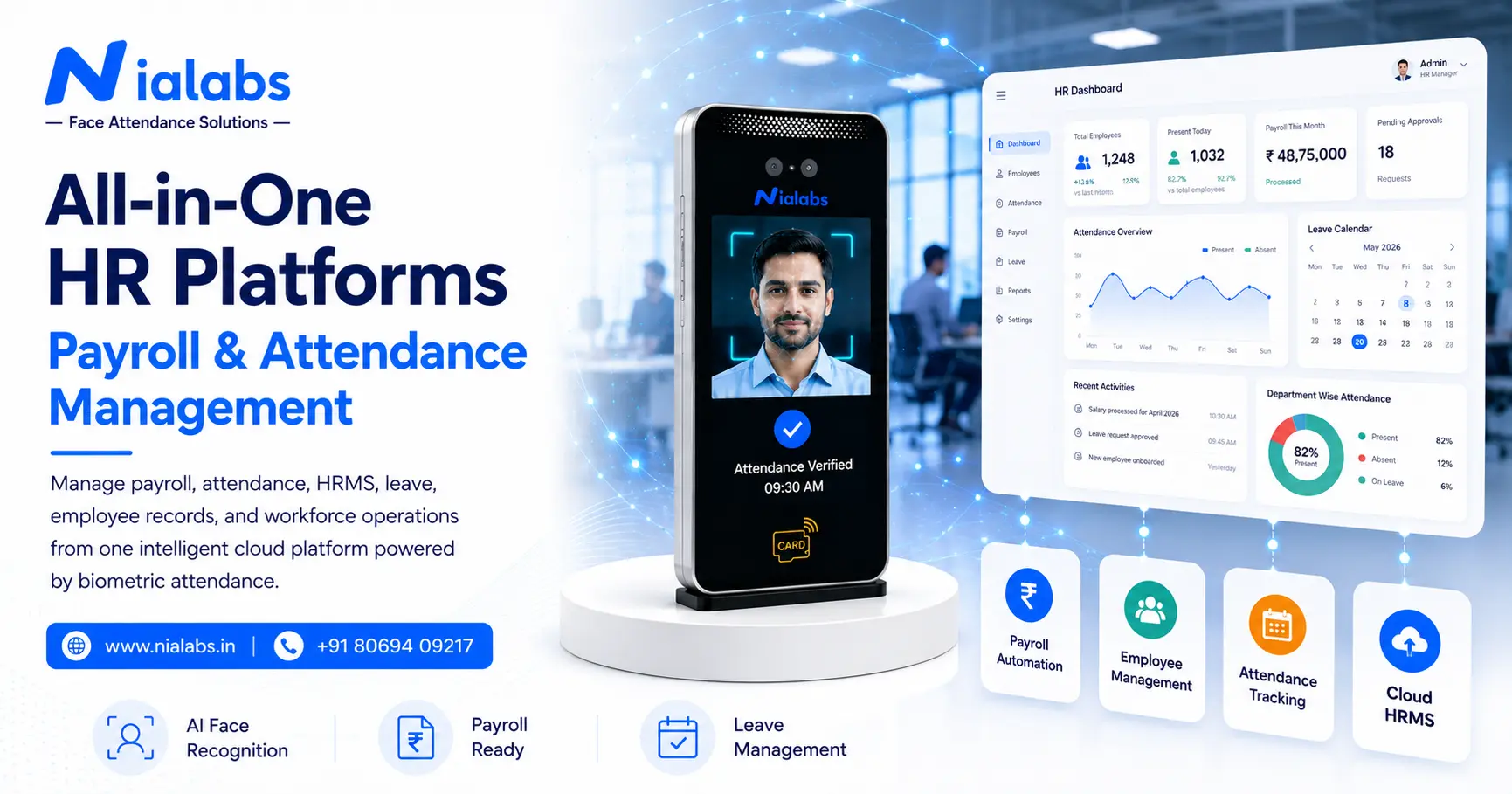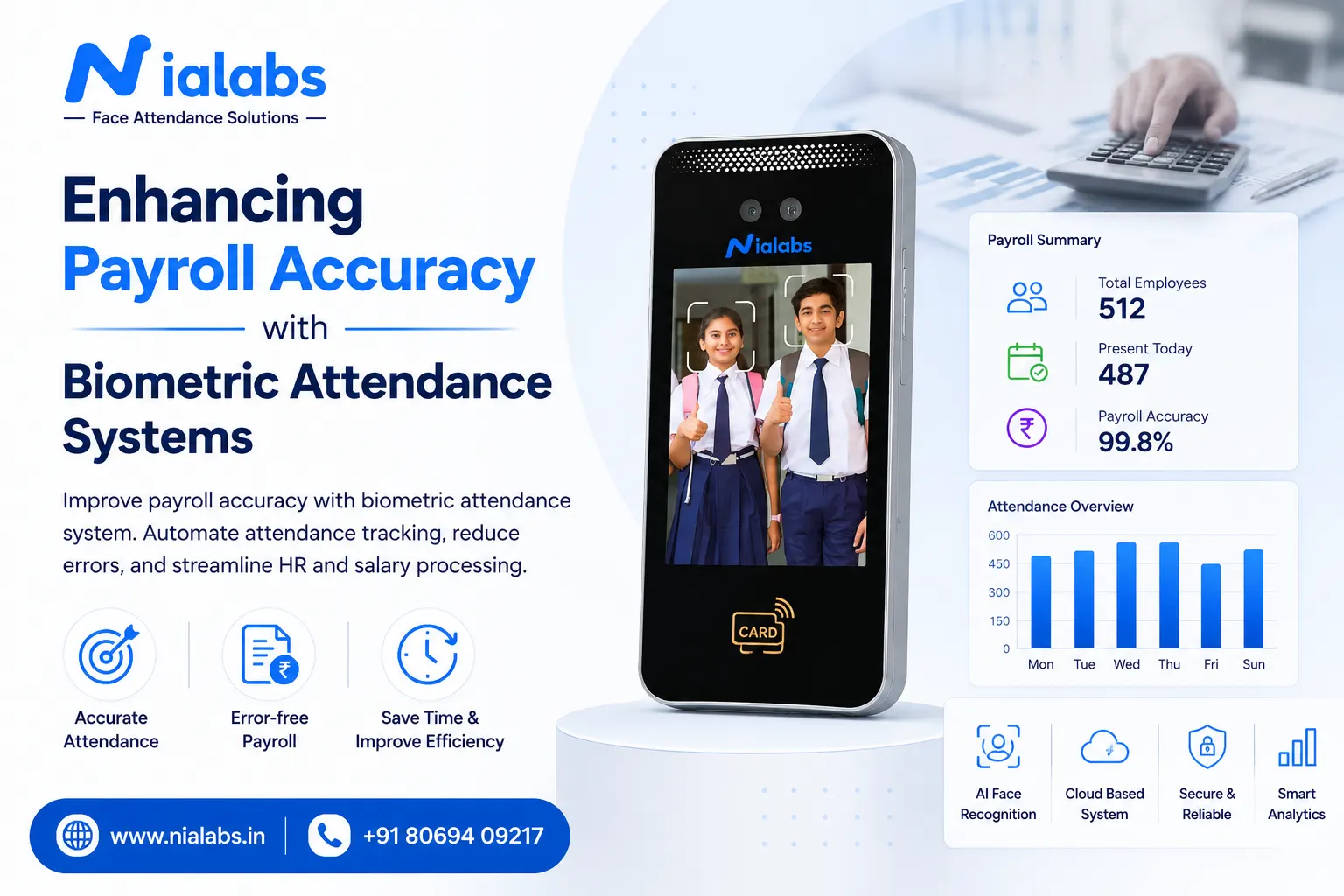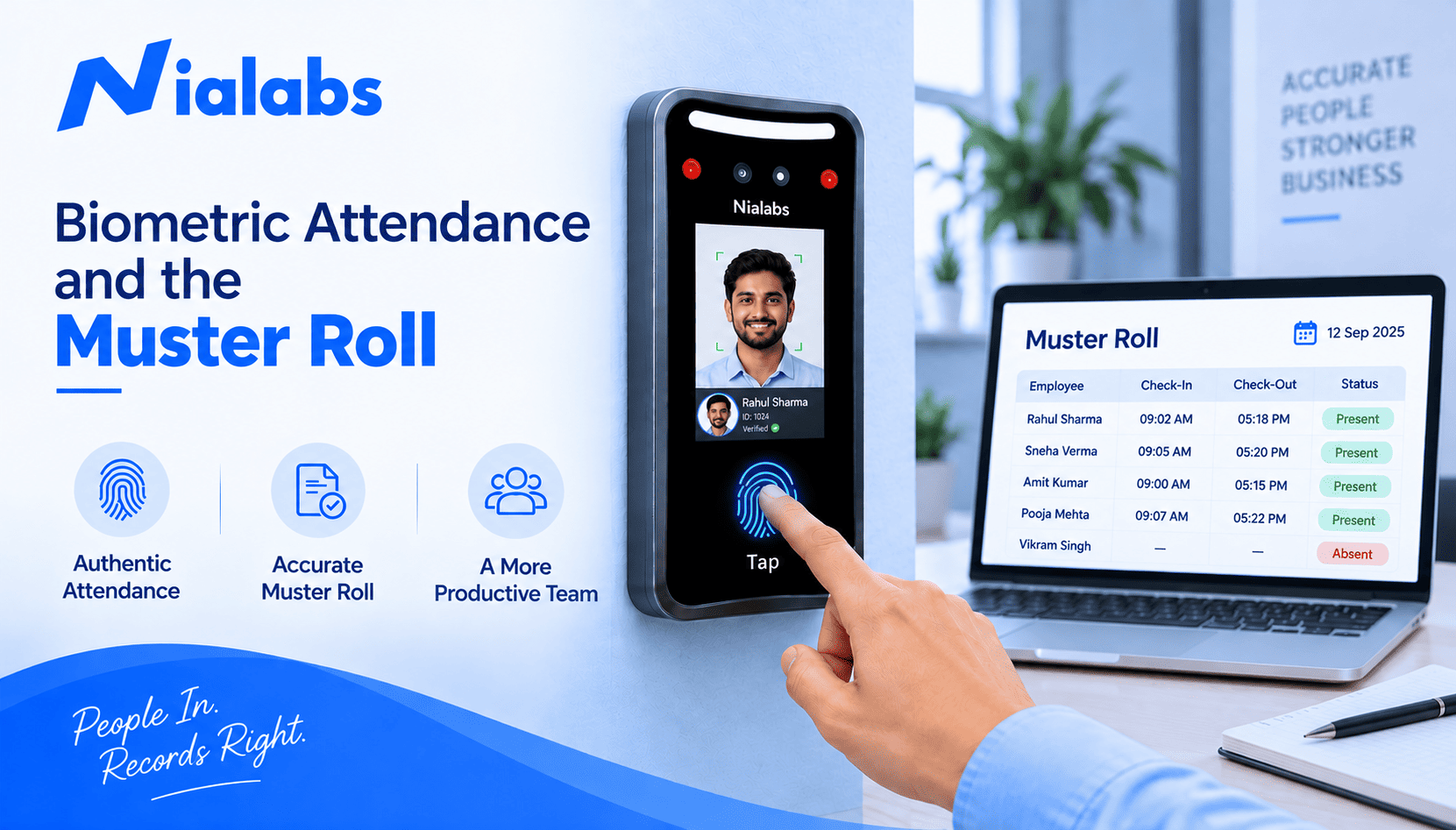

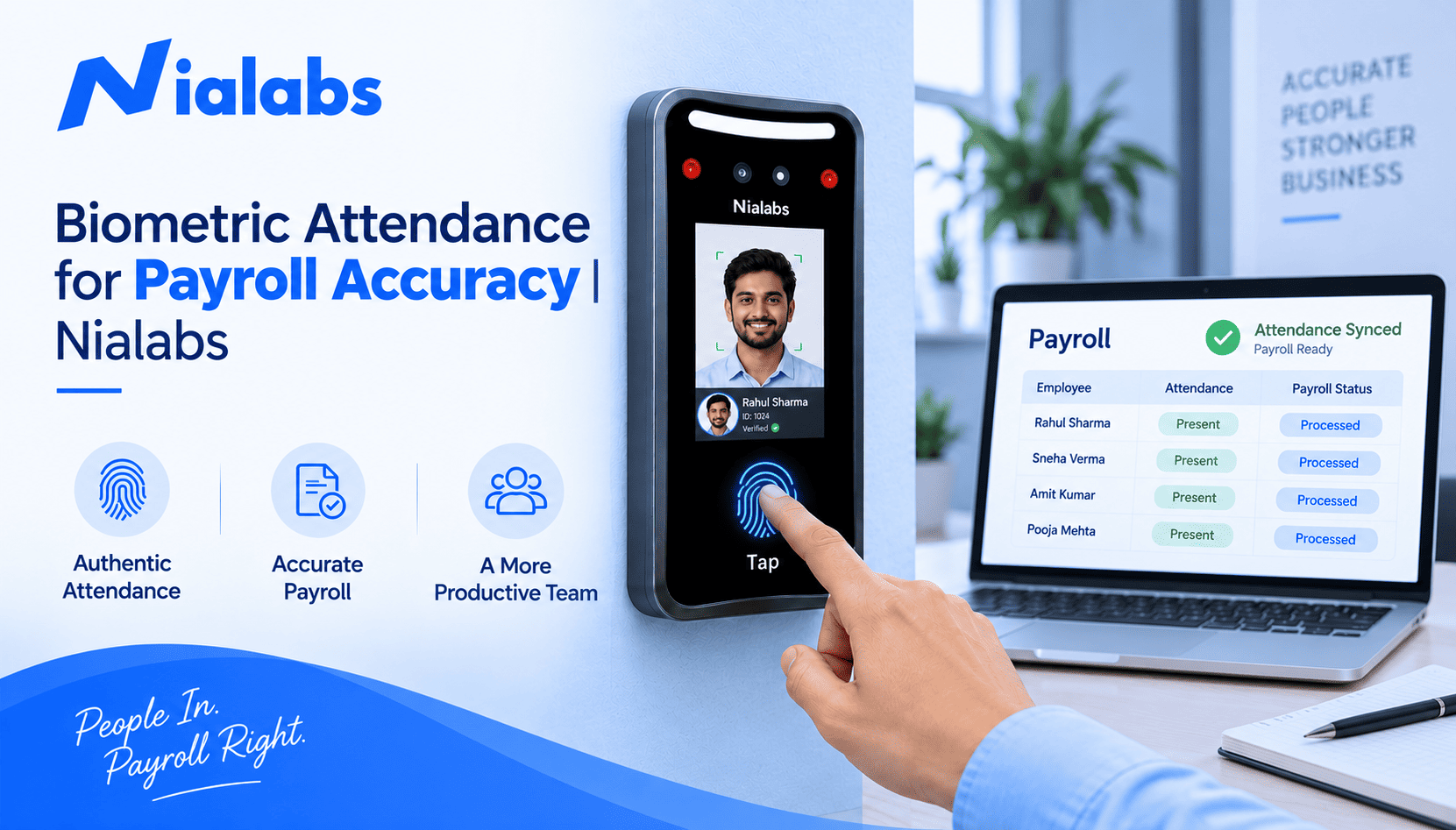
Payroll accuracy in India runs on one input: attendance data. A missed punch at a Bhiwandi warehouse gate or a disputed overtime hour on a Jaipur factory floor turns into a payroll dispute within days, not months. Biometric attendance systems close that gap by tying every punch to a verified identity instead of a card, a PIN, or a colleague's signature. Nialabs devices already process over 1 million punches a day across 3,000-plus clients in India, feeding straight into HRMS and payroll systems with no manual entry in between. Here is exactly where biometric attendance moves the payroll-accuracy needle, and where it does not.
Key Takeaways
• Nialabs biometric devices process over 1M punches daily across 3,000+ clients, with zero manual data entry into payroll.
• Buddy punching, not software error, is the single biggest source of disputed payroll hours in Indian workplaces.
• The NiaFace A90 stores up to 100,000 attendance records and syncs via API directly into HRMS and payroll software.
• Biometric attendance is not a legal mandate for payroll in India, but it is what most compliance audits are defended on.
Does Biometric Attendance Actually Reduce Payroll Errors?
Yes, primarily by closing the two error sources that manual and card-based systems cannot close on their own: buddy punching and manual re-entry into payroll software. A biometric device verifies the person physically present at the point of punch, so the record payroll runs on is the record of who actually worked, not who was marked present.
For a mid-size factory running two or three shifts, disputed overtime is usually the loudest payroll complaint each month, and it almost always traces back to a punch that either did not happen or happened for the wrong person. See how a biometric attendance system works for the full verification flow. Removing that ambiguity is what actually moves the accuracy number, not the software layer sitting on top of it.
What Is a Biometric Attendance System, in Payroll Terms?
A biometric attendance system verifies an employee's identity using a physical trait, face, fingerprint, or both, and timestamps that verification the moment it happens. For payroll, that timestamp is the raw material every salary calculation depends on: hours worked, late arrivals, overtime, and leave.
Unlike a card or a PIN, this identity cannot be borrowed, lost, or handed to a colleague, which is what makes the resulting attendance data usable for payroll without a manual accuracy check layered on top of it.
The Five Features That Actually Move Payroll Accuracy
Accuracy: AI face and fingerprint matching removes buddy punching outright, since biometric identity cannot be shared between employees.
Security: Encrypted templates and tamper-resistant records mean the data a payroll audit relies on cannot be edited after the fact the way a paper register can.
Integration: Attendance data flows into HRMS and payroll software through an API, not a manual export. This payroll integration layer is the single feature that decides whether the accuracy gains upstream actually reach the salary calculation, or die in a spreadsheet in between.
Data storage: Attendance logs are encrypted and retained both on-device and in the cloud, so records survive a power cut or a network outage without a gap in the payroll trail.
Real-time sync: The NiaFace A90 stores up to 100,000 attendance records and supports up to 50,000 registered faces, syncing continuously rather than in a nightly batch, so payroll teams work from same-day data instead of reconciling a week's backlog at month-end.
Is Biometric Attendance Mandatory for Accurate Payroll in India?
No, biometric attendance is not a legal requirement for payroll processing in India. What Indian labour law and compliance audits actually require is defensible attendance evidence, and a paper register or card-swipe log is far easier to dispute than a timestamped biometric record.
Government and PSU procurement specifications increasingly ask for biometric verification by default, which signals where compliance expectations are heading even without a blanket private-sector mandate. For most businesses, the decision is a risk one, not a legal one: how much payroll dispute and audit exposure is acceptable versus the cost of removing it.
Buddy Punching, Real-Time Sync, and Overtime: How the Error Chain Breaks
Every payroll error traces back to one of four points in the attendance chain: who punched, when the data reached payroll, how overtime was calculated, and what evidence exists if the calculation is disputed. Manual and card-based systems leave all four open. Biometric attendance closes them one at a time.
|
Error source |
Manual / card-based system |
Biometric attendance |
|
Buddy punching |
Possible; a colleague can punch on someone's behalf |
Not possible; identity is verified at the point of punch |
|
Manual re-entry into payroll |
Required, introduces transcription error |
Not required, synced via API |
|
Overtime calculation |
Manual, disputed at month-end |
Automatic, timestamped |
|
Audit trail for compliance |
Paper register, easy to dispute |
Digital, timestamped, exportable |
None of these four fixes requires a bigger payroll team or a new process. They require one thing: an attendance record that cannot be edited, borrowed, or lost between the gate and the salary run.
What Does This Cost a Business That Skips It?
Employees notice payroll errors immediately, and repeated ones read as disrespect, not accident, which erodes trust fast. Every unresolved discrepancy is also compliance exposure: labour-law and tax audits are won or lost on the attendance evidence behind them. Financially, time theft and miscalculated overtime compound monthly and rarely get corrected retroactively. Reputationally, payroll disputes travel through informal networks faster than any HR announcement. And ultimately, none of this helps retention: employees who are paid inaccurately or late do not stay loyal to the company that got it wrong.
Conclusion
Biometric attendance does not fix a payroll process on its own. What it does is remove the two things that break every payroll process eventually: a punch that was not real, and a manual step that introduced an error nobody catches until month-end. Nialabs builds the biometric hardware and the software layer on top of it, so that data path stays intact from the gate to the salary run. Talk to an expert about connecting your attendance data directly to payroll.
Frequently Asked Questions
1. Does biometric attendance actually improve payroll accuracy?
Yes. A biometric attendance system verifies employee identity at every punch, which eliminates buddy punching and removes the manual re-entry step that introduces transcription errors. The resulting attendance record syncs directly with payroll software, so salary calculations are based on verified hours rather than a disputable register.
2. Biometric lagana worth it hai kya for payroll accuracy?
Haan, biometric attendance worth it hai agar aapki company mein buddy punching, disputed overtime, ya manual payroll errors ek recurring problem hain. Ek Nialabs biometric device ki cost aam taur par ek do se teen months ke andar hi disputed overtime aur manual correction time mein recover ho jaati hai.
3. Can a biometric attendance system integrate with payroll software?
Yes. Nialabs biometric devices support API-based integration with HRMS and payroll software, so attendance records sync automatically for salary processing, overtime calculation, leave management, and compliance reporting, with no manual export step in between.
4. Is biometric attendance mandatory for accurate payroll in India?
No, it is not a legal mandate. Indian labour law requires defensible attendance evidence for payroll and compliance audits, and a timestamped biometric record is significantly harder to dispute than a paper register or card-swipe log, which is why adoption is rising even without a blanket requirement.
5. Which industries benefit most from biometric attendance and payroll integration?
Factories, warehouses, hospitals, schools, coaching institutes, and multi-shift offices see the largest payroll-accuracy gains, since these environments have the highest exposure to buddy punching and manual overtime disputes. Any business running more than one shift or more than one location benefits from the same real-time sync.
6. What features should I look for in a biometric attendance system for payroll?
Prioritise API-based HRMS and payroll integration, real-time data sync rather than nightly batch uploads, encrypted on-device and cloud data storage, and AI face or fingerprint accuracy rated for your specific environment, such as low light or outdoor gates. Cloud-based reporting and offline punch storage during network outages also protect payroll continuity.