
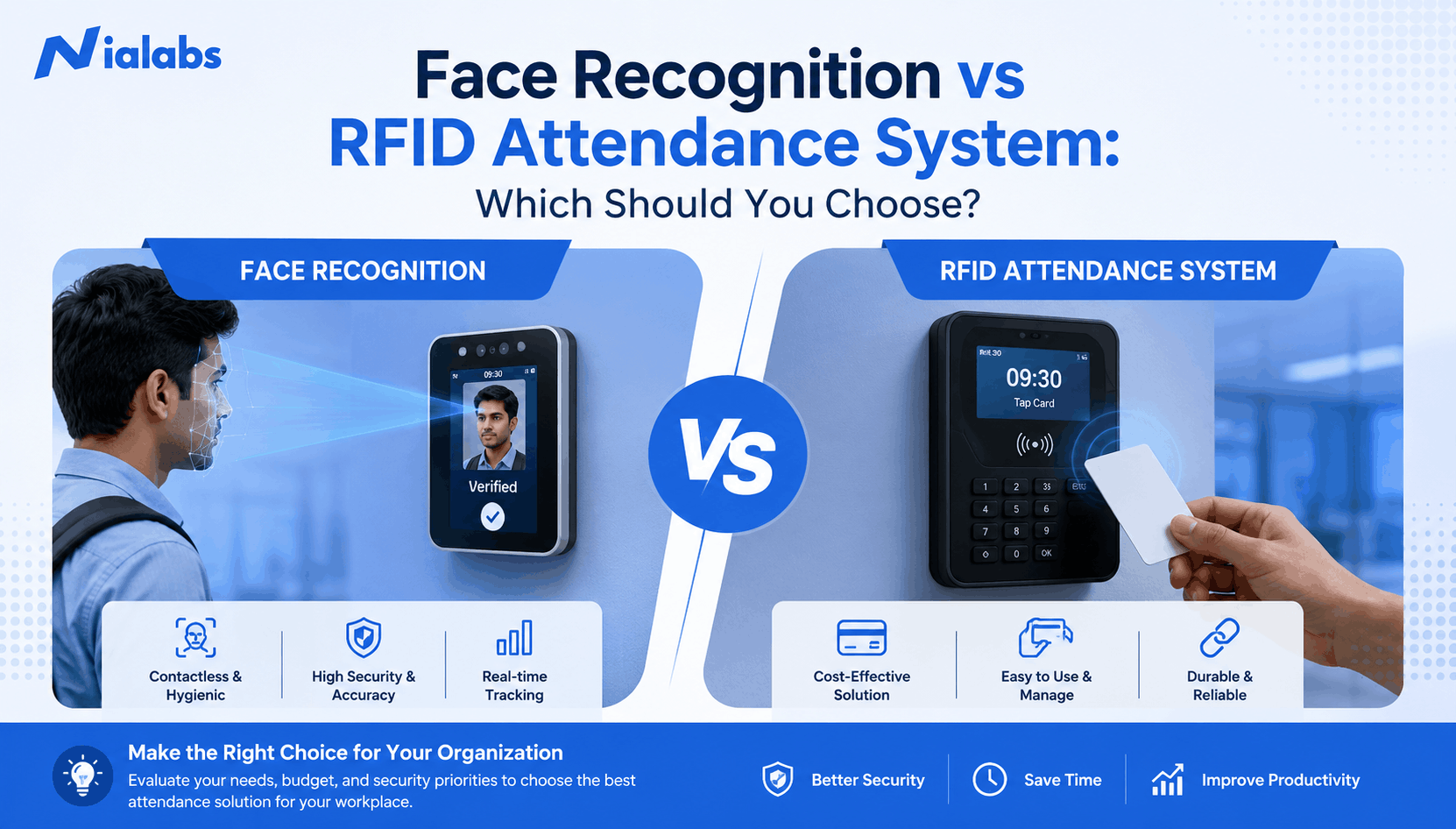
Face recognition wins on security and long-term cost. RFID wins on upfront price. If your organisation needs to eliminate proxy attendance and buddy punching, a face recognition attendance system is the safer long-term investment. If you need a low-cost, fast rollout for a small office or a first step toward automation, an RFID attendance system gets you there quickly. This guide compares both technologies on security, accuracy, cost, ease of use, and integration, so you can pick the right fit for your school, office, or factory in India.
Key Takeaways
Face recognition attendance systems verify a person's face in under 0.5 seconds and eliminate buddy punching entirely. RFID cards can be tapped by anyone holding them.
RFID costs less upfront and cards typically last 5 to 10 years, but ongoing card replacement and administration add recurring costs that face recognition does not carry.
Nialabs face recognition devices use anti-spoofing and liveness detection, which blocks photo and video-based attendance fraud that RFID cannot detect.
Both technologies integrate with HRMS, payroll and ERP software. The difference is authentication accuracy, not integration capability.
For high-security sites such as factories, hospitals and multi-branch offices, face recognition is the stronger default. For low-risk, high-traffic sites, RFID remains a practical option
What Is a Face Recognition Attendance System?
A face recognition attendance system uses AI and computer vision to record attendance from a person's face, with no card or fingerprint required. The camera captures a live image, matches it against a pre-registered facial template, and logs the punch in under a second.
Nialabs face recognition devices add anti-spoofing, liveness detection and mask-aware recognition, so a photo, video or printed image cannot be used to fake a punch. Attendance syncs to the cloud in real time and keeps working offline during a network outage, then syncs once connectivity returns. It integrates directly with HRMS, payroll and school ERP platforms, which is why it is the default choice for organisations that need both accuracy and automation.
What Is an RFID Attendance System?
An RFID attendance system is a card-based system where each employee or student taps or presents an RFID card near a reader. The card transmits a unique ID, and the system logs the punch instantly.
RFID cards remain popular because they are cheap to deploy and simple to operate, which is why most schools and small offices start automation with RFID rather than biometrics. The trade-off is that the card, not the person, is what gets verified. A card can be lost, shared or duplicated, and once that happens, the attendance record no longer reflects who was actually present. Nialabs RFID cards support attendance, access control and cashless payments on a single card.
Face Recognition vs RFID: Side-by-Side Comparison
Table A. Build as an HTML table, not an image.
|
Feature |
Face Recognition |
RFID Attendance |
|---|---|---|
|
Authentication |
Facial biometrics |
RFID card or tag |
|
Contactless |
Yes |
No, card tap required |
|
Buddy punching |
Eliminated |
Possible |
|
Security |
Very high |
Moderate |
|
Card required |
No |
Yes |
|
Speed |
Under 0.5 seconds |
1 to 2 seconds |
|
Maintenance |
Low, lens cleaning only |
Card replacement required |
|
Accuracy of identity check |
Very high |
High for card read, not identity |
|
Initial cost |
Higher |
Lower |
|
3-year cost of ownership |
Often lower |
Higher, due to card management |
Security: Which System Actually Stops Proxy Attendance?
Face recognition wins on security because it verifies the person, not an object the person is carrying. Nialabs devices pair a colour camera with liveness detection, so a printed photo or a phone screen held up to the camera fails the check.
RFID protects the door, not the identity behind the card. A card can be handed to a colleague, and the reader has no way to know the difference. This is the single biggest reason schools and factories in India move from RFID to biometrics once proxy attendance becomes a real cost.
For a full comparison of every method that actually stops proxy punching, including geofencing and dynamic QR, see our guide on how to stop proxy attendance. For more on how anti-spoofing works, read our explainer on liveness detection.
Accuracy and Reliability
Face recognition verifies identity, not just a signal, so it is accurate to well above 99 percent under normal lighting on modern devices. RFID readers are close to 100 percent accurate at reading the card itself, but that accuracy says nothing about whether the right person was actually present.
This distinction matters most in regulated environments such as hospitals, factories with shift-based payroll, and schools reporting attendance to parents. A missed or fraudulent punch on a face recognition system is a device or lighting problem you can fix. A missed or fraudulent punch on an RFID system is a policy problem, because the card worked exactly as designed even when the wrong person used it.
Cost in India: Upfront Price vs 3-Year Total Cost of Ownership
RFID costs less to install but more to run. A basic RFID attendance setup is cheaper upfront because the readers are simple, but every lost, damaged or reissued card adds a recurring cost, and a mid-sized office replaces a meaningful share of its cards every year.
Face recognition devices cost more upfront and need no consumables. There are no cards to print, replace or manage, so the 3-year total cost of ownership is often lower even though the day-one invoice is higher.
For exact 2026 price ranges by device type, GST and AMC, see our full biometric attendance system price breakdown for India.
As a rule of thumb: budget for RFID if you need to equip a large headcount immediately on a fixed budget. Budget for face recognition if you are optimising for the lowest cost per year over the life of the device.
Ease of Use and Maintenance
Face recognition is contactless by design. Employees and students walk past the device, and attendance is logged without touching anything, carrying anything, or waiting for a card to read correctly.
RFID requires a card to be present, charged if active, and undamaged. Cards get left at home, get demagnetised, and get lost, and each of those events becomes a support ticket. Maintenance on a face recognition device is mostly lens cleaning and firmware updates. Maintenance on an RFID fleet is ongoing card administration.
Integration with HRMS, Payroll and Access Control
Both technologies integrate with the same downstream systems, so integration is not the deciding factor. Nialabs face recognition attendance system and Nialabs RFID cards both connect to HRMS, payroll and school ERP software through the same cloud API, and both can extend into a full access control system for gates, doors and turnstiles.
The difference shows up upstream, in what data reaches HRMS in the first place. A face recognition punch is tied to a verified person. An RFID punch is tied to a card. If your HRMS calculates overtime, shift pay, or attendance-linked incentives, the accuracy of the source data matters more than which system it flows through.
Face Recognition vs RFID vs Fingerprint: How This Fits the Bigger Biometric Picture
This guide covers face recognition specifically. If you are weighing RFID against biometrics as a category, including fingerprint, our broader guide on biometric systems vs RFID cards covers the full picture across every biometric method, not face recognition alone.
The short version: fingerprint biometrics sit between RFID and face recognition on both cost and hygiene. Fingerprint scanners are cheaper than face recognition devices and more secure than RFID, but they require physical contact, which face recognition avoids entirely. For hospitals, factories and any site with hygiene concerns, face recognition is the only fully contactless biometric option available today.
Best Use Cases: When to Choose Each System
Choose face recognition when you need:
-
High-security zones, corporate offices, and multi-branch businesses
-
Schools, colleges and educational institutions preventing proxy attendance
-
Manufacturing units and factories with high daily footfall at the gate
-
Hospitals and healthcare facilities with hygiene requirements
-
Contactless attendance across multiple branches or work locations
Choose RFID when you need:
-
A low-cost first step into attendance automation
-
Basic attendance tracking for a small business or single site
-
Fast rollout for a short-term event, conference or visitor management
-
Compatibility with an existing RFID-based access control system
Which Should You Choose in 2026?
Choose face recognition if security, contactless operation and long-term cost matter more than the size of the first invoice. This is the right default for schools, hospitals, factories and any multi-branch business tracking attendance across locations.
Choose RFID if you need a fast, low-cost rollout, your risk from proxy attendance is low, or you already have RFID-based access control and want attendance on the same card.
Many organisations run both: RFID for gate access and visitor management, face recognition for verified attendance. Nialabs builds and supports both technologies, so you are not locked into one path as your requirements change.
Frequently Asked Questions
Which is more secure, face recognition or RFID attendance?
Face recognition is more secure. It verifies a person's own facial features, so proxy attendance and card sharing are not possible without defeating the liveness check. RFID verifies a card, and a card can be lost, shared or duplicated, so it offers weaker identity assurance on its own.
Does face recognition cost more than RFID?
Yes, upfront. A face recognition device costs more to buy than an RFID reader and cards. Over 3 years, face recognition is often cheaper to run because there are no cards to print, replace or administer, while RFID card replacement adds a recurring cost.
Will an RFID attendance system stop buddy punching?
No, not on its own. RFID verifies the card, not the person carrying it, so one employee can tap in for another. Preventing buddy punching requires face recognition, fingerprint verification, or an added layer such as photo capture at the reader.
Which attendance system works best for schools in India?
Face recognition works best where schools need to prevent proxy attendance and give parents reliable, real-time updates. RFID remains a practical option for library access, bus tracking and schools on a tighter budget where absolute proof of identity is less critical.
Can face recognition and RFID work together?
Yes. Many Nialabs deployments combine both: RFID cards for gate access and visitor management, and face recognition for verified employee or student attendance. Running both layers gives you fast, low-cost access alongside high-accuracy attendance records.
Which is better for factories and multi-branch offices in India?
Face recognition is the stronger choice for factories and multi-branch offices. It removes buddy punching at high-traffic gates, works contactlessly across shifts, and gives centralised, verified attendance data across every branch through the same cloud dashboard.