
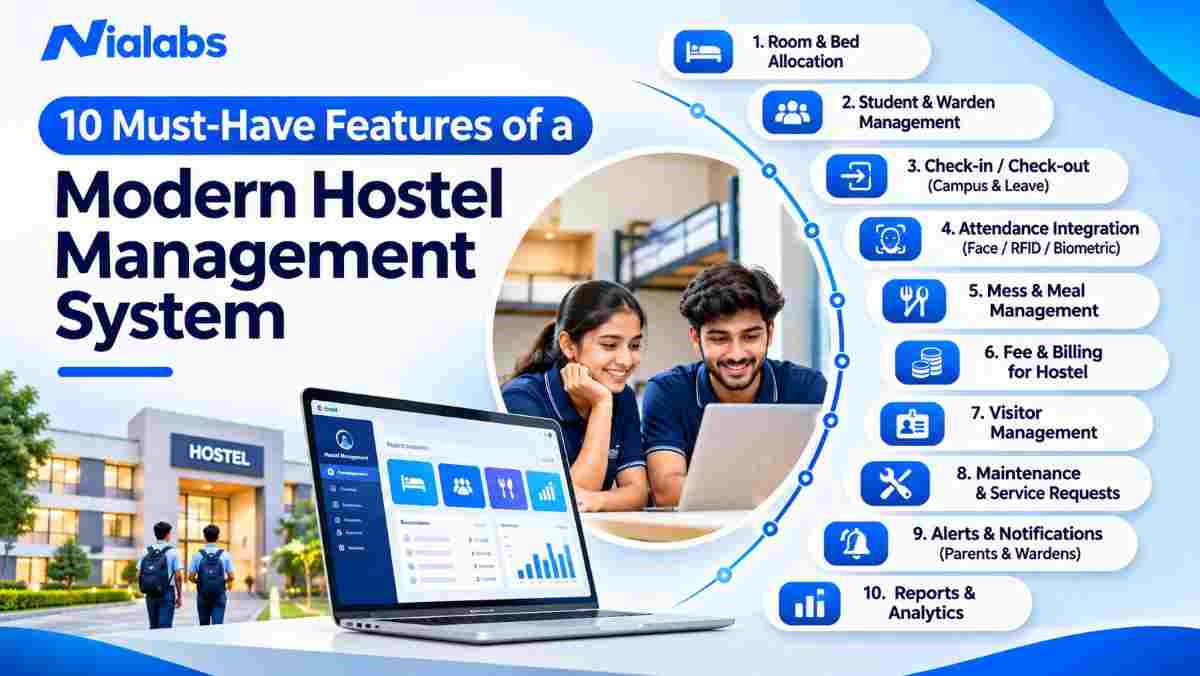
The 10 must-have features of a modern hostel management system are bed-level room allocation, centralised tenant records, automated billing, biometric attendance, digital leave and visitor requests, mobile apps, real-time reports, multi-property management, integrations and role-based data security. Together, these features replace registers and spreadsheets with one connected platform for hostels, PGs and student accommodation.
Managing a hostel involves much more than assigning rooms and collecting fees. Administrators maintain resident records, manage occupancy, track attendance, collect payments, handle complaints and coordinate daily operations. When each of these depends on a separate register or spreadsheet, even routine tasks slow down and errors creep in.
Not every hostel management software offers the same capabilities, though. This guide explains what each feature should do, gives a practical example, and ends with a checklist you can use when comparing vendors.
Key Takeaways
• Bed-level allocation prevents duplicate assignments and shows true vacancy, not just room-level occupancy.
• Automated billing with pro-rata dues, grace periods and penalties removes manual fee calculations.
• Biometric attendance creates a digital record of every resident check-in and check-out.
• Digital leave, complaint and visitor workflows give wardens a clear approval trail.
• Under India's DPDP Act, 2023, resident data needs consent, role-based access and secure storage.
What Is a Hostel Management System?
A hostel management system is software that manages rooms, beds, residents, fees, attendance and resident requests for hostels, PGs, guest houses and student accommodation from one centralized platform. It gives wardens, accountants and management a single, accurate view of who is staying where, which beds are free, what dues are pending and which requests need attention.
It is used by college and university hostels, private student hostels, PGs, co-living spaces, guest houses and corporate housing, especially where one team manages several blocks or properties.
Manual Registers vs Hostel Management Software
|
Task |
Manual registers and spreadsheets |
Hostel management software |
|
Room and bed availability |
Checked room by room, often outdated |
Live bed-level view across all blocks |
|
Fee calculation |
Manual, error-prone for mid-cycle joiners |
Automatic invoices with pro-rata rules |
|
Attendance |
Handwritten roll call, easy to manipulate |
Biometric check-in and check-out logs |
|
Leave and complaints |
Paper slips and informal messages |
Tracked requests with approval history |
|
Reports |
Compiled by hand at month end |
Real-time dashboards and exports |
|
Multiple properties |
Separate files for each hostel |
One dashboard with property-wise data |
10 Must-Have Features of a Modern Hostel Management System
1. Structured Room and Bed Allocation
Bed-level allocation is the foundation of any hostel management system, because it shows exactly which bed in which room is occupied or free. Managing several blocks, floors and occupancy types in spreadsheets quickly leads to double bookings and confusion about real availability.
Reliable hostel room allocation software should let administrators build a property hierarchy (property, block, floor, room and bed), configure single, double and triple sharing rooms, and assign each bed to one resident. For example, if a double-sharing room has one occupied and one vacant bed, the system should show that one bed as available instead of treating the whole room as full or empty.
2. Centralised Tenant and Student Records
A centralised tenant database keeps every resident's details in one place, so wardens do not search through files when they need a phone number or a room history. Key records include:
• Student or tenant name and contact details
• Parent or guardian contact information
• Identification and KYC details, where required
• Assigned property, room and bed
• Joining date and allocation history
• Billing and payment information
This makes it easy to verify residents, manage room transfers and close records cleanly when a student leaves.
3. Automated Fee Collection and Billing
Automated billing calculates hostel fees, generates invoices and tracks dues without manual spreadsheets. This matters most when a hostel has several room categories, billing cycles, security deposits and payment deadlines. Look for:
• Monthly, quarterly and yearly billing cycles
• Automatic invoice generation
• Pro-rata billing for mid-cycle admissions
• Configurable due dates and grace periods
• Security deposit management
• Automatic late payment penalty rules
• UPI and online payment gateway support
• Outstanding dues and collection reports
For instance, when a student joins mid-cycle, the system should calculate the first bill using the configured pro-rata rule. The accounts team can then see every pending payment without checking multiple registers.
4. Biometric Attendance and Resident In-Out Tracking
Biometric attendance gives hostels a tamper-proof digital record of when each resident enters and leaves. This is especially important for student hostels, girls' hostels and residential campuses with in-time rules.
A modern hostel attendance management system should connect to face recognition or fingerprint devices at the hostel gate, with manual entry available as a backup. Administrators can then review check-in and check-out logs, attendance history and each resident's inside or outside status. If you are new to the technology, this guide on how biometric attendance works explains enrollment, matching and data sync in simple steps.
should always follow clear institutional policies, limited access permissions and data protection practices. It supports physical supervision and emergency procedures; it does not replace them.
5. Digital Leave, Complaint and Visitor Requests
Request management turns leave applications, maintenance complaints and visitor approvals into tracked digital workflows instead of paper slips and phone calls. Students need permission to go home, report issues and invite visitors every day, and informal handling makes approvals hard to trace.
A good student hostel management software should offer:
• Digital leave applications
• Warden approval and rejection
• Maintenance and complaint registration
• Request status tracking
• Visitor pass requests
• Centralized request history
For example, a student reporting a faulty water cooler should be able to log a complaint and see whether it is pending, in progress or resolved. Leave applications can be submitted from the phone and approved by the concerned warden, creating clear accountability between residents, wardens and administrators.
Note that a visitor pass request inside a hostel app is not the same as full gate security. Campuses that need QR check-in, host approvals and gate-level visitor logs should pair their hostel software with a dedicated digital visitor management platform.
6. Mobile Apps for Wardens and Residents
Mobile apps let wardens and residents handle hostel tasks on the move, without depending on a desktop in the admin office. Wardens move between buildings all day, so they need occupancy, attendance and approvals on their phone.
A useful mobile hostel management system should provide:
• Occupancy and room information
• Attendance records
• Fee and payment details
• Leave and complaint requests
• Resident information
• Notifications and request updates
Separate apps or views for administrators, wardens and residents keep each user focused on their own tasks. A warden reviews attendance and approvals, while a resident checks dues, payments and the status of submitted requests.
7. Real-Time Occupancy and Management Reports
Real-time dashboards show occupancy, collections and pending requests instantly, so management decisions are based on current data rather than month-end compilations. Useful reports include:
• Total, occupied and vacant beds
• Property-wise occupancy
• Student and tenant records
• Fee collection and outstanding dues
• Attendance summaries
• Expense records
• Pending requests
For example, an administrator managing three hostel buildings should be able to compare occupancy and outstanding dues for each building in seconds, without merging separate spreadsheets.
8. Multi-Hostel and Multi-Property Management
Multi-property support lets one team manage several hostels, PGs or guest houses from a single dashboard while keeping each property's records separate. Educational groups and accommodation operators often run properties across different campuses or cities, and managing each one independently makes consistent reporting almost impossible.
For example, a university with separate boys' and girls' hostels across different campus blocks can keep property-wise records for each warden, while senior management reviews consolidated occupancy, collections and dues.
9. Integrations with Biometric Devices, Payments and Messaging
Integrations connect your hostel software with the devices and channels you already use, so attendance, payments and communication flow automatically. Depending on the platform, useful integrations include:
• Face and fingerprint biometric devices
• Payment gateways and UPI
• SMS notifications
• WhatsApp communication
• Push notifications and email alerts
• Open APIs for ERP or accounting software
Before selecting a solution, confirm which integrations are included and which cost extra. Not every integration comes with every package. If you are also choosing the gate hardware, our face attendance machine buying guide covers liveness detection, user capacity and low-light performance for hostel entrances.
10. Role-Based Permissions and Secure Data Management
Role-based permissions ensure that each staff member sees only the resident, payment and attendance data their job requires. A warden needs attendance and leave requests, while an accountant mainly needs billing and collection records. Before choosing a platform, check that it provides:
• Separate user accounts for authorised staff
• Role-based access to relevant information
• Restrictions on sensitive administrative actions
• Secure handling of resident and payment records
• Regular data backup and recovery
• Clear data retention and privacy policies
Resident records and biometric data are personal data under India's Digital Personal Data Protection Act, 2023, so institutions should collect informed consent and confirm these controls with the software provider instead of assuming every platform offers them.
Hostel Management System Feature Checklist for Buyers
Use this checklist when you compare vendors or attend a product demo:
|
Feature |
What it solves |
Question to ask the vendor |
|
Bed-level allocation |
Double bookings, unclear vacancy |
Can I see vacant beds inside partly filled rooms? |
|
Tenant records |
Scattered resident files |
Is allocation and payment history stored per resident? |
|
Automated billing |
Manual fee errors |
Does it handle pro-rata dues, deposits and penalties? |
|
Biometric attendance |
Proxy roll calls |
Which face and fingerprint devices does it support? |
|
Request workflows |
Lost leave slips and complaints |
Can wardens approve leave from a mobile app? |
|
Mobile apps |
Desk-bound wardens |
Are there separate apps for wardens and residents? |
|
Reports |
Month-end manual compilation |
Are occupancy and dues reports available in real time? |
|
Multi-property |
Separate files per hostel |
Can I view each property separately and combined? |
|
Integrations |
Duplicate data entry |
Are UPI, SMS and WhatsApp included or extra? |
|
Data security |
Unauthorised access, DPDP risk |
How are roles, backups and data deletion handled? |
How Does Nialabs Simplify Hostel Management?
Nialabs brings property structure, room and bed allocation, tenant records, billing, biometric attendance and resident requests together on one centralised platform. Instead of managing these through disconnected registers, administrators follow one structured workflow. Key capabilities of the hostel management software include:
• Property and bed management: configure properties, blocks, floors, rooms and individual beds for accurate occupancy.
• Tenant management: maintain resident contact details, identification information and allocation history.
• Automated billing: set pro-rata first dues, recurring cycles, due dates, grace periods, penalty rules and security deposits.
• Biometric and manual attendance: record attendance through connected biometric devices, with manual entry as a backup.
• Request management: handle leave applications, complaints and visitor pass requests through structured workflows.
• Mobile applications: separate mobile experiences for administrators, wardens and tenants.
• Reports and dashboards: monitor occupancy, collections, outstanding dues, attendance and expenses.
• Integration support: connect supported biometric devices, payment gateways, SMS, WhatsApp, push notifications, email and open APIs, subject to implementation requirements.
The platform suits student hostels, colleges, universities, private hostels, PGs, guest houses, co-living spaces and multi-property accommodation operators.
Frequently Asked Questions
What are the most important features of a hostel management system?
The essentials are bed-level room allocation, tenant records, automated billing, biometric attendance, leave and complaint requests, mobile apps, occupancy reports and multi-property management.
What is a hostel management system?
A hostel management system is software that manages rooms, beds, residents, fees, attendance and requests for hostels, PGs and student accommodation from one centralized platform.
How does hostel management software help colleges and universities?
It replaces registers and spreadsheets with one system for allocation, resident records, fee collection, attendance and leave approvals, giving wardens and management real-time visibility.
Can a hostel management system track bed-level availability?
Yes. Bed-level allocation shows which beds are occupied, vacant or held for maintenance in every room, so a half-filled double room is never shown as fully booked.
Does hostel management software support biometric attendance?
Yes. Connected face recognition or fingerprint devices record resident check-in and check-out automatically, with manual entry available as a backup.
Can parents receive alerts about hostel attendance or leave?
Yes, when SMS, WhatsApp or app notifications are configured. Parents can be informed about leave approvals, late returns or absences, depending on the institution's policy.
Is hostel management software suitable for PGs and co-living spaces?
Yes. The same room, bed, tenant and billing features work for PGs, guest houses, co-living spaces and corporate housing, not just college hostels.
Can one hostel management system manage multiple properties?
Yes. Multi-property support lets you manage several hostels or PGs from one dashboard while keeping occupancy, collections and dues separate for each property.
Is resident data safe in a hostel management system?
It is when the platform offers role-based access, encrypted storage, regular backups and DPDP Act, 2023 compliant consent and data retention practices. Confirm these with the vendor.
How do I choose the right hostel management software?
Check bed-level allocation, billing flexibility, biometric attendance, request workflows, mobile apps, reports, integrations and data security, then test it with your own hostel's data.
Conclusion
Running a modern hostel takes more than room registers and fee receipts. Administrators need one connected system for allocation, resident records, billing, attendance, requests and reporting. Before you select a platform, test its bed-level allocation, billing flexibility, biometric attendance, mobile apps, reports and data security against your hostel's real workflows. A solution that connects these functions makes hostel administration more organized and far easier to scale, and Nialabs helps educational institutions and accommodation operators do exactly that with biometric attendance and hostel management on one platform.