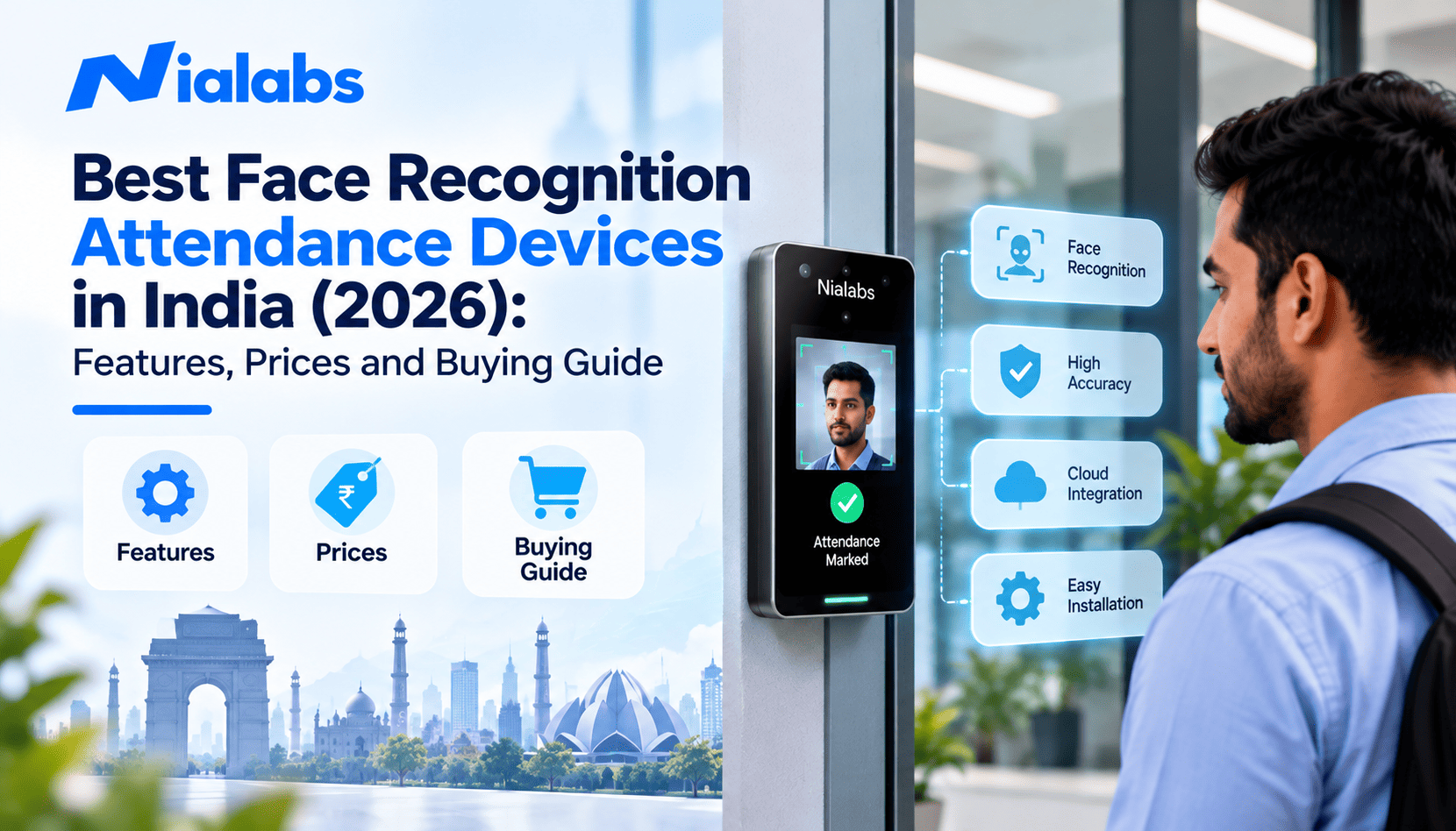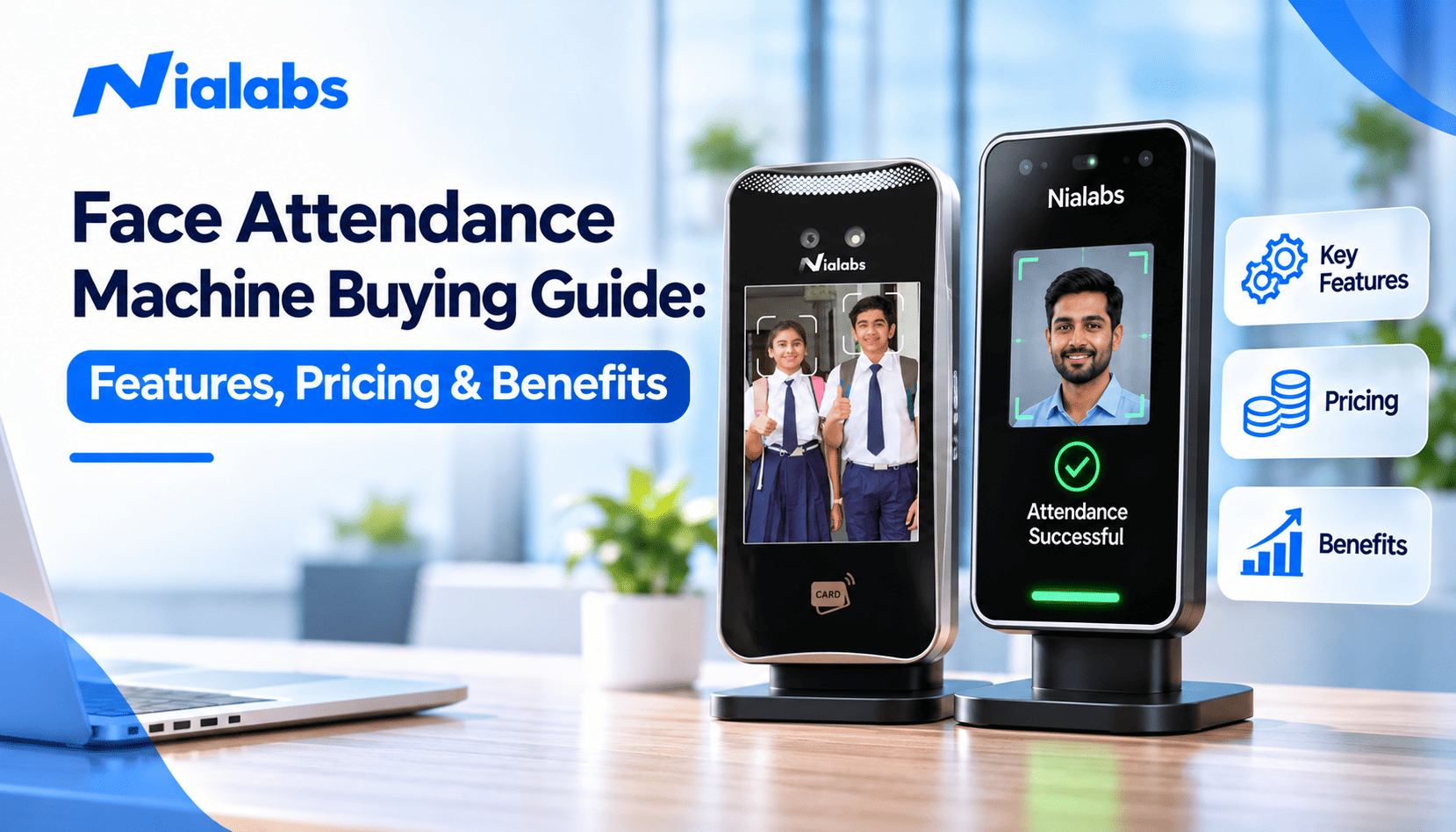

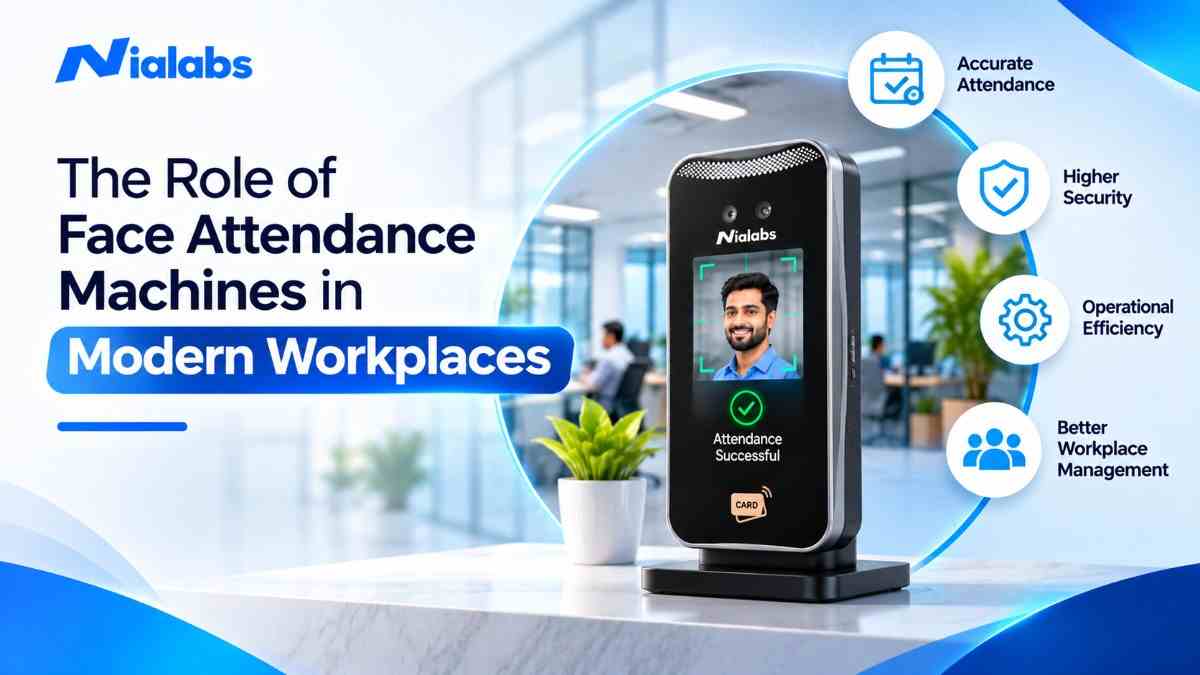
A face attendance machine identifies employees by their face, records time in and time out without any touch, and sends verified data to HR and payroll. In modern workplaces it has become the default upgrade from registers, punch cards and fingerprint scanners because it ends buddy punching, clears shift-change queues in seconds and gives managers live attendance for every branch.
Key Takeaways
-
Face attendance machines verify a live face in under one second and reject photo or video spoofing through liveness detection.
-
They remove proxy attendance, the most common source of attendance fraud in Indian offices, factories and hospitals.
-
Contactless check-in means no shared sensor, no cards to lose and no queue at the gate during shift change.
-
Verified punches flow into HRMS and payroll automatically, which supports the working-hour and overtime records employers must keep under India's Labour Codes (in force since 21 November 2025).
-
Employers storing face data must plan for DPDP Act consent, security and retention duties that apply from May 2027.
What Is a Face Attendance Machine?
A face attendance machine is a biometric device with a camera and an AI model that matches a person's live face against a stored facial template, then logs the date and time of entry or exit. Unlike a fingerprint scanner, the employee only has to look at the device. No touch, card or PIN is needed.
Inside the workplace it does three jobs at once: it proves who arrived, records exactly when they arrived, and shares that record with the systems that calculate pay. That combination is why it now sits at the centre of attendance, payroll and entry security for growing Indian businesses.
Why Modern Workplaces Are Switching to Face Attendance
Workplaces in India have changed faster than their attendance systems. Teams run multiple shifts, companies operate across several cities, and HR teams are expected to close payroll in days, not weeks. Four pressures drive the switch:
-
Proxy attendance is costly. Registers and RFID cards can be signed or swiped by a colleague. Even a few proxy punches a week inflate salary costs and distort overtime.
-
Hygiene and speed at the gate. Shared fingerprint sensors slow down at shift change and fail on worn, wet or dusty fingers, which is common on shop floors and in hospitals.
-
Multi-location visibility. Owners want one live view of who is present at every office, plant, branch or site without waiting for end-of-month Excel files.
-
Stricter record keeping. India's four Labour Codes came into force on 21 November 2025 and require accurate records of working hours and overtime. Machine-verified punches are far easier to defend in an inspection or dispute than handwritten registers.
How a Face Attendance Machine Works at the Workplace Entrance
Every face attendance machine follows the same short cycle, from one-time enrolment to an automatic attendance entry:
-
Enrolment: HR captures each employee's face once, at the device or through a mobile app.
-
Template creation: The AI converts facial features such as eye spacing and jawline into an encrypted mathematical template. The raw photo is not needed for matching.
-
Live capture: At check-in, the camera detects a face at a normal walking distance.
-
Liveness check and matching: The device confirms a real person is present, then compares the live face with stored templates in under a second.
-
Logging and sync: A verified punch is saved with time, device and location, then synced to the cloud dashboard, HRMS and payroll.
If you want the full technical picture, including enrolment, data storage and reporting, read our guide on how biometric attendance works step by step.
8 Benefits of Face Attendance Machines for Employers
1. Ends buddy punching and proxy attendance
Attendance is marked only when the live face matches the enrolled employee. Nobody can sign, swipe or punch for an absent colleague, which directly protects your salary budget.
2. Clears shift-change queues in seconds
Recognition takes under one second per person and works as employees walk up. A factory gate or hospital entrance that takes 15 minutes to clear with a register keeps moving almost continuously with face attendance.
3. Fully contactless and hygienic
No shared sensor means no cross-contamination, which matters in hospitals, food processing units and schools. It also means no failed reads from cuts, dust, oil or worn fingerprints.
4. Accurate, automatic payroll inputs
Late arrivals, early exits, half days and overtime are calculated from verified punches. HR stops re-keying attendance into Excel, and salary disputes drop because every entry has a timestamp.
5. Real-time visibility across branches
Cloud-connected devices give managers a live dashboard of who is in, who is late and who is absent at every location. This is especially useful for chains, multi-plant manufacturers and companies with field offices.
6. Stronger entry security
The same face that marks attendance can open the door. Pairing devices with face-based door access control lets you restrict server rooms, labs, stores and cash areas to approved staff and keep a log of every entry.
7. Audit-ready records
Each punch carries the employee, device, time and location. That trail supports Labour Code working-hour and overtime registers, client billing for contract staff and internal audits.
8. Lower long-term cost of attendance
There are no cards to reprint, no registers to store and far less HR time spent reconciling attendance. Savings from blocked proxy punches and recovered HR hours add up every pay cycle, which is why the investment usually pays back quickly in workplaces with 50 or more employees.
Face Attendance vs Fingerprint vs RFID vs Manual Registers
Face attendance is the only common method that is contactless, proxy-proof and fast at high footfall. Here is how the four options compare in a typical Indian workplace:
|
Factor |
Face attendance |
Fingerprint |
RFID card |
Manual register |
|---|---|---|---|---|
|
Stops proxy attendance |
Yes, with liveness check |
Mostly |
No, cards can be shared |
No |
|
Contactless |
Yes |
No |
Yes |
No |
|
Speed at shift change |
Under 1 second, walk-up |
1 to 3 seconds, retries common |
Fast |
Slow |
|
Works with worn or dusty fingers |
Not affected |
Often fails |
Not affected |
Not affected |
|
Running cost |
Low |
Low |
Card replacement |
Admin time |
|
Payroll integration |
Automatic |
Automatic |
Automatic |
Manual entry |
|
Best for |
Offices, factories, hospitals, schools |
Small offices with low footfall |
Low-security entry |
Very small teams only |
How Different Workplaces Use Face Attendance Machines
Corporate offices and IT companies
Offices use face attendance to track hybrid and flexible schedules, link attendance to leave and payroll in their HRMS, and secure floors and meeting areas. Multi-city companies get one consolidated report instead of separate files from each branch.
Factories and manufacturing plants
Plants run two or three shifts with hundreds of workers crossing the gate at once. Face attendance handles that volume, works with greasy or dusty hands and records contractor attendance accurately for billing. For night shifts, choose a dual-camera model with infrared support, such as the Nialabs NiaFace A90.
Hospitals and healthcare
Doctors, nurses and support staff work rotating 24x7 shifts where hygiene is critical. Contactless face attendance avoids shared sensors and gives administrators a live view of staffing per ward and per shift.
Banks and BFSI branches
Branch networks need tamper-proof attendance and restricted access to cash and record rooms. Face attendance logs both, and head office can monitor every branch from one dashboard.
Schools, colleges and coaching institutes
Institutions use face attendance for teachers and non-teaching staff, and increasingly for students. It removes roll-call time from classes and can notify parents when a student arrives.
Warehouses, retail chains and multi-site teams
Warehouses and stores deal with high staff turnover and temporary workers. Quick mobile or device enrolment, offline punching during network drops and central reporting make face attendance practical across dozens of sites.
Face Attendance and Compliance in India
Face attendance helps with labour compliance but also brings data protection duties. Two laws matter most for employers in 2026:
-
Labour Codes (in force from 21 November 2025): The four codes replaced 29 central labour laws and require employers to maintain records of working hours, overtime and wages. Verified digital punches make those registers accurate and inspection-ready.
-
DPDP Act 2023 and DPDP Rules 2025: The Rules were notified in November 2025 with a phased rollout. Core obligations on notice, consent, security safeguards, breach reporting and data retention apply from May 2027.
Practical checklist for face data:
-
Give employees a clear written notice explaining why face data is collected and how long it is kept.
-
Record consent at enrolment and offer an alternative method for anyone who declines.
-
Store only encrypted templates, restrict admin access and keep data on servers located in India where possible.
-
Delete face templates within a defined period after an employee exits.
This section is general information, not legal advice. Confirm obligations for your state and sector with your legal or compliance team.
How to Roll Out Face Attendance in Your Workplace
-
Map entry points and shifts. Count gates, peak arrivals per minute, lighting conditions and night shifts.
-
Pick the right device class. Match face capacity, camera type, outdoor or indoor rating and access control needs to each entry point. Our buying guide lists the features and price ranges to compare before you buy.
-
Plan connectivity. Decide between cloud sync over Wi-Fi, LAN or 4G and confirm the device stores punches offline during outages.
-
Enrol employees with consent. Capture faces in good light and record DPDP-ready consent at the same time.
-
Configure rules and integrations. Set shifts, grace time, overtime and leave rules, then connect HRMS and payroll.
-
Run in parallel for one cycle. Compare face attendance with the old system for a week or one pay cycle, fix gaps, then switch over fully.
Why teams choose Nialabs: Jaipur-based Nialabs builds AI face attendance devices with liveness detection, under-one-second recognition, cloud and offline modes, and ready integrations with HRMS, payroll and school ERP platforms. The same platform scales from a single office to plants, hospitals and campuses across India.
Explore touchless AI face attendance for offices, factories and institutions, or book a free demo from the same page.
Frequently Asked Questions
What is the role of a face attendance machine in a modern workplace?
A face attendance machine verifies each employee by their face and records check-in and check-out time automatically. In a modern workplace it replaces registers, punch cards and shared fingerprint sensors, stops proxy attendance, and sends verified time data straight to HR and payroll.
How accurate is a face attendance machine?
AI face attendance machines with liveness detection are rated at up to 99.9% recognition accuracy by vendors, with identification in under one second. Real-world accuracy depends on camera quality, lighting at the entrance and how well each employee was enrolled.
Can a face attendance machine stop buddy punching and proxy attendance?
Yes. A face attendance machine only marks attendance when the live face matches the enrolled template, so one employee cannot punch in for another. Liveness detection also rejects photos, videos and printed masks held up to the camera.
Does a face attendance machine work with masks, glasses or in low light?
Most AI face attendance machines recognise employees wearing spectacles and many work with a partially covered face. Low-light performance varies by model: dual-camera devices with infrared support are the right choice for night shifts, basements and warehouse gates.
Face recognition attendance machine office ke liye, cloud wala koi option hai?
Yes. Cloud-connected face attendance machines push every punch to an online dashboard over Wi-Fi, LAN or 4G, so HR can see attendance for every branch in real time. Good devices also store punches offline during a network outage and sync them once the connection returns.
Is employee face data safe and legal under India's DPDP Act?
It can be, if the employer collects face data with clear notice and consent, stores it encrypted, limits access and deletes it when the employee leaves. India's DPDP Rules were notified in November 2025 and the core consent and security obligations apply from May 2027, so employers should set these processes up now.
How much does a face attendance machine cost in India?
A standalone face attendance machine in India typically costs between ₹5,000 and ₹30,000 or more. The price depends on face capacity, camera type, liveness detection, cloud software, access control support and the number of devices across locations.
Which industries use face attendance machines?
Face attendance machines are used in corporate offices, IT companies, factories, hospitals, banks, schools, colleges, coaching institutes, warehouses, retail chains and government offices. They suit any workplace with shift work, high footfall at entry or a history of proxy attendance.
Can face attendance integrate with payroll and HRMS software?
Yes. Modern face attendance machines share verified punch data with HRMS and payroll software through cloud sync or APIs. This removes manual data entry and lets late marks, overtime, leave and salary deductions calculate automatically.
How long does it take to roll out face attendance in an office?
A single-site office with up to a few hundred employees can usually go live within one to two weeks. That covers device installation, employee enrolment, shift rule setup, payroll integration and a short parallel run against the old system.
Conclusion
Face attendance machines have moved from a premium add-on to the standard way modern workplaces record attendance. They stop proxy punches, speed up entry, feed payroll without manual work and create the verified records that India's Labour Codes expect. Roll them out with clear consent and secure storage, and they also put you ahead of DPDP obligations arriving in 2027.