

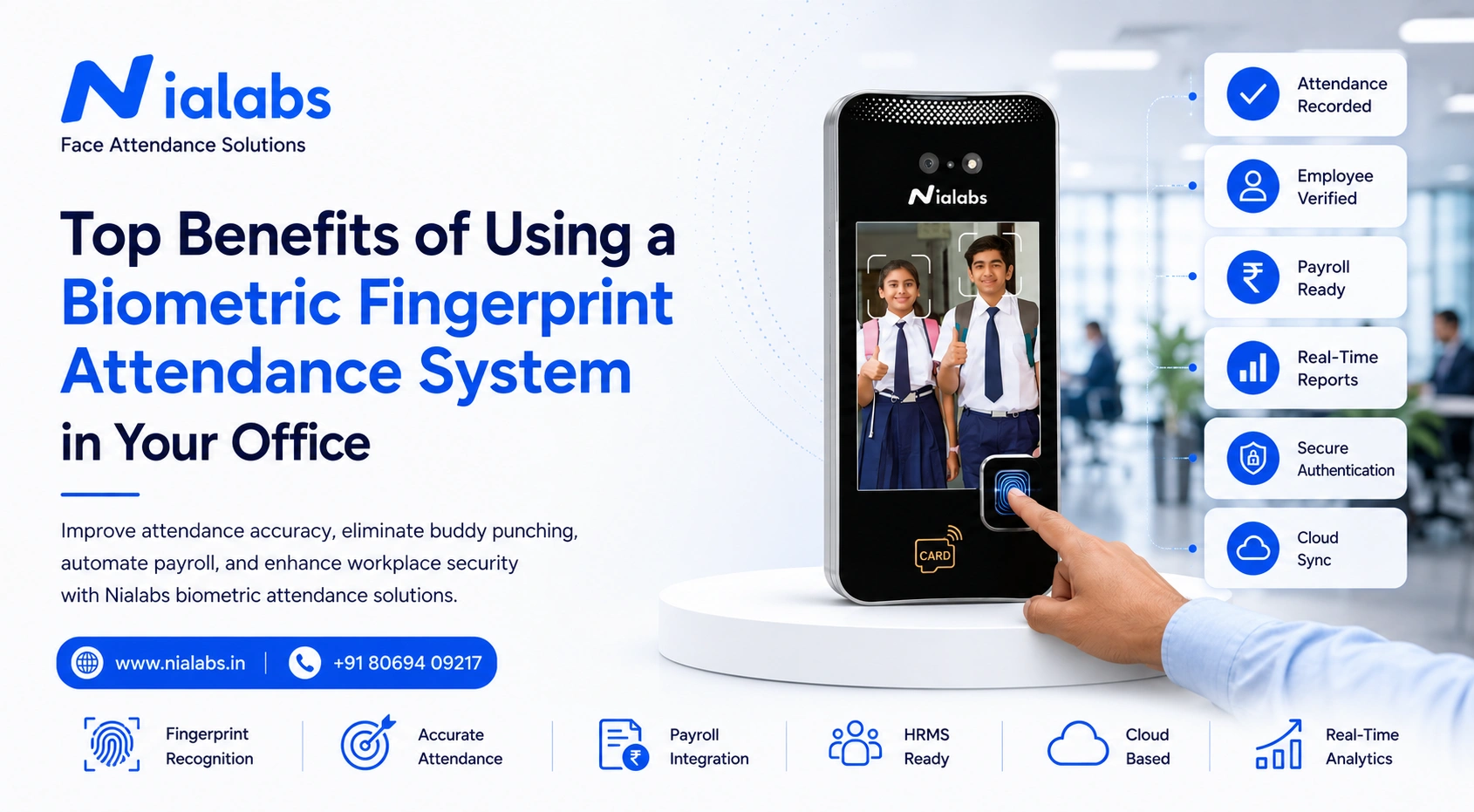
In today's technology-driven world, adopting new technologies to improve our business is a must. Managing the workforce is a hectic task, and an organisation must be equipped with the latest technologies and software to do it effectively. In this management, employee attendance of the employees is a crucial task. Traditional methods of attendance are no longer reliable and are outdated. Biometric attendance systems are much better than traditional methods and provide more accuracy and security. Nialabs is here to provide such accuracy and security.
Biometric Machines
Biometric machines are security identification systems and authentication devices that use an individual's unique physical and biological traits to verify their identity. They record and manage an employee's attendance, which helps in reducing labour costs, increasing the productivity of the company, and efficiently tracking employee data for better growth.
Types of Biometric Devices
Fingerprint Scanner by Nialabs
The most used feature is the fingerprint attendance machine, which marks the attendance of an employee. These machines use physical features such as the friction ridges of a finger or thumb. The impression is captured and used to identify the employee by matching it with an already stored template.
A fingerprint is an impression left by these friction ridges. It is detailed, unique, difficult to alter, and durable over an individual's life. Fingerprints have long been used for identity verification, from criminal records to voting and signatures, and today they are used to mark attendance in offices and schools.
Facial Recognition System by Nialabs
Attendance is marked by detecting the face of an employee. The technology maps and analyses specific points on the face and matches them against an enrolled template to mark attendance without any physical contact.
Iris Scanner
It is the most secure biometric attendance method, scanning the retina and the coloured part of the eye. With the help of eye scanning, recognition is done, and attendance is marked with very high accuracy.
Voice Recognition
Another physical feature used for identification is an employee's voice. It analyses vocal characteristics for marking attendance. It is less commonly used but remains a niche feature of some biometric attendance systems.
Benefits of a Biometric Fingerprint Attendance System
Accurate Tracking
A fingerprint attendance system helps in the precise recording of employee attendance. It calculates the exact timing of arrival and departure for every employee. Even five minutes of daily lateness, left unchecked, can reduce company productivity over time.
Eliminates Buddy Punching
Buddy punching is a major problem where card or register-based systems are used for marking attendance: an employee who has not come to the office gets their attendance marked by a colleague instead. A fingerprint attendance system removes this risk entirely, since a fingerprint cannot be shared, borrowed or duplicated at the terminal.
Increases Security
A fingerprint attendance system strengthens the overall security of an organisation. Only employees who work there can enter the premises, keeping unauthorised individuals out. Pairing it with a full access control system extends this protection to every door and gate, not just the attendance register.
Cost-Effectiveness
Accurate workforce management reduces the extra costs that erode a company's balance sheet. Integrating fingerprint attendance with other software improves administration and lowers overhead. No manual labour is required to keep attendance records, and the one-time device cost replaces the recurring cost of printed punch cards.
Convenience
The biometric fingerprint attendance system is user-friendly and provides quick clock-in and clock-out. It is easy to install, requires minimal training, and smooths the transition away from traditional methods, which is why employees generally prefer it.
Compliance with Labour Laws
Keeping accurate attendance records and data is mandatory for every organisation under Indian labour law. A biometric fingerprint attendance system helps maintain the compliant, auditable records regulators expect.
Enhanced Reporting
A biometric fingerprint attendance system is a real-time monitoring system that keeps track of attendance and provides accurate data. It makes the work of HR officials easier when assessing employee records, and attendance patterns can be studied to improve overall productivity.
Integrates with Payroll Software
Integrating a biometric fingerprint attendance system with payroll software lets you calculate salaries directly from verified attendance data, factoring in overtime, leave and deductions automatically. For more on how this improves payroll accuracy, see our dedicated guide.
Eco-Friendly Solution
Environmental impact is a growing concern worldwide, and plastic is a major contributor. Fingerprint attendance devices remove the need for plastic punch cards entirely, making them a small but genuine step toward a lower-waste workplace.
Improves Employee Accountability
A fingerprint attendance system increases employee accountability across an organisation, since attendance can no longer be manipulated the way it can with a proxy attendance scheme. Employees are less likely to take unapproved leave or skip work without valid reason, which strengthens overall work culture.
Conclusion
Adopting Nialabs' fingerprint attendance solutions can meaningfully increase the efficiency and productivity of your organisation. Real-time monitoring, accuracy, security, convenience and reliable tracking make outdated attendance systems a genuine competitive disadvantage in a workplace that is only getting more digital.
Frequently Asked Questions
1. What is a biometric fingerprint attendance system?
A biometric fingerprint attendance system records employee attendance by scanning and verifying unique fingerprint patterns. It provides accurate attendance records, reduces manual errors, and prevents unauthorised attendance without relying on cards or registers.
2. How does a biometric fingerprint attendance system work?
The system captures an employee's fingerprint, converts it into an encrypted biometric template, and compares it with stored records at the terminal. Once verified, attendance is recorded instantly with the exact date and time.
3. What are the benefits of using a fingerprint attendance system in an office?
Fingerprint attendance systems improve attendance accuracy, eliminate buddy punching, automate payroll calculations, strengthen workplace security, reduce administrative work, and provide real-time attendance reports for HR teams.
4. Is a fingerprint attendance system better than manual attendance?
Yes. Fingerprint attendance systems are faster, more accurate and more secure than manual registers or punch cards. They reduce attendance fraud and generate reliable, audit-ready reports for HR and payroll teams.
5. Can fingerprint attendance systems integrate with HRMS and payroll software?
Yes. Modern biometric fingerprint attendance systems integrate with HRMS and payroll software to automate salary calculations, overtime tracking, leave management and attendance reporting without manual data entry.
6. Which businesses should use a biometric fingerprint attendance system?
Fingerprint attendance systems suit corporate offices, factories, warehouses, retail stores, hospitals, educational institutions, hotels, and government organisations that need secure, accurate attendance management.
7. Are fingerprint attendance systems secure?
Yes. Most modern systems store encrypted biometric templates rather than raw fingerprint images, which protects employee data while still providing reliable identity verification at the terminal.
