1. Introduction
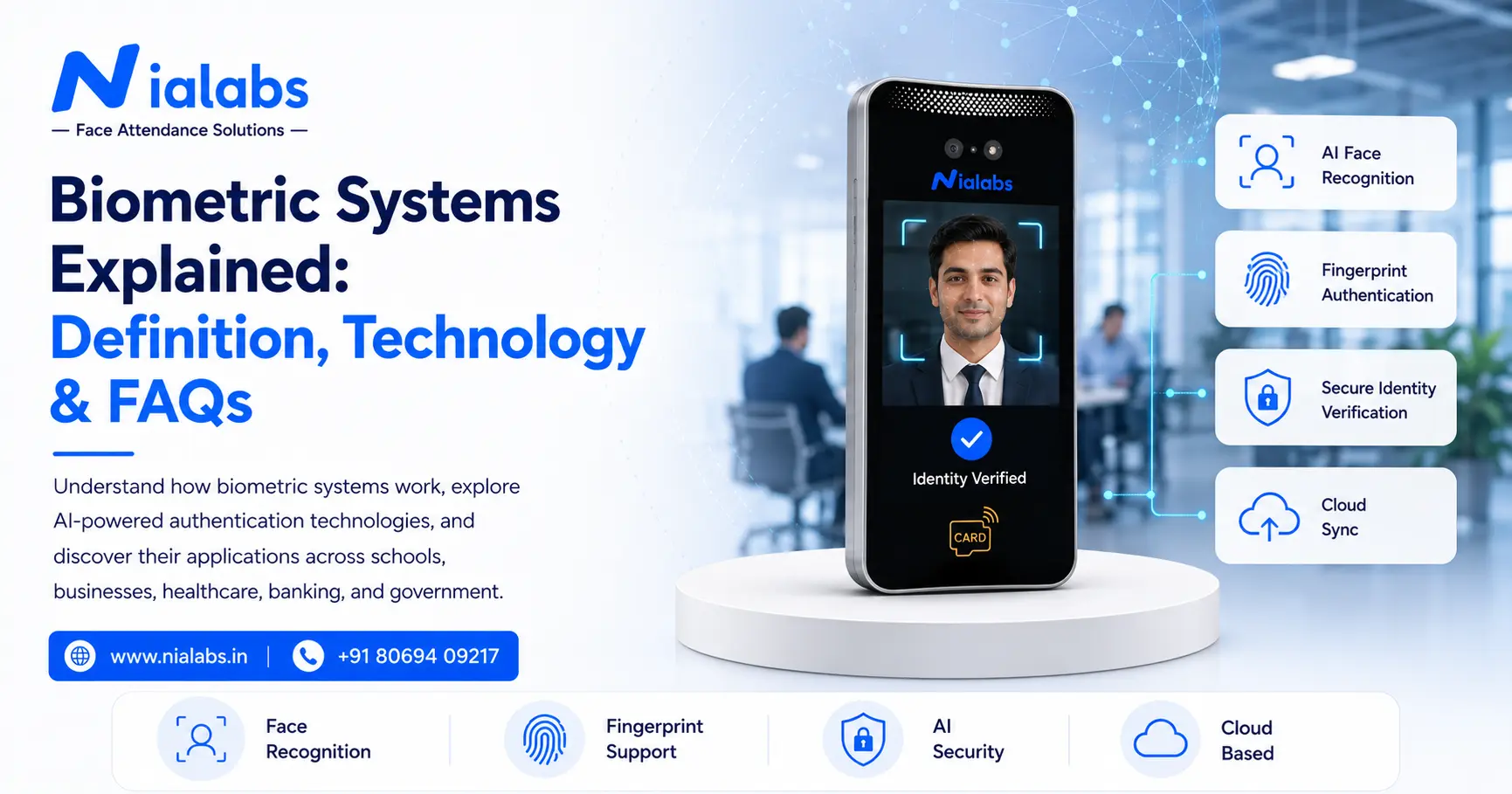
Biometric systems are computer-based automation techniques for an individual’s recognition or verification through their distinct physical or behavioural characteristics. In an increasingly digital environment, the necessity of securing these accounts has made biometric systems a cornerstone of authentication – from unlocking a phone to controlling entry at the airport.
At Nialabs, we have developed biometric authentication systems that are fast and accurate, developed for scale to all enterprises, government offices, schools, universities, etc., to identify authorized individuals confidently.
2. What is a Biometric System?
Biometric systems uniquely recognize an individual based on certain physiological traits that can be recorded, compared, and classified. Biometric traits are inherently more difficult to forget or lose, like a password, than they are to be stolen, like a security card.
Types of biometric characteristics:
-
Face Recognitionv
-
Fingerprint Recognition
-
Patterns of the iris and retina
-
Palmprints and vein patterns
-
Voice and gait patterns
Introduction to Automated Biometric Identification System (ABIS)
ABIS stands for 'automated biometrics identification system' and is considered a large-scale platform capable of registering, storing, and comparing biometric information for millions of records.
3. How Does a Biometric System Work?
Here is the modern process flow for a biometric system:
-
Data collection (biometric input)
Your biometrics are scanned (by a camera, fingerprint scanner, or an iris scanner).
-
Feature extraction using algorithms
The input data is analyzed to locate unique points. A face recognition attendance system may look for unique features around the nose or eyes, while a fingerprint scanner may look at ridgelines.
-
Creation of biometric templates
These points or other distinctive characteristics are converted into binary form for storage as a compact digital "template", and the system adds it to a database.
-
Matching with the database
The template is then matched against the template on file.
-
Speed and scalability of modern systems
A second scan of the biometric is taken, and the probability that the scan matches the template is determined within milliseconds. Smart technologies and neural networks have improved system speed to allow the matching of thousands of records per second.
4. Performance Metrics of Biometric Systems
There are three main performance measures for a biometric system's working process:
4.1 False Rejection Rate (FRR)
This is the proportion of valid users who are incorrectly denied access.
Result: Users are annoyed, and processes are slowed. As a result, high FRR may be a very serious problem at busy locations (e.g., border control points).
4.2 False Acceptance Rate (FAR)
It is the measure that shows the rate at which an intruder is authenticated. The security implications of a high FAR are severe. A law enforcement agency or any access control system will prioritize minimizing the FAR.
4.3 Equal Error Rate (EER)
It is the point where FRR is the same as FAR. Low EER means a highly biometric system accuracy.
Effect: The EER is the normal criterion for comparing biometrics; a lower EER means a better system.
5. Why Are Biometric Systems Used?
-
Historical background (19th-century use in policing)
Biometrics is not new to the criminal justice system; Alphonse Bertillon, even in the late 1800s, was using anthropometric measurements as an official method of criminal identification.
-
Limitations of manual systems
For generations, the traditional identification processes- from paper records and physical documentation to live verification- have been characterized by time-consuming, error-prone, and fraudulent techniques. The use of biometric systems will address each of these issues.
-
Role of AI and neural networks
With new AI systems, biometric identification systems are capable of providing levels of speed, accuracy, and reliability that previously were inconceivable.
-
Advantages:
Speed
Identifying an individual can be instantaneous. AI models are even capable of recognizing people on live video, a process that could previously take hours.
Accuracy
The ability to train AI on very large, diverse data sets means it does not have some of the inaccuracies and biases associated with older systems.
Reliability
The automation of the verification process removed human limitations and the fatigue of using human identifiers.
6. Where Are Biometric Systems Used?
-
Government applications
Biometric technologies are utilized in national ID programmes, passport issuance, e-visa systems, and airports and border control to verify the identities of both citizens and travellers on a large scale.
-
Law enforcement
Biometric databases are utilized by law enforcement in identifying criminal suspects, comparing crime scene data against criminal files, and reinvestigating previously inactive or cold case investigations through the biometric attendance machine and face recognition capabilities offered by the database.
-
Enterprises and businesses
Biometrics are employed by businesses to restrict unauthorized employees from entering sensitive areas, instead of using time cards, and to prevent "buddy punching".
-
Everyday applications (smartphones, banking, access control)
Smartphones and the convenience of mobile banking and payment apps have become the norm for instant, safe access using finger and face recognition systems.
7. Role of Biometric Systems in Criminal Investigations
In the present day, technology has been adapted to speed up the accuracy of the use of forensics and biometric technology.
Identification Tools:
-
Face Recognition:
Search for matches for individuals in surveillance footage or photographs in criminal databases.
-
Fingerprint & Palmprint Identification:
Compare crime scene prints against databases of enrolled records within a second.
Video Surveillance Integration:
By performing real-time biometric matching against live video feeds, subjects can be proactively identified in public places such as airports and transit centres and at public events.
Case & Evidence Management:
A modern ABIS may have integrated case management systems that will help to manage biometric evidence, identify cases with connections to each other, and receive matches that may not have been previously identified.
8. Biometric Systems in Trusted Enrollment
Enrolment is the backbone of any biometric attendance system. Getting good quality enrolment at the source is key to any subsequent performance.
Registration methods:
-
Self-service kiosks:
Users will register themselves without operator assistance by following simple on-screen prompts.
-
Assisted enrolment:
Operators trained for remote/mobile or support services enrolment assist the user in enrolment.
Technologies used:
-
OCR (Optical Character Recognition)
Reads and authenticates the identity document automatically.
-
Face matching
Compares a live facial image against that held on an identity document to establish identity.
-
Liveness detection
Preventing fraud through spoofing, verifying that a live person is present
-
Document verification
Analyzing the document for authenticity using AI
Centralized biometric database:
Once you enrol, all of your enrolled records are stored in one secure, centrally managed ABIS. It’s built to perform quick and accurate matches across the channels, regardless of whether you are calling it from a web app, a mobile app, or from a device in the field.
9. Advantages of Biometric Systems
-
Time efficiency
Each one is verified in a split second, saving long hours spent verifying each manually.
-
High accuracy
An accuracy of above 99.9% can be reached with modern AI models, but only in a very well-controlled environment.
-
Reduced fraud
Impossible to steal or duplicate specific biometric traits.
-
Ease of use
No need to remember any passwords, carry any cards, or memorize any PINs – your identity will always be with you.
10. Challenges and Limitations
-
Privacy issues
In addition, biometric data collection poses some issues, including the issues of consent, surveillance, and civil liberties.
-
Data security risks
Biometric data security will always be a tempting target. A breach in the database is unfixable by simply changing a password.
-
False matches and errors
No system will be perfectly accurate; environmental factors and unique circumstances can lead to identification inaccuracies.
-
Dependence on technology
A down system or network failure can compromise identity-verification processes.
Nialabs addresses all these with a privacy-by-design approach, end-to-end encryption, and thorough testing across diverse demographic ranges.
11. Conclusion
Biometrics has changed from being primarily a tool for forensic investigation to becoming one used by governments, businesses, and for individual use. AI in biometric systems will increase in speed and security.
Nialabs is leading this change by offering biometric system technology that is dependable, scalable, and engineered for privacy. Whether it be for a national ID or a corporate access control system, our technology is ready for what comes next.
12. FAQ
-
1. What is a biometric system?
A biometric system identifies or verifies a person's identity using unique physical or behavioural characteristics such as fingerprints, facial features, iris patterns, voice, or palm veins. These systems provide secure and accurate authentication across many industries.
-
2. How does a biometric system work?
A biometric system captures a biometric trait, extracts unique features, converts them into a secure digital template, and compares that template with stored records to verify or identify an individual within seconds.
3. What are the different types of biometric systems?
Common biometric systems include:
- Face recognition
- Fingerprint recognition
- Iris recognition
- Retina scanning
- Palm vein recognition
- Voice recognition
- Behavioural biometrics such as gait and typing patterns.
-
4. Where are biometric systems used?
Biometric systems are used in government ID programs, airports, border control, schools, offices, factories, hospitals, banks, smartphones, and access control systems to improve security and automate identity verification
-
5. What are the advantages of biometric systems?
Key benefits include the following:
- Fast authentication
- High accuracy
- Reduced fraud
- Contactless verification
- Better security
- Improved user convenience
- Integration with HRMS, ERP, and access control platforms.
-
6. Are biometric systems secure?
Modern biometric systems use AI, encryption, liveness detection, and anti-spoofing technologies to protect biometric data and reduce unauthorized access. However, organizations should also implement strong privacy and data protection practices.