Quick answer: Proxy attendance is stopped by switching from possession-based verification to identity-based verification. Registers, ID cards and QR codes only confirm that a card or code was presented, not who presented it. The most effective single method is a face recognition attendance system with liveness detection, which verifies the actual person at the moment of check-in. Layering geofencing and audit trails on top raises accountability further.
In colleges, offices and coaching centres that track attendance closely, one person marking attendance for another is a routine problem. A student answers roll call for an absent friend. A colleague punches in a second card. The record looks complete; the room is half empty.
The reason this keeps happening is structural. Traditional attendance methods verify a register signature, a card or a code never the human being. As organisations move to digital attendance, fake attendance prevention has become the deciding factor in whether records can be trusted for payroll, eligibility and compliance.
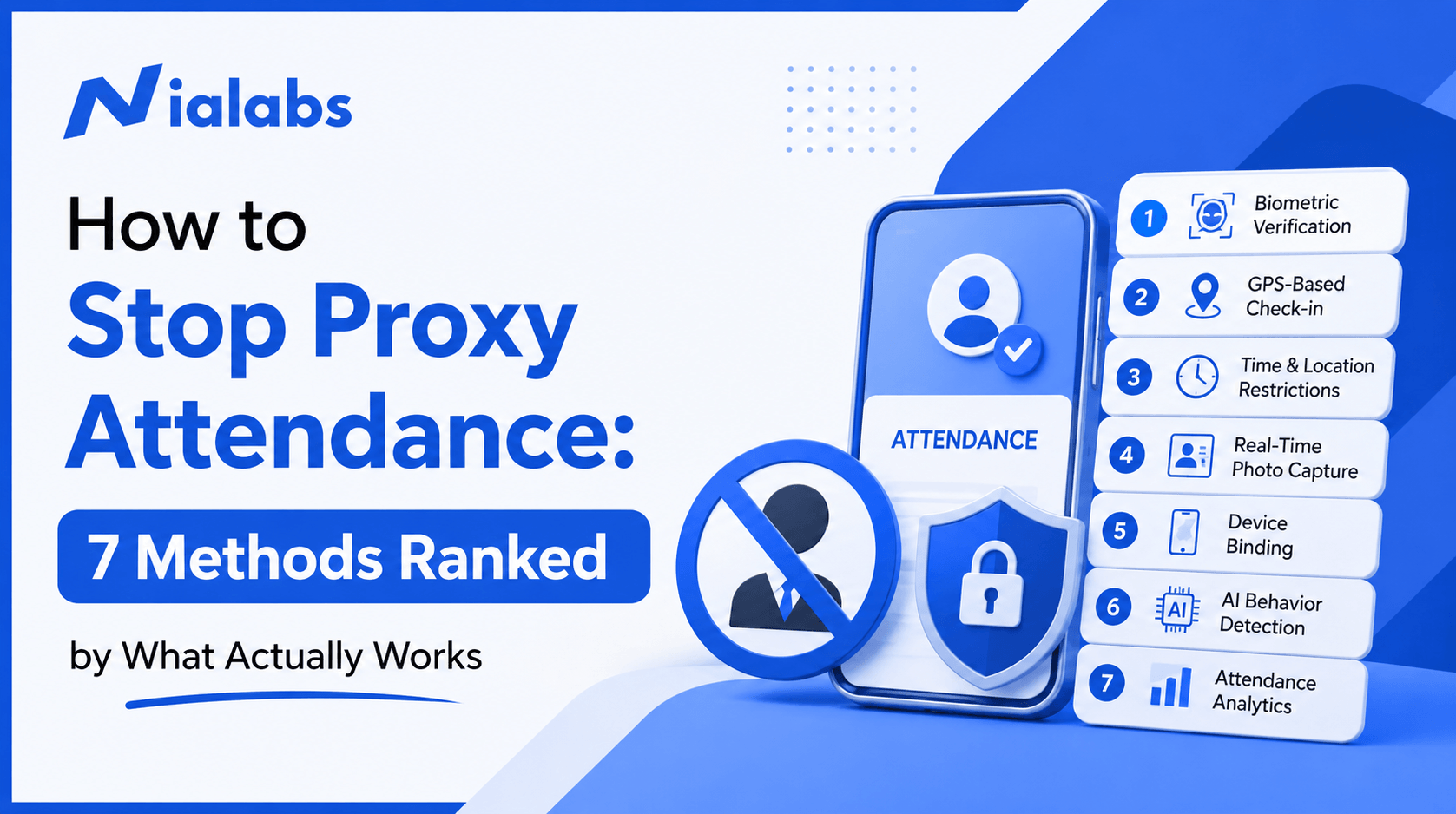
So what actually works? The answer depends on your environment, budget and required security level. Below are seven methods ranked on accuracy, spoof resistance, cost, ease of use and scalability.
What Is Proxy Attendance?
Proxy attendance is when one person marks attendance on behalf of another who is not physically present. In colleges it appears as roll-call substitution or signing a register for an absent classmate. In workplaces the same behaviour is called buddy punching and one employee clocking in for another.
Manual attendance is the most exposed, because no identity check happens at all. Cards and QR codes narrow the gap but do not close it: they authenticate the object, not the owner.
The downstream costs are consistent across sectors:
-
Inaccurate attendance and eligibility records
-
Payroll leakage from hours never worked
-
Disciplinary disputes with no reliable evidence
-
Weakened accountability across departments
That is why two questions matter, not one: how to prevent proxy attendance at the point of check-in, and how to detect proxy attendance after it has already occurred.
How We Ranked These Methods
Each method is scored on five practical criteria:
|
Criterion |
What it measures |
|---|---|
|
Accuracy |
How reliably the method confirms user identity |
|
Spoof resistance |
How hard the mechanism is to fool |
|
Cost |
Hardware, software and rollout investment |
|
Ease of use |
Day-to-day simplicity for users and administrators |
|
Scalability |
Performance as headcount and locations grow |
The ranking reflects real-world suitability not how often a technology appears in attendance product listicles.
7 Methods to Stop Proxy Attendance (Ranked)
1. Biometric Attendance (Fingerprint or Face Recognition)
Verdict: the strongest all-round method for preventing proxy attendance.
Biometric attendance verifies a physical trait that belongs to one person and cannot be handed over. That single property is what separates it from every card- and code-based system.
A face recognition attendance system captures and matches the face presented at the terminal before the attendance record is written. Because the credential is the person, substituting someone else is far harder, which is why face recognition is the primary route to buddy punching prevention.
Fingerprint systems offer equally strong identity verification but require physical contact and clean, readable prints. Face recognition is contactless, faster at peak entry times and better suited to schools, colleges, offices and large enterprises.
-
Pros: strong identity verification; credential cannot be shared; contactless options; scales across sites
-
Cons: higher upfront investment; accuracy depends on correct enrolment quality
-
Cost: medium to high
-
Best for: schools, colleges, offices, factories, multi-site organisations
2. Geofencing and Location-Based Check-ins
Verdict: essential for field and remote teams but pair it with an identity check.
GPS-based attendance confirms that a check-in happened inside an approved geographic boundary. Geofencing draws an invisible perimeter around an office, campus, site or project area; check-ins attempted outside it are rejected.
This solves the where problem cleanly for sales teams, field engineers, delivery staff and distributed workforces. It does not solve the who problem. Location alone cannot tell you whether the right person is holding the phone, so geofencing should be combined with face verification for meaningful attendance fraud prevention.
-
Pros: built for field teams; supports multiple locations; cuts supervisory overhead
-
Cons: GPS accuracy varies indoors and in dense areas; no identity verification
-
Cost: medium
-
Best for: remote, field and multi-location teams
3. QR Codes with Time-Bound Refresh
Verdict: cheap and easy but not sufficient on its own.
QR-based attendance replaces the paper register without any biometric hardware. An administrator or faculty member displays a code that refreshes on a timer, and scans are only accepted inside the validity window.
A rotating code is a clear improvement on a static one, because a screenshot expires within seconds. The underlying limitation remains: the system validates a scan, not a person. A code shared to a group chat still produces attendance for someone sitting elsewhere unless the validity window is short and the check is combined with location verification, device binding or face authentication.
-
Pros: minimal cost; fast to deploy; no special hardware
-
Cons: codes and devices can be shared; weak individual verification
-
Cost: low
-
Best for: coaching institutes, classrooms, small businesses
4. RFID and NFC Card Systems
Verdict: fast at the door, but card sharing is a real weakness.
RFID and NFC systems record attendance by reading a unique ID stored on a registered card, tag or device. They are considerably faster than sign-in registers and perform well at busy entry points where throughput matters.
The drawback is inherent to the design: the reader authenticates the card, not the cardholder. A student can hand their card to a friend and both are marked present. RFID and NFC remain excellent for access control and movement logging, but need a second identity factor before they can be trusted as an anti-proxy measure.
-
Pros: quick throughput; inexpensive; familiar to users
-
Cons: cards can be lost, cloned or passed on
-
Cost: low to medium
-
Best for: schools, universities, offices, factories
5. AI-Based Face Liveness Detection (Anti-Spoofing)
Verdict: the security layer that makes face recognition genuinely hard to defeat.
Face recognition establishes who is at the camera. Liveness detection establishes that it is a live human and not a photo, a video replay or a mask the class of attacks known as presentation attacks.
Adding liveness detection converts a face-matching system into a proxy attendance system that resists deliberate, prepared spoofing rather than only casual substitution. For organisations that need the highest assurance, liveness detection plus location verification plus audit trails is the strongest available combination.
-
Pros: resistant to photo and video spoofing; contactless; ideal for digital attendance management
-
Cons: higher cost; requires compatible cameras and software
-
Cost: medium to high
-
Best for: security-conscious schools, colleges and enterprises
6. Random Roll Call and Surprise Attendance Checks
Verdict: free and useful as a deterrent but it does not scale.
Unannounced checks work on probability. Because nobody can predict when verification will happen, the expected cost of arranging a proxy rises. Faculty can call names mid-lecture; managers can run spot checks on the floor.
The method depends entirely on human observation, which makes it inconsistent and labour-intensive. It is a supplement to a verification system, never a replacement for one.
-
Pros: zero cost; no technology required; immediate to implement
-
Cons: inconsistent; time-consuming; unworkable at scale
-
Cost: free
-
Best for: small classrooms and small teams
7. Attendance Software with Audit Trails and Anomaly Flags
Verdict: a strong detection layer, not an identity solution.
Smart attendance systems log every record with a timestamp, device identifier, location and correction history. That log is what makes proxy attendance visible after the fact.
Supervisors can flag patterns that manual review would never surface: repeated manual corrections for the same person, check-ins from an unfamiliar device, or entries that cluster at improbable times. This is the practical answer to how to detect proxy attendance retrospectively.
Audit trails cannot prevent a proxy on their own and they only record what the authentication layer accepted. Their value is realised when they sit on top of biometric or location-based verification.
-
Pros: complete traceability; strong reporting; supports investigations
-
Cons: does not verify identity; requires correct configuration and review discipline
-
Cost: low to medium
-
Best for: organisations already running a digital attendance system
Comparison Table: Effectiveness vs Cost vs Ease
|
Rank |
Method |
Effectiveness |
Cost |
Verifies Identity? |
Best For |
|---|---|---|---|---|---|
|
1 |
Biometric attendance |
Very high |
Medium–high |
Yes |
Schools, colleges, offices |
|
2 |
GPS + geofencing |
High |
Medium |
No (location only) |
Field and remote teams |
|
3 |
Dynamic QR codes |
Moderate |
Low |
No |
Coaching institutes, classrooms |
|
4 |
RFID / NFC |
Moderate |
Low–medium |
No (card only) |
Offices, institutions |
|
5 |
Face liveness detection |
Very high |
Medium–high |
Yes |
High-security environments |
|
6 |
Random attendance checks |
Low–moderate |
Free |
Yes (manual) |
Small teams and classes |
|
7 |
Audit trails and alerts |
Moderate |
Low–medium |
No (detection only) |
Existing digital attendance users |
Which Method Should You Choose?
For colleges and universities
For proxy attendance in colleges, biometric face recognition is the strongest option because it binds the attendance record directly to the student and no register, no card, no shared QR code. Institutions running multiple departments and rooms benefit from a central attendance system for schools and colleges that consolidates records across the campus.
For corporate offices
A biometric attendance system handles proxy attendance in offices for fixed-location staff. Organisations with several branches or a mobile workforce should combine face recognition with geofencing so that both identity and location are confirmed at check-in.
For remote and field teams
Where staff move between sites, GPS and geofencing provide the location layer and face verification provides the identity layer. Together they give reasonable confidence that the assigned employee checked in at the correct place.
Organisations that transport students or staff can extend the same principle to vehicles with a dedicated bus attendance system.
Frequently Asked Questions
Is proxy attendance illegal?
Proxy attendance is generally not a criminal offence in itself, but it usually breaches academic regulations, employment terms or contractual obligations. Where it results in payment for hours not worked, it can escalate into a fraud or misconduct matter. Consequences depend on the organisation, the circumstances and applicable local law.
Can biometric attendance be faked?
Any attendance technology can be attacked, but biometrics raise the difficulty substantially. Basic face recognition can be targeted with photos or video replays; adding liveness detection defeats most of those attempts. Combining liveness detection, geofencing and audit trails makes casual proxy attendance impractical.
What is the cheapest way to stop proxy attendance?
Manual spot checks cost nothing but demand constant supervision and do not scale. Dynamic QR attendance is the cheapest digital option, though it verifies the scan rather than the person. Biometric verification costs more upfront and is the only category that confirms identity directly.
Does GPS attendance work without internet?
In many systems, yes. Attendance apps commonly cache the check-in and its location on the device and sync to the cloud once connectivity returns. Exact behaviour depends on the specific system, so confirm offline support before deployment.
What is the difference between proxy attendance and buddy punching?
They describe the same behaviour in different settings. Proxy attendance is the term used in schools and colleges; buddy punching is the workplace equivalent, where one employee clocks in or out for another. Both stem from the same root cause: a system that verifies a credential instead of a person.
Conclusion
The single most important step in attendance fraud prevention is abandoning verification methods that rely on a register, card, QR code or device alone. Each of those confirms possession, and possession transfers easily.
Face recognition with liveness detection is the strongest authentication mechanism available for everyday attendance, and it becomes considerably harder to defeat when paired with GPS geofencing and audit trails. Organisations evaluating hardware options can review leading biometric device manufacturers in India before shortlisting.
If your organisation is asking how to stop proxy attendance, the practical path is layered: verify identity at check-in, verify location where relevant, and keep an auditable record of both.
Explore Nialabs biometric attendance system built to automate attendance and eliminate proxy marking.