
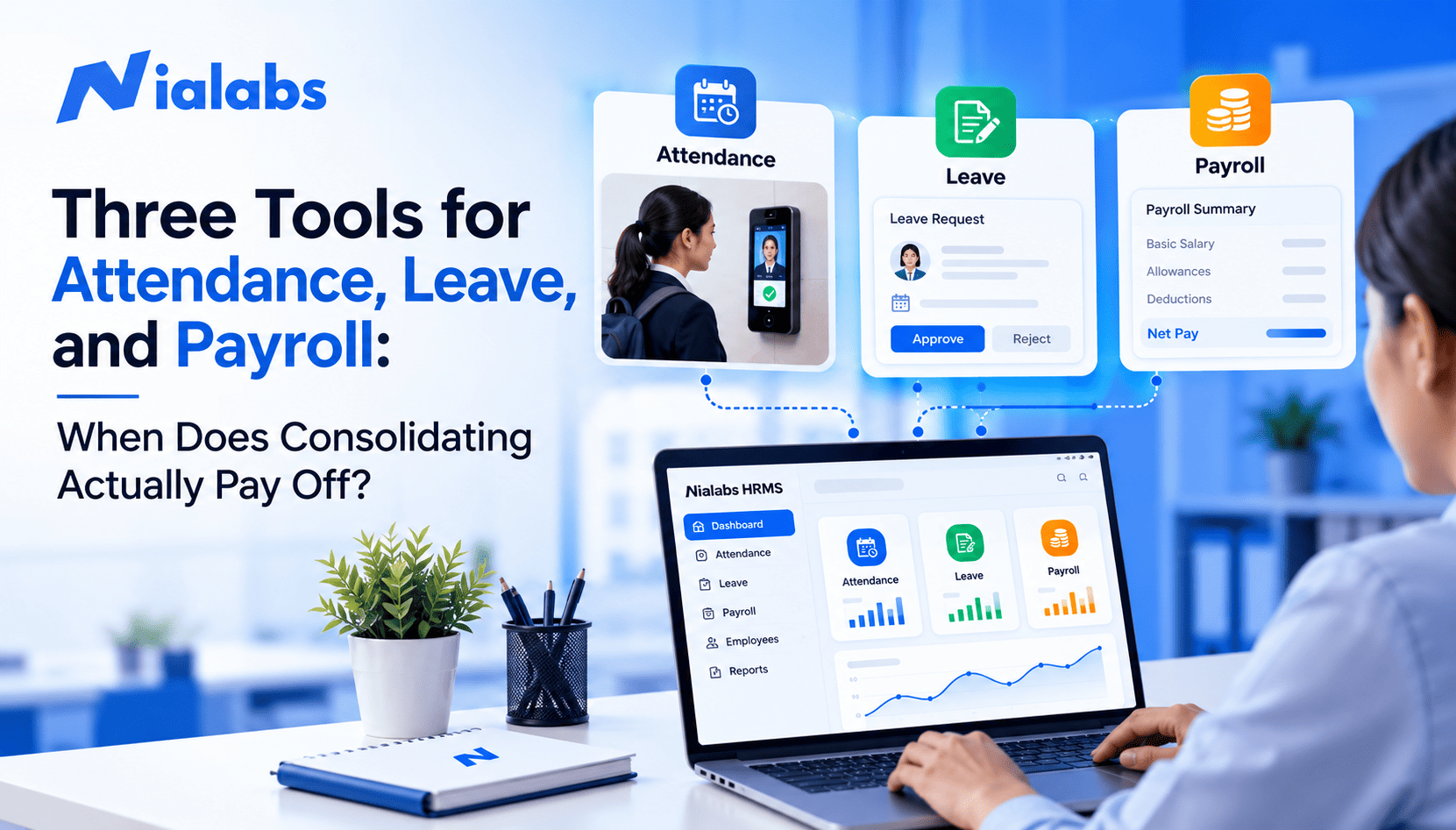
Most companies record employee attendance, leave, and payroll in three distinct software systems. If a company is small and has only a handful of employees, this isn’t much of an issue. But as you expand, managing three systems adds to the workload.
You may need to export attendance, verify leave, and check payroll input before paying salaries. This leads to the question: when does an HR system really make sense?
It depends on the size of your HR workforce, the workload of the HR team, the number of locations your company has, and the degree to which your existing attendance systems demand the transfer of data by users.
Why Do Companies Use Separate Tools for Attendance, Leave and Payroll?
Each employee group has different HR requirements. Attendance, pay, and leave cover each of those.
The employee sign-in tracking and attendance and payroll software works on employee sign-in, their hours, shifts, late arrivals, strikes, leave, and overtime. The leave management system handles leave requests and leave approvals, leave balance, and holidays.
The payroll application uses leave balance and attendance information to start processing salary.
Using different tools isn't the problem. The challenge lies in repeating the process of transferring data between those tools. For example, an HR person might have to export attendance data on a monthly basis, run it with approved leave, check OT, and load the data into the payroll software.
Where Do Separate Systems Start Creating Problems?
Attendance Data Has to Be Transferred
HR may have to export the attendance file and reformat it for payroll if payroll does not process it directly.
With each manual transfer, there is now an additional step and an increased risk of data entry errors or omissions.
Leave and Attendance Records May Not Match
The employee has an approved leave entry on one system but is recorded as absent on the attendance system.
Unfortunately, if they are not linked, this is where HR will need to check the data and make amendments to the entries before payroll is run.
Payroll Processing Takes More Time
Payroll teams require reliable data for the working days, absence data, overtime, and other attendance-related data.
HR has to work harder to compare and cross-reference their data if it exists across multiple applications.
Multiple Employee Databases Create More Work
It may result in data duplication by saving the same employee data to multiple locations.
If an employee is transferred to another department, location, working hours, etc., the information may have to be updated in several systems.
When Do Three Separate Tools Still Make Sense?
Consolidation is not necessarily always the right solution.
Three separate tools might still work well when:
· The company has a small workforce
· Attendance requirements are straightforward
· Payroll requires few attendance-related inputs
· Existing systems already integrate properly
· HR spends very little time reconciling data
· Current software meets the organization’s requirements
Replacing existing systems might not be worthwhile if you can depend on those systems, requiring only a small amount of manual input.
When Does Consolidating Start Paying off?
The requirement for consolidation tends to be more evident when HR processes become more sophisticated.
Your Workforce is Growing
More personnel: More timesheets, more leave forms, more edits, more pay inputs. A method that is manageable with few employees can be hard to control when the number of employees rises.
You Have Multiple Locations
Managing attendance across the various branches, offices, plants, or other workplaces can impose extra scheduling demands. An employee attendance management system allows the HR team to get attendance data from all locations on one platform.
You Manage Shifts and Overtime
Shift-based organisations tend to have to deal with working hours, overtime, late arrivals, and various types of work hours.
Reconciliation is even more important when this data has to transfer between different systems.
Payroll Requires Frequent Corrections
If payroll teams frequently notice errors with attendance, leave, or overtime data, the problem could lie with how the data flows between systems.
Attendance data integration with a current HRMS and payroll integration can further alleviate some of this reconciliation.
HR Spends Too Much Time on Month-End Processing
Payroll software processing at month-end should not involve HR teams spending hours just matching spreadsheets, downloading files, and ensuring the right data set.
If reconciliation is a regular task for your team, it could be time to look into a more integrated solution.
What does it actually change to have consolidation of Attendance, Leave & Payroll?
A consolidation’s major advantage is not just the availability of a single login. It is for a better, smoother flow of employee data.
A connected workflow can look like:
Employee > Attendance > Leave > Payroll
Remaining days of work can be noted, and approved leave can be considered in conjunction with attendance, then passed on to the payroll system.
But make sure to check how integrated the systems are; it might be that some software has multiple separate modules, and that transferring data will still be needed manually.
How do you know whether a Consolidation will be worth it?
You need to look beyond the software subscription rate before you can discard three systems and take on one.
Start by calculating the monthly cost of managing all three systems.
Consider:
· Monthly software subscriptions
· HR time spent transferring data
· Payroll processing time
· Time spent correcting attendance or leave discrepancies
· Cost of maintaining multiple systems
· Support and maintenance expenses
Also consider the value of the time saved. If HR can make the effort to correct data entry duplication and save time in the reconciliation process, there could be a great operational gain in consolidation, independent of the software subscription.
What Should You Check Before Consolidating?
A single platform does not necessarily ensure your systems are integrated correctly.
Before switching, check whether the solution can:
· Connect attendance with payroll workflows
· Manage employee leave records
· Handle shifts and overtime
· Maintain a centralised employee database
· Support attendance corrections and approvals
· Provide centralised attendance reports
· Integrate with existing HR and payroll software
· Support multiple locations
· Work with a biometric attendance machine or mobile attendance apps
We should aim to ease the workload, not to continue replacing three applications with an application that has three modules inside it.
Nialabs for Attendance and Payroll Integration
Nialabs focuses on employee attendance management, and on the extent to which the attendance information is processed with HRMS, payroll, or other school ERP systems. Biometric attendance systems include facial attendance solutions, fingerprint, and RFID solutions. Attendance data can be uploaded to supported HR and payroll software through the available attendance API.
With this solution, companies are able to use their current payroll system while still capturing attendance and integrating the data via Nialabs. The specific workflow is determined by your HRMS or payroll platform in use.
Conclusion
Multiple attendance, leave, and payroll options may not pose a problem in your business. The value of integration increases when your HR staff spends most of their day transferring data, correcting errors, and generating records. Assess your volume, software total cost of ownership, and automation to determine whether a consolidated solution for attendance and payroll is a good fit.
FAQ
When is it appropriate for a business to adopt integrated attendance and payroll software?
When manual data entry, attendance reconciliation, or payroll adjustments are taking up considerable time.
Can attendance data be connected to payroll?
Yes, such records may be pushed to any of the supported HRMS or payroll systems.
Does Nialabs provide payroll software?
Nialabs mainly offers attendance management solutions and integration. It can integrate attendance data with HRMS, payroll, and ERP systems it supports.