
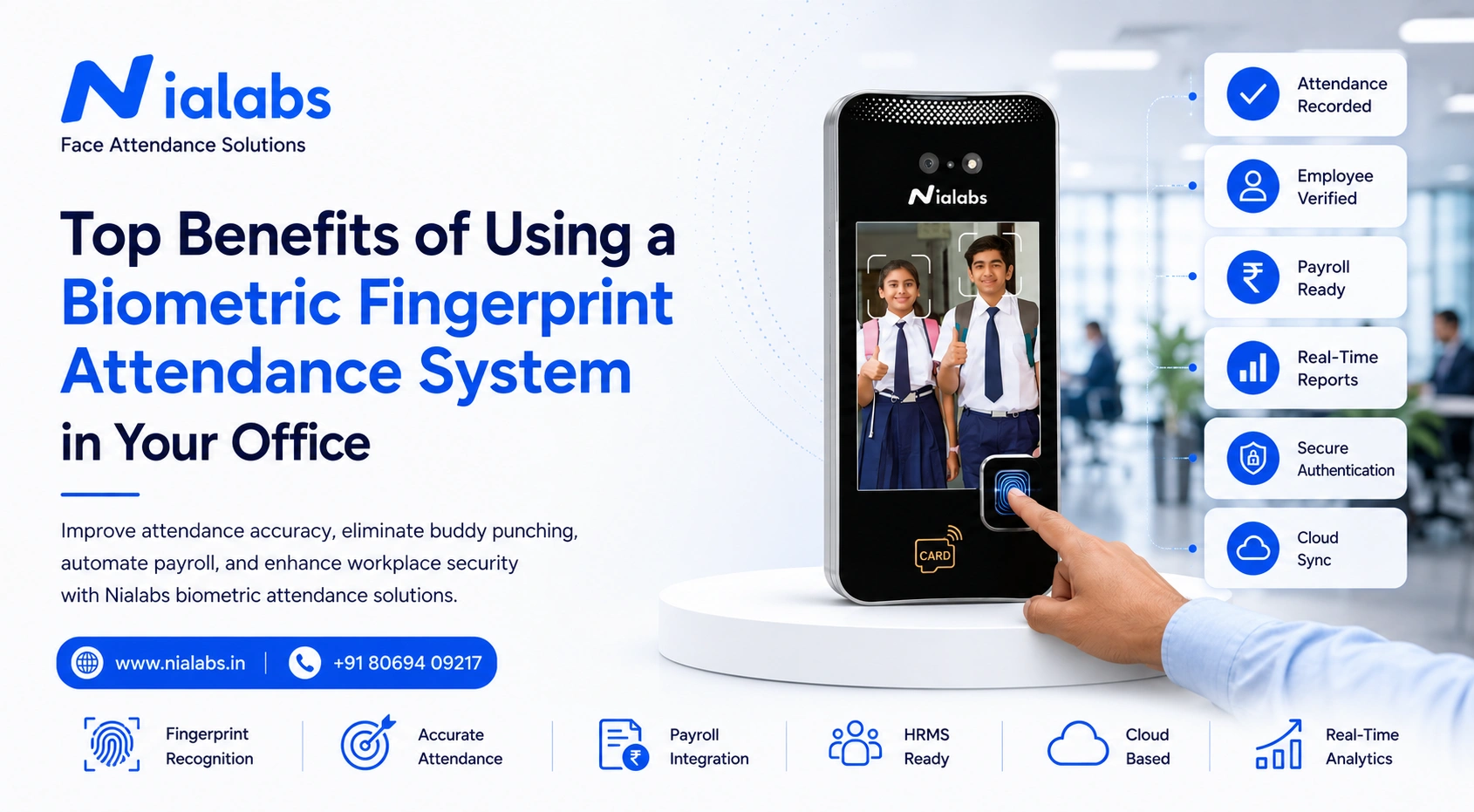
As we live in a technologically driven world, adopting new technologies for our businesses' betterment is a must. Handling the workforce is a hectic task, and an organisation must be equipped with the latest technologies and software to manage the workforce. In this management, the attendance of the employees is a crucial task. Traditional methods of attendance are no longer reliable and are outdated. Biometric attendance systems are much better than traditional methods and provide more accuracy and security. Nialabs is here to provide such accuracy and security.
Biometric Machines
Biometric machines are security identification systems and authentication devices that use an individual’s unique physical and biological traits to verify their identity. They record and manage an employee’s attendance, which helps in reducing labour costs, increasing the productivity of the company, efficiently tracking employee data for better growth, etc.
Types of Biometric Devices:
Fingerprint scanner by NIALABS:
The most used feature is the fingerprint scanner to mark the attendance of an employee. These machines use physical features such as the friction ridges of a finger or thumb. The impression is captured and used to identify the employee by matching it with an already stored template.
Facial recognition system by NIALABS: -
Attendance is marked by detecting the face of an employee. The technology maps and analyses specific points on the face of an employee and identifies marks to mark the attendance.
Iris scanner:
It is the most secure biometric attendance system, a system that scans the retina and the coloured part of the eye. With the help of eye scanning of the eyes, recognition is done, and attendance is marked.
Voice recognition:
Another physical feature is recognising the voice of an employee. It analyses the vocal characteristics of the voice for marking attendance. It is less commonly used but still an important feature of the biometric attendance system.
Fingerprint:
A fingerprint is an impression left by friction ridges present on the thumb and fingers. They are detailed, unique, difficult to alter, and durable over an individual’s life. They have many uses in different fields, such as keeping criminal records. They were earlier used for casting votes and wherever signatures were required. Now they are used for marking attendance in offices or schools.
Benefits of Biometric Fingerprint Attendance System:
Accurate Tracking:
The fingerprint attendance system helps in the precise recording of employee attendance. They calculate the exact timing of arriving and leaving the office for an employee. Even if the employees come five minutes late every day, that can reduce the productivity of the company in the long run.
Eliminate Buddy Punching:
Buddy punching is a major problem where normal punching cards are used for marking attendance. Employees don’t come to the office and get their attendance marked by friends or fellow employees. In a survey conducted worldwide, it was noted that companies lose 75 per cent of their money due to fake attendance. With the fingerprint attendance system, more than 90 per cent of the cost is recovered.
Increase security:
A fingerprint attendance system helps in the overall security of an organisation. Only those employees can enter the premises who are working there. Mischievous people with wrong intentions who can harm others can be avoided. So, with this, security is enhanced in the organisation.
Cost-effectiveness:
With the management of the workforce and accurate keeping of their time and attendance, we can easily reduce the burden of extra costs that ruin the balance sheets of a company. Integrating biometric fingerprint attendance with other software can help provide better ways of administration and thus keep down the cost burden of running a company. No manual labour is required to keep the attendance records, so here we can cut the cost as well. It also reduces the cost of punching cards for marking attendance, as it is just a one-time investment.
Convenience:
The biometric fingerprint attendance system is user-friendly and provides quick clock-in and clock-out. They are easily installed, require minimal training and smooth the transition from traditional methods. Their smooth operation is preferred by all the employees, making this system more popular in the industry.
Laws:
Keeping accurate records and data is mandatory for every organisation. Several labour laws must be followed to not violate the rights of the employees. A biometric fingerprint attendance system helps to keep compliance with labour laws.
Enhancing reporting:
A biometric fingerprint attendance system is a real-time monitoring system that keeps track of attendance and provides accurate data. It makes the work of HR officials easy in assessing the records of employees. With this system, the attendance patterns of employees can be studied to increase the productivity of the company.
Integrating with Payroll Software:
Integrating a biometric fingerprint attendance system with payroll software can help assess payroll by tracking the data of the employees. This can help in assessing the salaries of the employees by monitoring overtime, leave, deductions, etc. Data provided by a biometric fingerprint attendance system can help maintain a balance in the company.
Eco-friendly solution:
Today, we are dealing with environmental pollution, which is a major concern for the whole world. Plastics are the major contributors to this. We must minimise the use of things that harm Mother Earth. By installing a biometric fingerprint attendance system, we can reduce plastic consumption to a greater extent. A few machines are better alternatives to punching cards in terms of environmental protection.
Employee accountability:
A biometric fingerprint attendance system increases employee accountability in an organisation. Employees are less likely to take leave or miss the office without valid reasons. This promotes the work culture and professionalism, which enhances the efficiency of the company.
Conclusion
By using Nialabs’ products, one can increase the efficiency and productivity of their company. Providing real-time monitoring, accuracy, security, convenience, and better tracking can be a game-changer for any organisation. No one wants to work with outdated technology that hinders the growth of the organisation. With technology advancing daily, one must keep the organisation up to date to thrive in the highly competitive world.
FAQ’s
1. What is a biometric fingerprint attendance system?
A biometric fingerprint attendance system records employee attendance by scanning and verifying unique fingerprint patterns. It provides accurate attendance records, reduces manual errors, and prevents unauthorized attendance.
2. How does a biometric fingerprint attendance system work?
The system captures an employee's fingerprint, converts it into an encrypted biometric template, and compares it with stored records. Once verified, attendance is recorded instantly with the date and time.
3. What are the benefits of using a fingerprint attendance system in an office?
Fingerprint attendance systems improve attendance accuracy, eliminate buddy punching, automate payroll calculations, enhance workplace security, reduce administrative work, and provide real-time attendance reports.
4. Is a fingerprint attendance system better than manual attendance?
Yes. Fingerprint attendance systems are faster, more accurate, and more secure than manual registers or punch cards. They reduce attendance fraud and generate reliable reports for HR and payroll teams.
5. Can fingerprint attendance systems integrate with HRMS and payroll software?
Yes. Modern biometric fingerprint attendance systems integrate with HRMS and payroll software to automate salary calculations, overtime tracking, leave management, and attendance reporting.
6. Which businesses should use a biometric fingerprint attendance system?
Fingerprint attendance systems are suitable for corporate offices, factories, warehouses, retail stores, hospitals, educational institutions, hotels, and government organizations that need secure and accurate attendance management.
7. Are fingerprint attendance systems secure?
Yes. Most modern systems store encrypted biometric templates instead of raw fingerprint images, helping protect employee data while providing secure identity verification