
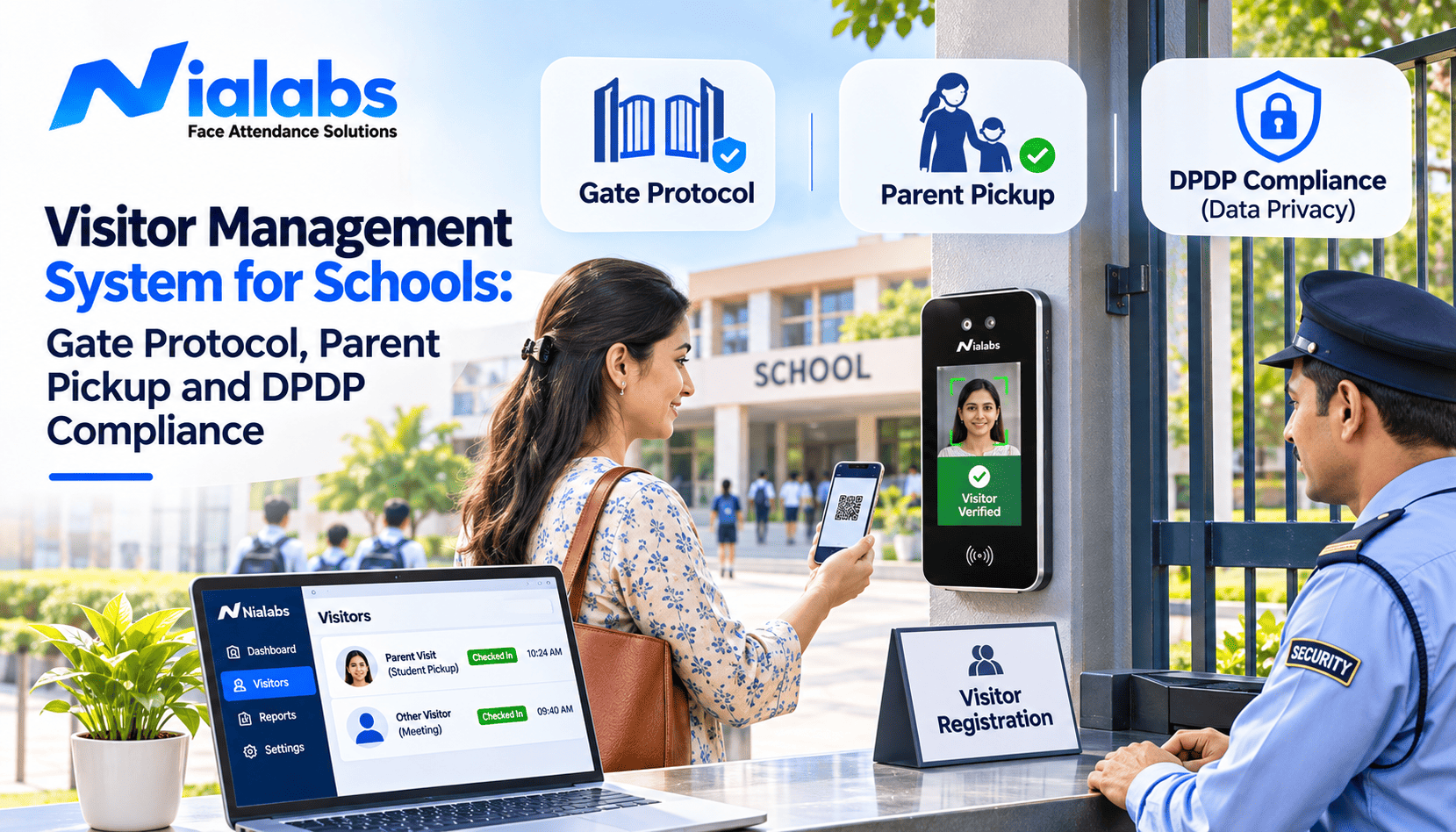
A visitor management system for schools is software that registers, approves and tracks every outsider who enters a campus, from parents and vendors to contractors. It works best alongside three things: a written gate protocol, a verified parent pickup process and DPDP-compliant handling of visitor and student data. Together they show a school exactly who is on campus, why, and when they left.
Key takeaways
• Every visitor should pass six gate steps: identify, register, verify, approve, badge and exit.
• Release a child only to a person listed in the school’s authorised guardian records.
• CBSE requires CCTV at entry and exit gates with at least 15 days of stored footage (amendment to the Affiliation Bye-Laws, July 2025).
• The DPDP Rules, 2025 were notified on 14 November 2025. Notice, consent, security and children’s data obligations apply from 14 May 2027.
• Schools have a narrow DPDP exemption for tracking and monitoring children for safety or educational activities. It does not cover adult visitors’ data.
What is a visitor management system for schools?
A school visitor management system is a digital tool that records, verifies and monitors every external person who enters and leaves the school. It replaces or supports the paper register with digital visitor records, host approvals, visitor passes and a live list of who is inside.
Its main purpose is accountability. At any moment, the school should know who is on campus, whom they came to meet, which areas they may enter and when they left.
|
Factor |
Paper visitor register |
Digital visitor management system |
|
Entry time |
Slow, handwritten |
Self-registration by QR in under a minute |
|
Host approval |
Phone call or runner |
Automatic or one-tap approval alert |
|
Identity check |
Guard’s judgement |
Photo or face check against the visit pass |
|
Who is inside now |
Not known without counting |
Live list by gate |
|
Exit record |
Often skipped |
Checked out on the same pass |
|
Search and audit |
Manual page-flipping |
Instant search and reports |
|
Data security |
Open book at the gate |
Role-based access and stored logs |
Why do Indian schools need a defined visitor process in 2026?
School safety rules in India are getting stricter and more specific about entry points. Three recent signals show the direction:
• CBSE CCTV mandate: In July 2025, CBSE amended Chapter 4 of its Affiliation Bye-Laws, 2018, to make CCTV with audio-visual recording mandatory in affiliated schools. Cameras must cover entry and exit gates, corridors, classrooms and other shared areas, with footage stored for at least 15 days.
• State entry rules: On 21 October 2026, Gujarat’s Office of the Commissioner of Schools issued a circular requiring outsiders to get prior written permission from the principal, record their details in a visitor register and stay accompanied by authorised staff.
• Child protection guidance: The National Commission for Protection of Child Rights (NCPCR) Manual on Safety and Security of Children in Schools treats controlled campus access as part of child safety.
A visitor management system turns these rules into a daily routine that guards can follow and principals can prove.
How should a school gate protocol work?
A school gate protocol is the fixed sequence every visitor follows, whether they are a parent, vendor, contractor or admission enquiry. A strong protocol has six steps:
1. Identify: The guard asks the visitor for their name, purpose of visit and the person they want to meet.
2. Register: The visitor’s name, phone number, purpose, host and time of entry are recorded, ideally through a QR form on the visitor’s own phone.
3. Verify: The host teacher, administrator, or office confirms the appointment before entry.
4. Approve: Only a designated school authority gives final entry approval.
5. Badge: The visitor gets a visible pass that shows their name, host and allowed areas.
6. Exit: The guard records the departure time and collects or deactivates the pass.
Schools should also set one visitor entry point and a waiting area near the gate. Visitors should not walk into classrooms, labs or hostels without an escort and permission. For inner zones, door and turnstile access control keeps restricted areas locked to everyone except authorised staff.
How should schools manage parent pickup and student handover?
Schools should release a child only to an adult whose identity matches the school’s authorised guardian records, and log every handover with a time and name. This matters most for pre-primary and primary students, when several parents, grandparents and drivers arrive at dispersal time together.
A reliable parent pickup system includes:
• Authorised guardian records: Keep an updated list of parents and adults approved to collect each child, with a photo of each.
• Pickup identity check: Match the collecting adult against those records before releasing the child.
• Official change requests: Accept temporary pickup changes only through a verified channel, such as a message from the registered parent number or the school app.
• Handover log: Record the date, time, student name and the adult who collected the child.
• Exception rule: If an unknown person arrives, or details do not match, hold the child and call the registered parent before release.
For example, if a child’s usual pickup person is unwell and an uncle arrives instead, the school should confirm with the registered parent before letting the child leave. Schools should also write down what happens for late pickups, disputed custody and emergencies.
Students who travel by school bus need the same discipline at the bus stop. A GPS-tracked student bus handover records when each child boards and gets off, so parents and the school see the same trail. Digital records support these steps, but staff supervision and in-person checks remain essential.
How should schools handle vendors, contractors and other visitors?
Each visitor type needs its own entry rule, because a delivery person and a maintenance contractor need very different access.
|
Visitor type |
Where they enter |
Who approves |
Movement limit |
|
Parents (meetings) |
Main visitor gate |
Host teacher or office |
Meeting room or office only |
|
Admission enquiries |
Main visitor gate |
Admission office |
Admission office only |
|
Delivery staff |
Service gate |
Store or admin office |
Delivery point only |
|
Maintenance contractors |
Service gate |
Estate or admin head |
Assigned work area, escorted |
|
Transport vendors |
Vehicle gate |
Transport in-charge |
Parking and bus bay only |
|
Event visitors |
Event gate |
Event coordinator |
Event venue, pre-approved list |
These rules keep accountability clear and reduce unnecessary movement on campus.
What should a school visitor management policy include?
A school visitor management policy is a written document that sets how outsiders enter, move around and leave the campus, and who is responsible at each step. A practical policy covers eight points:
1. Visitor categories: Rules for parents, vendors, contractors, admission visitors and event guests.
2. Entry approval: Who can approve entry and how appointments are confirmed.
3. Restricted areas: Zones visitors cannot enter without extra permission and an escort.
4. Parent pickup: Guardian verification, change requests and exception handling.
5. Photography and recording: Whether visitors may photograph or film students, and who can permit it.
6. Emergency drill: How to account for every visitor during a fire, lockdown or evacuation.
7. Data handling: What visitor data is collected, who can see it and how long it is kept.
8. Staff training: How often guards and front-desk staff are trained and reviewed.
Linking the policy to CBSE affiliation requirements and NCPCR guidance makes visitor management part of child protection, not just front-desk paperwork.
How does the DPDP Act apply to school visitor and pickup data?
The Digital Personal Data Protection Act, 2023 applies to the digital personal data a school collects from visitors, parents and students, including names, phone numbers, photos and pickup records. The DPDP Rules, 2025, notified on 14 November 2025, phase in the obligations:
|
Date |
What applies |
|
14 November 2025 |
Rules notified; Data Protection Board of India set up |
|
14 November 2026 |
Consent Manager registration provisions |
|
14 May 2027 |
Notice and consent, security safeguards, breach reporting, verifiable consent for children’s data, Data Principal rights |
For children’s data, the Fourth Schedule to the Rules gives educational institutions a limited exemption from section 9(1) (verifiable parental consent) and section 9(3) (the ban on tracking and behavioural monitoring). It applies only to tracking and behavioural monitoring for the school’s educational activities or in the interests of the safety of enrolled children. It does not cover adult visitors, parents or guardians, whose data still needs a clear notice and a lawful basis.
For a deeper look at student data, see our guide on DPDP compliance for school biometric data.
Six practices help schools prepare before May 2027:
1. Collect only what you need: Name, phone, purpose, host and time are enough for most visitors. Avoid copying full ID documents unless required.
2. Show a short privacy notice: Tell visitors what you collect, why and how long you keep it, ideally on the QR form itself.
3. Use the right legal basis: Take consent from adult visitors and guardians where it is required, and rely on the Fourth Schedule exemption only for its stated child-safety purposes.
4. Limit access: Only authorised administrators and security staff should see visitor and pickup records.
5. Set a retention period: Delete visitor data once its purpose is served, unless a law requires you to keep it. Write the period into your policy.
6. Secure the system: Use role-based logins, encryption where possible and an audit trail of who viewed or changed records.
A digital system alone does not make a school DPDP compliant. Compliance depends on the school’s policies, data practices and safeguards. This section is general information, not legal advice.
What visitor management mistakes should schools avoid?
The most common gaps are process gaps, not hardware gaps:
• Relying only on paper registers: Handwritten logs are hard to search, verify and audit.
• Outdated guardian lists: Old pickup details cause confusion and risk at dispersal time.
• Letting visitors roam: Visitors should only reach the area linked to their approved purpose.
• Collecting too much data: Extra personal data adds privacy risk with no security benefit.
• Skipping exit records: Entry without a checked-out exit leaves the “who is inside” list wrong.
• Untrained guards: Gate staff must know verification steps, exceptions and emergency drills.
A quarterly review of visitor logs and pickup exceptions helps schools find and close these gaps.
How does Nialabs support school visitor and access management?
Nialabs’ QR-based visitor check-in with gate approvals is built for campuses with several gates and many daily visitors. Features listed on the product page include:
• QR web form registration: Visitors self-register by scanning a QR code, with no app to download.
• Dynamic QR check-in and check-out: A new QR pass is issued for every visit.
• Auto or manual approval: Rules can auto-approve known visitors or send the request to the host.
• Face recognition check-in: The visitor’s face is verified at the gate against the visit pass.
• Live visitor tracking: Admins see who is inside, at which gate and for how long.
• Visitor types: Separate flows for parents, vendors and contractors.
• Badge printing and vehicle capture: Printed passes and vehicle number logging.
• Offline guard app: Guards keep working when the network drops, and data syncs later.
• Access control sync: Approved visitors are pushed to turnstiles and door controllers.
The system works alongside Nialabs’ AI biometric solutions, so visitor records, staff attendance and door permissions sit on one platform.
Conclusion
A safe school needs more than guards and CCTV. It needs a fixed gate protocol, a verified parent pickup process, clear rules for each visitor type and careful handling of personal data. A visitor management system for schools ties these together and gives principals a record they can show to parents, boards and inspectors.
Schools that set up these processes now will be ready well before the DPDP obligations start on 14 May 2027. Book a free demo with Nialabs to see how a QR and face-based visitor flow would work at your gates.
Frequently Asked Questions
1. What is a visitor management system for schools?
A visitor management system for schools is software that registers, approves and tracks every outsider who enters a school campus. It records each visitor’s name, purpose, host, entry time and exit time, issues a visitor pass, and shows administrators a live list of who is inside.
2. What should a school visitor management policy include?
A school visitor management policy should include visitor categories, entry approval rules, restricted areas, parent pickup procedures, rules on photography and recording, emergency drills for visitors, data handling and retention, and staff training. It should also name who is responsible for each step.
3. How can schools verify authorised parent pickups?
Schools should keep an updated list of authorised guardians with photos, match the collecting adult against that list before releasing a child, and log every handover with time and name. Schools should accept temporary pickup changes only through a verified channel, and check any mismatch with the registered parent first.
4. Does the DPDP Act apply to visitor data collected by schools?
Yes. The Digital Personal Data Protection Act, 2023 applies to digital personal data that schools collect from visitors, such as names, phone numbers and photos. Schools should give a clear notice, collect only necessary data, limit access, keep it secure and delete it once its purpose is served.
5. Do schools need parental consent to track students for safety under the DPDP Rules?
Not always. The Fourth Schedule to the DPDP Rules, 2025 exempts educational institutions from verifiable parental consent and the ban on tracking and behavioural monitoring, but only for their educational activities or the safety of enrolled children. The exemption does not cover other uses of children’s data or adult visitors’ data.
6. When do DPDP obligations start for schools?
The DPDP Rules, 2025 were notified on 14 November 2025 and apply in phases. The main obligations, including notice and consent, security safeguards, breach reporting and verifiable consent for children’s data, apply from 14 May 2027.
7. How long should schools keep visitor records?
The DPDP Act does not set one fixed period for visitor records. Schools should delete visitor data once its purpose is served, unless another law requires longer retention, and write the chosen period into their policy. Separately, CBSE requires affiliated schools to store CCTV footage for at least 15 days.
8. What is the difference between visitor management and access control?
Visitor management registers, verifies and tracks outsiders who come to the school. Access control decides which doors, gates or zones each person can open, using cards, PINs or face recognition. Used together, approved visitors get time-limited access only to the areas they need.