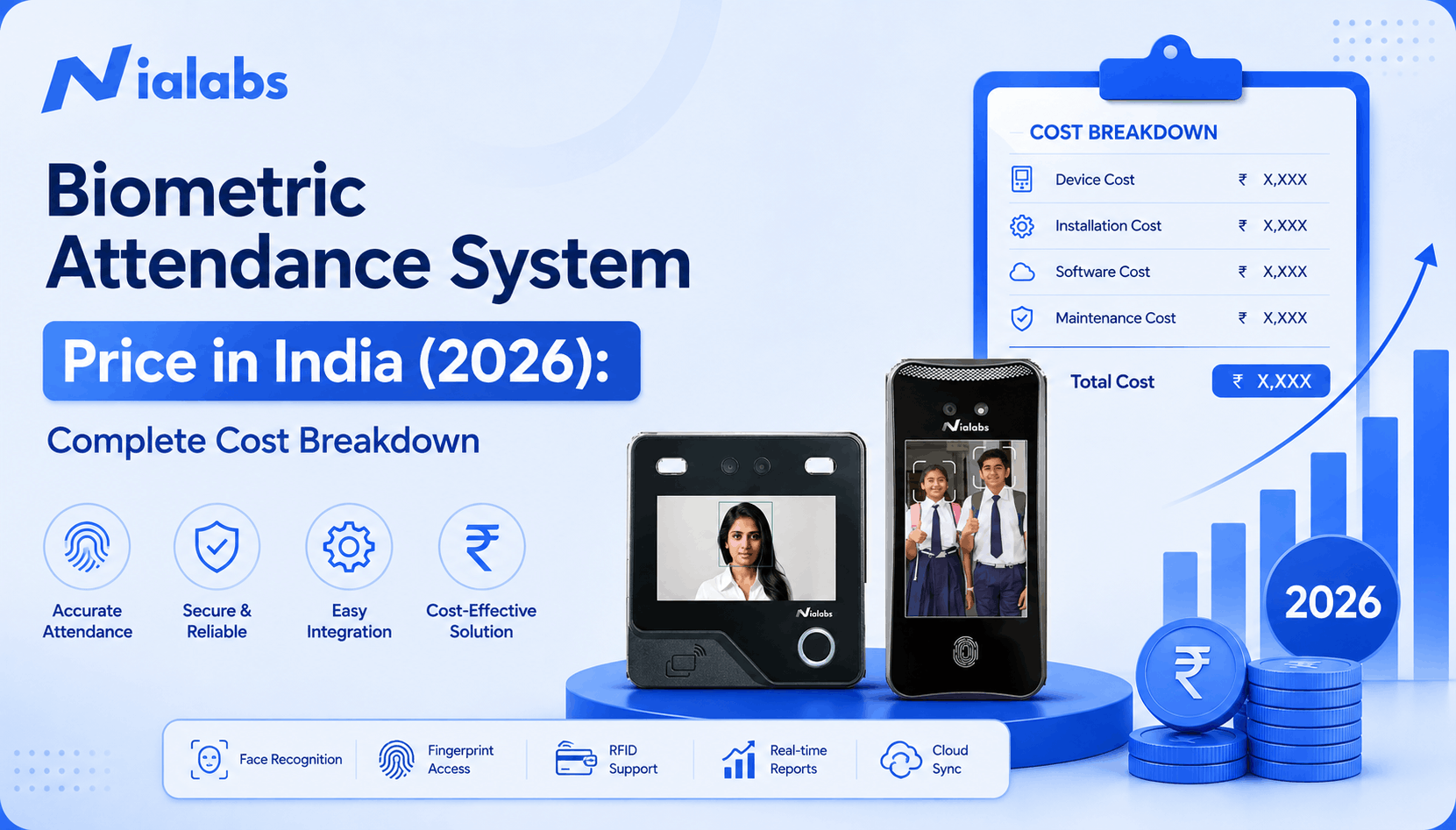
Those are device prices, not system prices — and the difference is where most Indian buyers lose money. A Rs 7,000 machine bundled with per-user cloud fees can cost more over three years than a Rs 22,000 machine with software included. This guide breaks down every line item in a biometric attendance purchase: hardware, software, cloud, installation, integration, AMC and GST, with a worked 3-year total cost of ownership comparison for a 100-user site.
Biometric Attendance System Price in India at a Glance
|
System type |
Price range |
User capacity |
Best suited for |
|---|---|---|---|
|
Basic fingerprint machine |
Rs 3,500 – Rs 7,500 |
500 – 1,000 |
Small offices, retail shops, clinics |
|
Fingerprint + RFID combo |
Rs 6,000 – Rs 12,000 |
1,000 – 3,000 |
MSMEs, coaching institutes |
|
Face recognition attendance machine |
Rs 7,000 – Rs 20,000 |
1,000 – 5,000 |
Offices, schools, hospitals |
|
AI face recognition with liveness detection |
Rs 18,000 – Rs 35,000+ |
5,000 – 20,000 |
High-traffic sites, factory gates |
|
Multi-biometric terminal (face + fingerprint + card) |
Rs 20,000 – Rs 60,000+ |
10,000 – 50,000 |
Enterprises, high-security facilities |
|
Complete cloud attendance solution |
Device + software licence |
Unlimited (cloud) |
Multi-branch, multi-city organisations |
Read these as market ranges, not quotes. Actual price depends on brand, user capacity, sensor grade, warranty terms and whether attendance software is bundled or licensed separately. Listing platforms such as IndiaMART show the widest spread because they aggregate unbranded imports alongside enterprise-grade terminals — the Rs 3,500 entry point and the Rs 60,000 ceiling are rarely comparable products.
Face Recognition Attendance System Price in India
Face recognition is now the default choice for new attendance deployments in India, and it is where price varies most. A face recognition attendance system can cost Rs 7,000 or Rs 35,000 for what looks like the same device on a spec sheet. Four variables explain the gap.
|
Capability |
Entry (Rs 7k–15k) |
Professional (Rs 15k–25k) |
Enterprise (Rs 25k+) |
|---|---|---|---|
|
Liveness / anti-spoof detection |
Basic or absent |
2D + IR liveness |
3D depth-sensing liveness |
|
Low-light performance |
Needs good ambient light |
IR-assisted, works in dim light |
Reliable in near-darkness |
|
Face template capacity |
500 – 1,500 |
3,000 – 10,000 |
20,000 – 50,000 |
|
Recognition speed |
Under 1 second |
Under 0.5 second |
Under 0.3 second, multi-face |
|
Mask / spectacle tolerance |
Limited |
Good |
High |
Liveness detection is the single most important line item to not economise on. A device without it can be defeated by a printed photograph or a phone screen, which reintroduces the exact problem you bought it to solve. If proxy attendance is the reason for the purchase, a Rs 9,000 device without liveness is not a cheaper version of a Rs 20,000 device with it — it is a different product that does not do the job.
Throughput matters more than unit price at scale. A factory gate clearing 800 workers in a 15-minute shift change needs sub-0.5-second recognition. A device that takes 1.2 seconds per person creates a queue that costs more in lost production minutes each month than the price difference between the two devices. Size for peak throughput, not headcount.
Fingerprint Attendance Machine Price in India
Fingerprint remains the lowest-cost entry into biometric attendance. A basic biometric attendance machine using optical fingerprint sensing costs Rs 3,500–Rs 7,500 and typically stores 500–1,000 templates. Adding RFID card support pushes the range to Rs 6,000–Rs 12,000.
The cost advantage is real, but it comes with environment-specific failure modes that Indian buyers should price in before deciding:
-
Manual labour and manufacturing: worn or calloused fingerprints fail to read. Rejection rates in factories and construction sites are materially higher than in offices.
-
Dust and heat: optical sensors degrade in dusty environments. Sensor replacement or cleaning becomes a recurring AMC cost.
-
Hygiene-sensitive sites: hospitals, labs and food processing units generally require contactless verification.
-
High-traffic gates: contact-based punching is slower than face recognition and creates queues at shift change.
For a 30-person office in Jaipur or Indore with a single entry point, a fingerprint device at Rs 6,000 is a sound purchase. For a 400-worker unit in Bhiwadi with three gates and rotating shifts, the lower device cost is usually erased within a year by failed reads and manual exception handling.
What Determines the Price of a Biometric Attendance System
1. Biometric technology and authentication mode
Fingerprint sensing is the cheapest modality because the sensor and processing requirements are modest. Face recognition adds a camera array, an AI inference chip and anti-spoof logic, which raises the bill of materials. Multi-biometric terminals that accept face, fingerprint and RFID on one device cost the most, but consolidate three purchases into one and give you a fallback when one modality fails for a particular user — genuinely useful in mixed workforces.
2. User capacity and storage
Capacity is the most common sizing mistake. Before you buy, confirm four numbers with the vendor in writing:
-
Maximum enrolled users (face and fingerprint templates are counted separately)
-
Maximum stored transactions before overwrite
-
Number of devices manageable under one admin login
-
Whether multi-location management is included or licensed as an add-on
A device rated for 1,000 users installed at a 900-student school has no headroom. Next admission cycle forces a hardware replacement. Buy roughly 2x your current headcount.
3. Connectivity and cloud capability
Offline devices store data locally and require USB, LAN or manual pull. Cloud-connected devices cost more per unit but remove recurring admin labour:
-
Live attendance visible from any location
-
Remote enrolment and device configuration
-
Automated daily, weekly and monthly reports
-
Centralised multi-branch dashboards
-
Direct sync to HRMS and payroll
Ask specifically about offline buffering. In Indian conditions, power cuts and ISP outages are routine. A device that loses punches during a two-hour outage is a payroll dispute waiting to happen. The correct behaviour is local storage with automatic cloud sync on reconnection — confirm this is standard, not an upgrade.
4. Attendance software
This is the most under-priced component in most quotations. The machine captures a verified identity and a timestamp. Everything that turns that into a usable business record is software:
-
Employee and student master data management
-
Shift scheduling and rotating shift rules
-
Late-in, early-out and half-day policy automation
-
Leave management and overtime calculation
-
Attendance reporting and analytics
-
Payroll and HRMS integration
-
Mobile and web access, real-time alerts
A Rs 22,000 device with all of this bundled delivers more value than a Rs 7,000 device that leaves your HR team exporting CSVs every month. Compare software feature lists line by line before comparing device prices.
Costs Beyond the Device: What Quotations Often Exclude
Installation and configuration
Wall mounting, power provisioning, LAN cabling, door and turnstile wiring, and initial enrolment of all users. Single-device office installs are often free or nominal. Multi-gate industrial installs with cabling runs are quoted separately and can be significant. Ask whether enrolment of your full user base is included or billed per head.
Software licences and cloud subscription
Three common models in the Indian market: software bundled perpetually with the device; an annual licence per device; or a recurring per-user, per-month cloud fee. The third model is the one that quietly overtakes hardware cost — see the TCO comparison below.
HRMS, payroll and ERP integration
If attendance must flow into payroll without manual export, budget for API integration. Vendors with a documented public API make this cheap; vendors without one make it a custom project. Nialabs publishes its biometric attendance API documentation — see the attendance API glossary entry for how the data flow works.
Access control integration
Linking attendance to physical entry adds controllers, electromagnetic locks, exit switches and sometimes turnstiles. Budget separately if you need access control and not only attendance logging. Related hardware such as UHF RFID readers and NFC cards is priced per unit.
Warranty, AMC and support
Standard warranty is typically 1 year. Annual Maintenance Contracts usually run 10–18% of device cost per year and cover firmware updates, preventive servicing and replacement terms. Confirm response time SLAs and whether on-site support exists in your city — a Jaipur-based vendor with no Chennai presence means every fault becomes a courier round trip.
GST on biometric attendance systems
Biometric attendance devices in India generally attract 18% GST. Most quotations in this category are published exclusive of GST, so a Rs 20,000 device is Rs 23,600 landed. Registered businesses can typically claim input tax credit on both the hardware and the software licence, which changes the effective cost materially — confirm applicability and current HSN classification with your accountant before finalising a budget.
3-Year Total Cost of Ownership: A Worked Example
The clearest way to see why device price misleads is to model it. Below is a 100-user site compared across two purchase decisions, over three years.
Assumptions: 100 users, single location, one device, GST excluded, AMC at 15% of device cost from year 2. Software fee assumed at Rs 30 per user per month for the subscription model.
|
Cost line |
Option A: low-cost device + per-user cloud fee |
Option B: mid-range device, software bundled |
|---|---|---|
|
Device |
Rs 7,000 |
Rs 22,000 |
|
Installation |
Rs 2,000 |
Rs 2,000 |
|
Software, year 1 |
Rs 36,000 |
Rs 0 (bundled) |
|
Software, years 2–3 |
Rs 72,000 |
Rs 0 (bundled) |
|
AMC, years 2–3 |
Rs 2,100 |
Rs 6,600 |
|
3-YEAR TOTAL |
Rs 1,19,100 |
Rs 30,600 |
|
Effective cost per user per year |
Rs 397 |
Rs 102 |
3-year total cost of ownership, 100-user site (illustrative model).
The device that cost Rs 15,000 more upfront is roughly Rs 88,500 cheaper over three years. The crossover happens in month 6. This is not an argument that expensive hardware always wins — it is an argument that per-user recurring fees are the dominant cost variable at any scale above about 50 users, and device price is not.
Run this model with your own numbers before signing. The three inputs that decide the answer are user count, the software pricing model, and contract length. If a vendor will not state the software pricing model in writing, that is the answer.
What a Complete Biometric Attendance Setup Costs by Organisation Size
Basic setup: Rs 5,000 – Rs 15,000
Single device, single entry point, local or light cloud software. Suits small offices, retail stores, clinics, coaching centres and businesses under roughly 50 users. Usually one fingerprint or entry-level face device with basic reporting.
Professional setup: Rs 15,000 – Rs 35,000
Face recognition with liveness detection, cloud dashboard, extended template capacity, shift management and payroll-ready reporting. Suits schools, mid-sized offices, hospitals and single-unit manufacturing. Typically one to three devices with centralised software. Schools in this tier usually also evaluate bus attendance tracking alongside gate attendance.
Enterprise setup: Rs 35,000+
Multiple terminals across gates or branches, central software, role-based admin access, API integration into HRMS, payroll or School ERP, and access control hardware. Suits multi-unit factories, large schools and colleges, hospital networks, IT parks and high-security facilities. Pricing at this tier is quoted per deployment, not per device.
Multi-branch organisations should price the software and management layer first and the hardware second. Ten devices across five cities with no centralised dashboard produces ten separate data silos and more manual work than a paper register. Nialabs' deployments in Chennai and Maharashtra are configured for exactly this centralised model.
Fingerprint vs Face Recognition: Which Offers Better Value?
|
Factor |
Fingerprint |
Face recognition |
|---|---|---|
|
Device price range |
Rs 3,500 – Rs 12,000 |
Rs 7,000 – Rs 35,000+ |
|
Contactless |
No |
Yes |
|
Speed at high traffic |
Moderate |
Faster, better queue handling |
|
Performance with worn fingerprints |
Poor |
Unaffected |
|
Performance in dust and heat |
Sensor degradation over time |
More resilient |
|
Hygiene |
Requires contact |
Fully contactless |
|
Proxy prevention |
Good |
Strong with liveness detection |
|
Low-light reliability |
Not affected |
Depends on IR capability |
|
Best fit |
Small offices, budget-constrained sites |
Schools, hospitals, factories, high-traffic gates |
Short answer: fingerprint wins on upfront price for small, clean, low-traffic sites. Face recognition wins on three-year value everywhere else — particularly in manual-labour environments, hygiene-sensitive facilities and any site with a shift-change rush. A detailed breakdown of the underlying technology differences is available in our guide to how biometric attendance systems work.
Are You Buying Hardware, or an Attendance Solution?
This is where most buyers go wrong. A biometric attendance machine is hardware. A biometric attendance system is hardware plus attendance software, cloud infrastructure, reporting, mobile access and integration into the systems you already run.
For a 20–50 person office with one door, hardware alone is often sufficient. For a school, factory, hospital or multi-branch company managing hundreds or thousands of users, buying hardware alone means your admin team absorbs the work the software was supposed to do — and that labour cost never appears in the quotation.
Nialabs builds both layers. The NiaFace terminals are our own hardware, and the attendance, HRMS and access control software is our own platform. That matters commercially: firmware and software ship together, integration issues have a single owner, and there is no vendor gap when a device and a dashboard disagree — a common failure point when hardware is imported and software is licensed from a third party.
How to Avoid Overpaying: A 10-Point Buyer Checklist
-
Get the quotation split by line item — device, software, installation, integration, AMC, GST. Refuse lump sums.
-
Confirm the software pricing model in writing — perpetual, annual per device, or per user per month.
-
Ask for face and fingerprint template capacity separately, not a single "user capacity" figure.
-
Verify liveness detection is present, and ask which spoof types it blocks.
-
Test offline buffering — pull the network cable, punch, reconnect, confirm the record synced.
-
Confirm AMC percentage and what it covers before year 2 arrives.
-
Ask whether enrolment of your full user base is included or billed per head.
-
Check for a documented API if payroll or ERP integration is required.
-
Confirm on-site support exists in your city, with a stated response SLA.
-
Model 3-year TCO, not device price — use the table above with your own user count.
A vendor who answers all ten in writing is quoting a system. A vendor who answers three is quoting a box.
Why Nialabs Is Built for Long-Term Value
Nialabs manufactures its own AI face recognition and fingerprint terminals and builds its own cloud attendance platform, HRMS and access control software. Devices sync in real time, buffer locally during outages, and integrate with payroll, HRMS and School ERP through a documented API.
Because the hardware and software are ours, attendance software is included with the system rather than licensed per user per month — which, as the TCO model above shows, is the single largest cost variable in a multi-year deployment. We operate across India from our Jaipur base, with deployments in schools, factories, hospitals, IT parks and multi-branch MSMEs.
Conclusion
Biometric attendance system price in India spans Rs 3,500 to Rs 60,000+ per device, but the device is rarely where the money goes. Software licensing model, user count, AMC terms and integration scope determine what you actually pay over three years — and at any scale above roughly 50 users, per-user recurring fees dominate everything else.
Price the system, not the machine. Model three years, not one. And insist on a line-itemised quotation before comparing any two vendors, because a Rs 7,000 device and a Rs 22,000 device are frequently not the same purchase at all.
Frequently Asked Questions
1. What is the cost of a biometric attendance system in India?
A biometric attendance system in India costs Rs 3,500 to Rs 60,000+ per device in 2026. Basic fingerprint machines start at Rs 3,500, face recognition devices range from Rs 7,000 to Rs 20,000, and AI multi-biometric enterprise terminals cost Rs 20,000 to Rs 60,000+. Software, installation, AMC and 18% GST are usually additional.
2. How much does a face recognition attendance machine cost in India?
A face recognition attendance machine costs Rs 7,000 to Rs 35,000+ in India. Entry-level devices with basic recognition start near Rs 7,000, professional devices with IR liveness detection and larger template capacity range from Rs 15,000 to Rs 25,000, and enterprise terminals with 3D liveness and 20,000+ face capacity exceed Rs 25,000.
3. Is fingerprint or face recognition cheaper?
Fingerprint attendance devices are cheaper upfront, typically Rs 3,500 to Rs 12,000 against Rs 7,000 to Rs 35,000 for face recognition. Face recognition often costs less over three years in factories, hospitals and high-traffic sites, because worn fingerprints, dust exposure and shift-change queues generate ongoing exception-handling costs that do not appear in the purchase price.
4. Is GST charged on biometric attendance devices?
Biometric attendance devices in India generally attract 18% GST, and most vendor quotations are published exclusive of GST. Registered businesses can usually claim input tax credit on both hardware and software. Confirm current HSN classification and ITC eligibility with your accountant.
5. How much does biometric attendance software cost?
Biometric attendance software is priced in three ways in India: bundled perpetually with the device at no extra cost, licensed annually per device, or charged per user per month. The per-user model typically becomes the largest cost line above 50 users — at Rs 30 per user per month, 100 users costs Rs 36,000 per year, which exceeds most device prices within the first year.
6. What is AMC and how much does it cost?
An Annual Maintenance Contract for biometric attendance devices typically costs 10–18% of the device price per year and begins after the standard one-year warranty. It generally covers preventive servicing, firmware updates and replacement terms. Confirm the response-time SLA and whether on-site support is available in your city.
7. Which biometric system is best for a large organisation?
Large organisations should choose face recognition or multi-biometric terminals with centralised cloud management. These handle high throughput at shift change, work without physical contact, support 10,000+ enrolled users per device, and allow multi-branch attendance to be consolidated into one dashboard rather than separate per-site exports.
8. Do biometric attendance systems work without internet?
Yes. Properly configured biometric attendance devices store punches locally during network or power outages and sync automatically to the cloud when connectivity returns, so no attendance records are lost. Confirm this offline buffering is standard on the model you are quoted rather than a paid upgrade.
9. How many users can one biometric device handle?
Capacity ranges from 500 users on entry-level fingerprint devices to 50,000 on enterprise multi-biometric terminals. Face and fingerprint template limits are counted separately, so ask for both figures. Buy roughly double your current headcount to avoid replacing hardware at the next growth cycle.
10. Can a biometric attendance system integrate with payroll and HRMS?
Yes. Biometric attendance systems with a documented API integrate directly with payroll, HRMS, ERP and School ERP software, passing verified punch data through without manual export. Vendors without a public API typically quote integration as a custom development project, which adds cost and delay.