
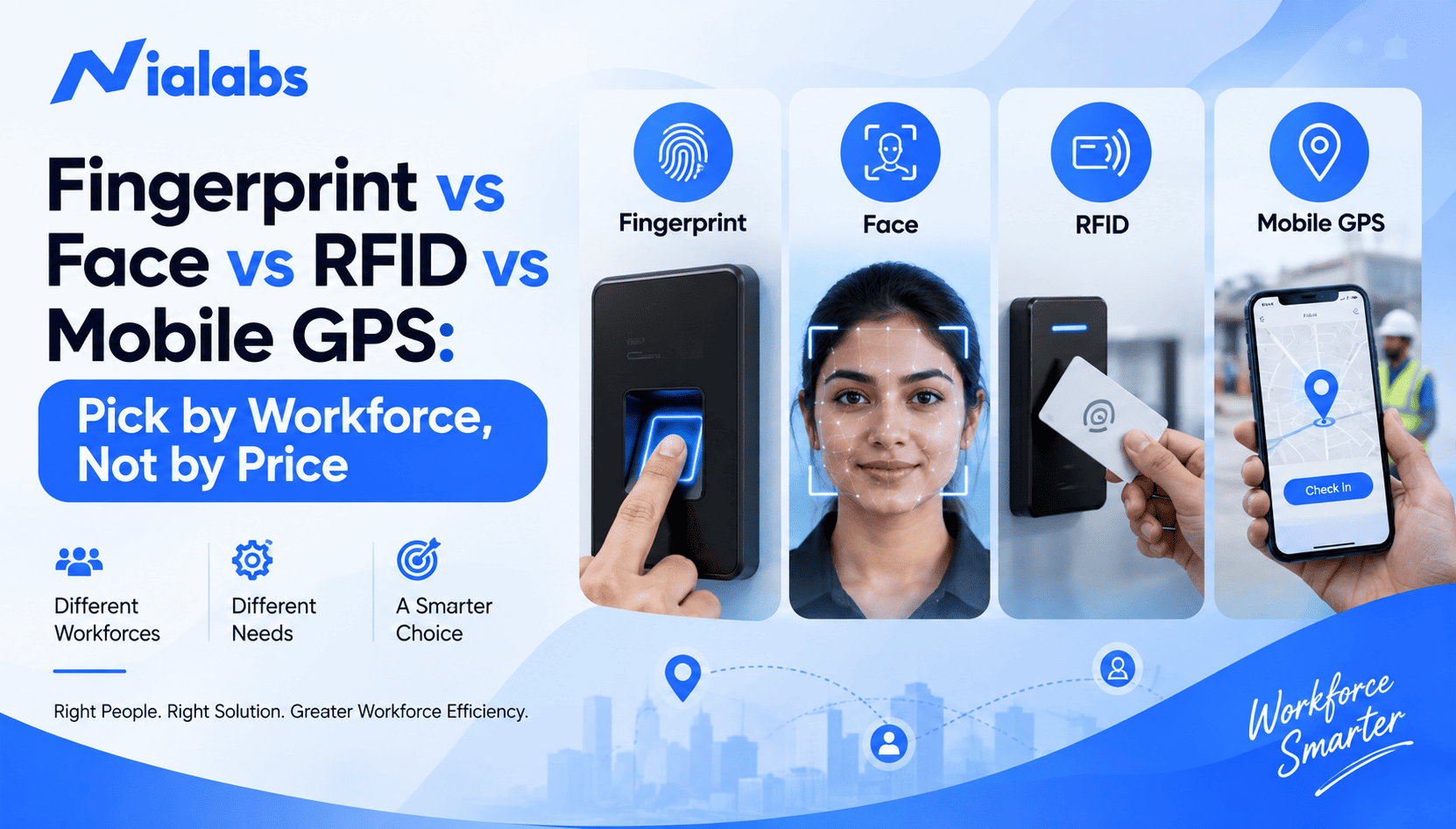
Selecting an attendance system on the basis of price alone tends to cause problems later. A system that suits a small office might not work the same way in a factory, university, construction site, or for field employees. Each type of attendance solution- fingerprint, face recognition attendance system, RFID, or mobile attendance systems- tackles a specific attendance problem and is built around a particular work environment. It comes down to the working area, the number of employees, how quickly they need to be processed, and the level of organisational control you want over attendance marking.
Instead of asking “which is the cheapest attendance system?”, the better question is: which biometric attendance system best suits the actual nature of the working environment and employees at your workplace?
Fingerprint Attendance: Best for Controlled Workplaces
A fingerprint attendance system is still useful for offices, schools, factories, and fixed workplaces where employees report to the same location daily. Employees confirm their identity using a registered fingerprint, creating a more secure employee attendance system than a manual register or a PIN access system.
Most appropriate use cases:
● Small and medium offices
● Institutions and schools
● Factories with a fixed entry point
● Employees on a fixed schedule or shift work
● Places with predictable arrival and departure times
Pros:
● Common, easy to learn and use
● High employee authentication accuracy
● Works well at a fixed location
● Can be connected to a time-and-attendance or HR system
● Best for shift-work time tracking
Where it may fail: it requires physical contact with the device and a reasonably clean fingerprint. Dirty, wet, greasy, or worn fingerprints, or harsh workplace conditions, can reduce accuracy. It works best when employees log in at the same place, at the same time, every day.
Face Recognition Attendance: Best for High-Volume Workforce
Face recognition works best when speed and non-contact identification are the priority. Workers scan their face instead of touching the device so that a large entrance can process fast check-ins without a queue forming at the scanner.
Ideal for:
● Large offices
● Universities and colleges
● Schools
● Factories
● Corporate campus sites
● Workplaces with a large number of users
Why businesses use this solution: the clear benefit is combining speed of identification with verification. When many employees need to clock in in a short time, reducing the queue directly improves workplace efficiency.
Advanced face recognition attendance systems can be enhanced with additional functionality such as anti-spoofing, low-light face recognition, and centralised monitoring, depending on the hardware and environment.
Best suited for a busy environment or office where contactless, rapid employee attendance tracking is the priority.
RFID Attendance: Best for Simple, Fast Identification
With an RFID attendance system, an employee's information is held on an RFID card or tag. The card is held or swiped against the RFID reader, and the attendance data is recorded automatically. It's a good fit for organisations that don't want to rely on fingerprints or faces.
Best for:
● Offices
● Schools and universities
● Factories
● Visitor and casual employee access
● Organisations already using ID badges
Benefits:
● Rapid verification
● Easy for employees to use
● Fast card printing and replacement
● Good for high-volume entries
● Can integrate with an access control system
The limitation: RFID cards only confirm that a card has been used, not who is actually holding it. Proxy attendance can become a major issue for an organisation if an employee transfers or shares their RFID card.
Best suited for organisations that want a simple, quick identification method and are already using RFID for employee ID or access cards.
Mobile GPS Attendance: Best for Field and Distributed Teams
Depending on configuration, this lets an organisation record locations, log coordinates against attendance, and monitor staff at remote sites.
Recommended for:
● Sales staff
● Outdoor employees
● Service engineers
● Construction crews
● Delivery personnel
● Remote and distributed workforces
Pros:
● No fixed attendance machine to purchase
● Location-based attendance validation
● Works for employees across different sites
● Attendance can be checked remotely
● Easy to track attendance through a mobile system
Cons: Mobile GPS attendance depends on a smartphone, the app running correctly, and location permissions being granted. Reliability for employees working on-premises can't be guaranteed the way it can with a dedicated attendance terminal.
Best suited for employees who work across multiple sites rather than one fixed premises.
Fingerprint vs Face vs RFID vs Mobile GPS: Which One Fits Your Workforce?
There's no single attendance technology that fits every organisation. The right choice depends on the organisation's size, where employees work, how often attendance is taken, and how much security the organisation needs around attendance verification.
|
Workforce Type |
Suitable Technology |
|
Small fixed office |
Fingerprint |
|
Large corporate office |
Face recognition |
|
School or college campus |
Face recognition / RFID |
|
Factory workforce |
Fingerprint / Face recognition |
|
Field sales team |
Mobile GPS |
|
Construction workforce |
Mobile GPS |
|
High-traffic entry point |
Face recognition / RFID |
|
Existing RFID access control setup |
RFID |
|
Mixed fixed + field workforce |
Hybrid approach |
The most critical factor is that the chosen technology fits the way people actually work today, rather than being the cheapest option in the short term.
What Should You Consider Before Choosing
Number of workers
A system that works fine for 50 employees can create a backlog at 1,000. High-volume employers with multiple entry and exit points should prioritise fast authentication above everything else.
Fixed or mobile employees
Be clear about where your employees actually work. Biometric or RFID entry points tend to work best for fixed-location employees, while GPS-based attendance is usually the better fit for mobile employees.
Attendance verification strength
For stricter authentication, where you want to prevent one person checking in for another, biometrics such as fingerprint or face recognition are more effective than a card alone.
Work environment
Factories, warehouses, outdoor sites, and construction sites typically need more rugged hardware than an air-conditioned office.
Integration
Attendance shouldn't run as an isolated system. Check whether the solution can integrate with your existing HRMS, payroll, ERP, and other workforce attendance systems through available integration points.
Scalability
Don't plan only for the current headcount. Factor in additional employees, sites, devices, shifts, and reporting needs as the organisation grows.
Why Nialabs Takes a Workforce-First Approach
Nialabs offers an AI-powered biometric attendance and access control solution built for a wide range of work environments. Rather than forcing one attendance technology on every customer, Nialabs offers a range of technologies to fit your operational needs, from face recognition and fingerprint to RFID and GPS attendance systems.
Biometric terminals can automate and restrict attendance within fixed workplaces. Face recognition handles crowded environments well. GPS-based attendance is a practical option for staff who regularly work across different locations.
Ultimately, the goal is simple: make the attendance technology fit the staff, the site, and the way people actually work, rather than picking the cheapest option by default.
Conclusion
Fingerprint, face recognition, RFID, and mobile GPS each have a role in managing a modern workforce.
● Choose fingerprint for permanent sites and a reliable biometric access control system.
● Choose face recognition for fast, contact-free tracking at a large workforce volume.
● Choose RFID where employee ID cards are already the familiar process.
● Choose mobile GPS where employees work remotely or across more than one location.
● If your company has both fixed and mobile workers, a hybrid strategy usually beats a single-technology approach.
The right access control system and attendance management system may not be the cheapest option, but it's the one that actually works the way your employees do.
FAQ
Which is best for attendance, fingerprint or face recognition?
It depends on the workforce. Fingerprint is best for a stable workplace, while face recognition is more effective for large-volume, contactless attendance.
Is RFID better than biometric attendance?
RFID is faster and simpler than a biometric system, while biometrics offers stronger person verification because it authenticates the individual, not just the card.
Is mobile GPS attendance a better choice for office staff?
Mobile GPS attendance can work for office employees too, but it's better suited to staff who are geographically dispersed or travelling.
Can my company use multiple attendance technologies?
Yes. A diversified workforce can be managed with a combination of biometric attendance, RFID, and GPS attendance technologies, matched to the job role and location of each employee.